
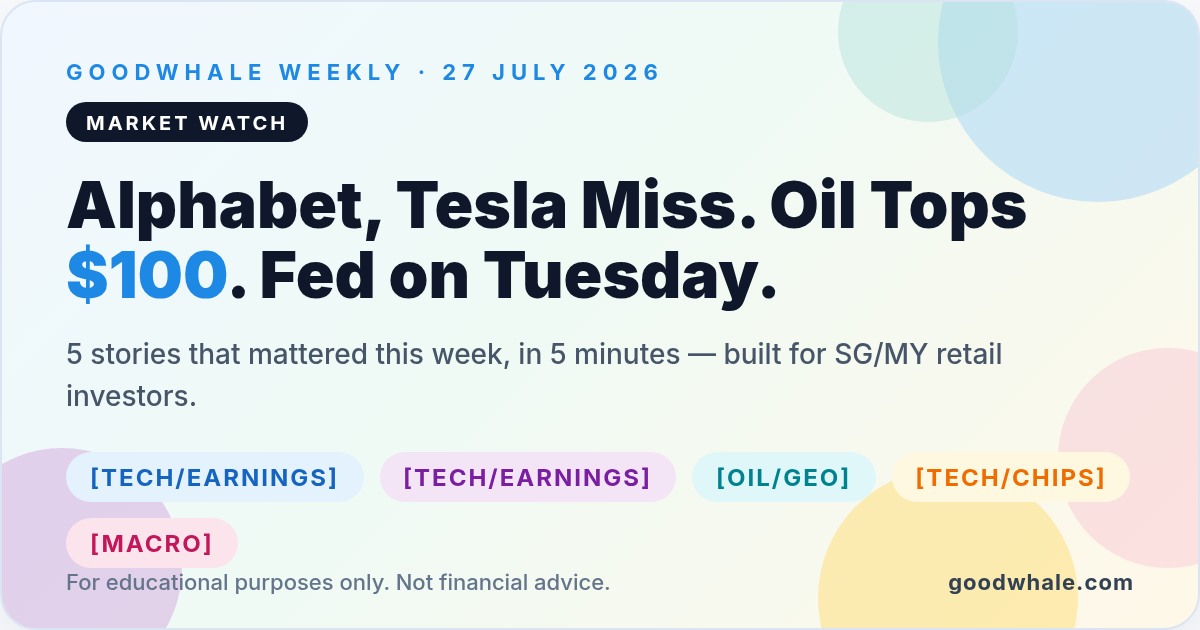
The Week in 30 Seconds
- [TECH/EARNINGS] Alphabet beat, then fell 7%. Revenue $119.8B (+24%), Cloud +64% — but capex hit $44.9B in one quarter and full-year guidance was raised to $195-205B. First-ever negative FCF quarter in Google history.
- [TECH/EARNINGS] Tesla missed and fell 14%. Revenue $28.2B (+26%) but adjusted margin collapsed to 1.4%; capex jumped 142% YoY to $5.79B; free cash flow -$1.09B.
- [OIL/GEO] Oil topped $100. Houthis struck two Saudi tankers in the Red Sea; Brent hit $100.69 (first time since May); Brent now up ~40% MTD; Goldman flags a $120 upside case for Q4.
- [TECH/CHIPS] Intel: revenue beat, $11B loss. Restructuring and impairments swamped the topline; fresh layoffs even in the fast-growing Data Center Group.
- [MACRO] FOMC July 28-29. CME FedWatch: 65% hold, 33% surprise hike; September hike odds 82%. Warsh: “prices are too high.” Watch the 2:30 pm ET presser tone.
1. Alphabet Tesla earnings: Alphabet Tesla Earnings: Google’s Beat Buried by a $205B Capex Shock
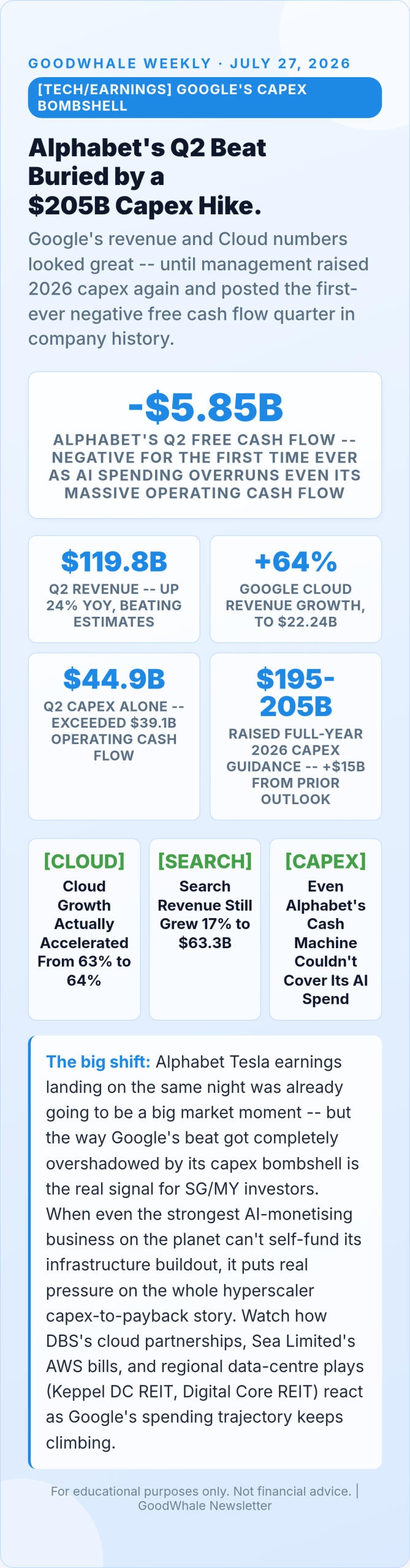
Meanwhile, the Alphabet Tesla earnings double-header on Wednesday night was supposed to give markets a clearer read on the AI trade after two rough weeks in chip stocks. Instead, it gave them a fresh reason to worry. Alphabet posted Q2 revenue of $119.8 billion, up 24% year-on-year and comfortably ahead of estimates, with Google Search still growing 17% to $63.3 billion and Google Cloud accelerating to 64% growth at $22.24 billion. On paper, an excellent quarter — so why did the stock fall roughly 7%?
Because the capex numbers were staggering. Alphabet spent $44.9 billion on capex in Q2 alone, more than its $39.1 billion in operating cash flow, producing negative free cash flow of $5.85 billion — the first negative FCF quarter in company history. Management then raised full-year 2026 capex guidance to $195-205 billion, another $15 billion higher than the prior outlook. For SG/MY investors, this is exactly the debate the Kimi K3 selloff was already asking two weeks ago: how long can hyperscalers keep raising AI spend faster than cash flow, and when does the market start demanding to see the payback? Regional data-centre and cloud beneficiaries (Keppel DC REIT, Digital Core REIT, Sea Limited) are the clearest reads on how this plays out.
2. Tesla Q2 Miss: 26% Revenue Growth Can’t Save a 1.4% Margin

Notably, the other half of the Alphabet Tesla earnings pair was, if anything, worse. Tesla reported Q2 revenue of $28.2 billion, up 26% year-on-year — a headline number that on its own would normally be applauded. But the profit line was the problem: adjusted EPS came in well below Wall Street expectations, with the adjusted profit margin compressing sharply to just 1.4%. The stock fell roughly 14% in after-hours trading, one of the steepest post-earnings drops in the Magnificent Seven this year.
The bigger picture is capex. Tesla spent $5.79 billion on capex in Q2, up 142% year-on-year, as the company aggressively builds out robotaxi, AI and energy-storage capacity — pushing free cash flow to negative $1.09 billion. Coming on the same night that Alphabet posted its first-ever negative FCF quarter on a $44.9 billion capex bill, the message is clear: the market is starting to force even the largest AI-adjacent companies to defend the actual returns on their infrastructure spending, not just the vision. For SG/MY investors, the direct Tesla exposure is small, but the sentiment read-through hits regional EV supply-chain and battery names — and reinforces the same message the chip stocks bear market started sending two weeks ago.
| Signal | Alphabet Q2 | Tesla Q2 |
|---|---|---|
| Revenue Growth YoY | +24% ($119.8B) | +26% ($28.2B) |
| Bottom-Line Reaction | Beat, then Sold Off | EPS Missed |
| Capex Direction | Raised to $195-205B | Up 142% YoY |
| Free Cash Flow | -$5.85B (First Ever) | -$1.09B |
| Stock Reaction (AH) | ~-7% | ~-14% |
3. Oil Tops $100 as Houthi Rebels Strike Saudi Tankers in the Red Sea
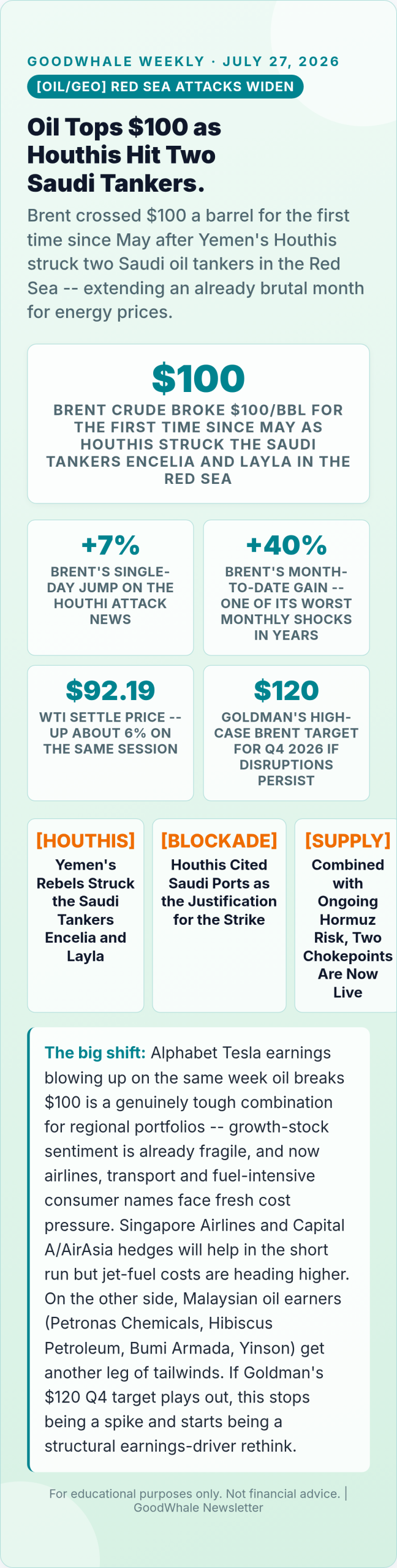
However, just as markets were digesting the Alphabet Tesla earnings drama, oil delivered its own shock. Yemen’s Houthi rebels attacked two Saudi oil tankers — the Encelia and Layla — in the Red Sea, citing what they described as their blockade of Saudi ports and shipping. The Encelia caught fire at the bow; all crew were reported safe. Brent crude jumped about 7% to close at $100.69, crossing $100 for the first time since May 26, while WTI settled around $92.19, up roughly 6% on the day.
The bigger story is the compounding: Brent is now up around 40% month-to-date, one of its worst monthly shocks in years, and it’s happening on top of the still-live Strait of Hormuz tensions with Iran. That’s two active chokepoints — Hormuz and Bab el-Mandeb — affecting roughly a quarter of global seaborne oil trade simultaneously. Goldman Sachs flagged that Brent could rally above $120 a barrel by Q4 if supply disruptions persist. For SG/MY investors, the split-screen is stark: airlines and fuel-intensive names face renewed cost pressure right when growth-stock sentiment is already fragile from Alphabet Tesla earnings, while Malaysian energy earners get another tailwind leg. The MAS’s stance on S$NEER also gets harder to hold if imported inflation from oil re-accelerates.
4. Intel Posts $11 Billion Loss and More Layoffs Despite a Revenue Beat

Additionally, the other big semi story this week came from Intel, which reported Q2 revenue that actually beat the roughly $14.4 billion Wall Street estimate — but the market focused on the bottom line: an $11 billion net loss, driven by heavy restructuring charges and impairments. It’s a familiar Intel pattern this year: a slightly better topline swamped by write-downs and by the cost of a still-unresolved turnaround.
The other headline was people. Intel confirmed fresh layoffs in its Data Center Group (DCG), its best-performing segment — Data Center revenue grew 22% year-on-year, yet even that team is being restructured. The message: the company is trying to become materially leaner even where growth is real. Coming alongside the Alphabet Tesla earnings capex reset, Intel’s loss reinforces the same theme — the market is repricing what it’s willing to pay for AI-adjacent stories that can’t yet show the cash. For SG/MY investors in the region’s chip-equipment and testing supply chain (AEM Holdings, UMS Holdings, Frencken, Inari Amertron, Vitrox), the Intel data point isn’t necessarily a demand signal — foundry and equipment leaders TSMC and ASML raised guidance just last week — but it is a reminder that the sentiment reset in semis isn’t over.
5. FOMC July 28-29 Preview: Warsh Meets $100 Oil and a Hot Earnings Season

On the other hand, the macro moment of next week is the FOMC meeting on July 28-29, capping a month that has thrown almost every possible curveball at the Fed. Chair Kevin Warsh, still in his first year at the helm, has already made clear he sees the job as unfinished — reiterating in a July speech in Sintra that “prices are too high” and reaffirming his commitment to deliver price stability. He’s also abandoned traditional forward guidance, which means the press conference will be studied word by word for tone.
Market pricing tells the story: CME FedWatch has the base case at roughly 65% probability of a hold at 3.50-3.75%, which would make it the fifth consecutive meeting without a change. But there’s a real one-in-three chance of a surprise hike priced in, and September hike odds have already climbed to 82%. The complication is that the same week markets absorbed the Alphabet Tesla earnings capex shock and oil breaking $100 on Houthi attacks — both push against the disinflation trend the Fed saw in June’s cooler CPI print. For SG/MY investors, the specific rate call matters less than Warsh’s tone in the 2:30 pm ET presser on July 29: any hawkish tilt will hit rate-sensitive REITs (CapitaLand Integrated Commercial Trust, Mapletree Pan Asia Commercial Trust), pressure DBS/OCBC/UOB net interest margins, and likely re-accelerate USD strength that MAS has been quietly managing on the S$NEER.
What I’m Watching Next Week
Key data and events — July 28 to August 1
- Tue-Wed 28-29 Jul — FOMC meeting. Decision at 2 pm ET Wed, Chair Warsh presser at 2:30. Every word will move rates, USD, gold, REITs.
- Wed 29 Jul — Meta Platforms and Microsoft report after the close. After Alphabet Tesla earnings, the next read on Big Tech AI capex discipline is here.
- Thu 30 Jul — Apple and Amazon report after the close. Consumer tech health check and another AWS capex signal.
- Fri 31 Jul — June PCE inflation print (the Fed’s preferred gauge). Cross-check against the June CPI cool-down after the day of the FOMC decision.
- All week — Oil above $100, Houthi/Iran headline risk, and how SG/MY airlines, energy names and REITs re-price the new backdrop.
Bottom Line
Five stories, one theme: the market is finally forcing the AI-capex story to defend itself in cash flow terms, not just narrative. Alphabet Tesla earnings both landed with beats that got overshadowed by capex and margin problems — Google spent more on capex than it earned in operating cash flow, and Tesla’s margin collapsed to 1.4% even as revenue grew 26%. Oil breaking $100 on Houthi attacks compounds the pressure on regional growth names while giving Malaysian energy earners another leg of tailwinds. Intel’s $11 billion loss and Data Center Group layoffs — even where topline is growing — underline how deep the semi-sector reset still runs after the Kimi K3 shock two weeks ago. And it all sets up the FOMC meeting on July 28-29 as the most consequential Fed sitting of the year: with Chair Warsh already saying “prices are too high” and oil above $100, the risk that a hold turns into a hawkish hold, or even a surprise hike, is genuinely in play. Practical playbook: don’t chase the growth-stock bounce until you see the FOMC tone, watch the SG/MY REITs and bank margins for the read-across, and treat oil above $100 as a live earnings-driver for both airlines and energy names, not just a headline.
For educational purposes only. Not financial advice. Always do your own research. Catch up on last week’s issue: GoodWhale Weekly: Chip Stocks Bear Market, Oil Tops $80, Record Bank Earnings.
Source: Alphabet’s Q2 revenue beat but the $195-205B capex hike sank the stock







[…] Previous […]
[…] For educational purposes only. Not financial advice. Always do your own research. Catch up on last week’s issue: GoodWhale Weekly: Alphabet Tesla Earnings Shock, Oil Tops $100, FOMC on Tuesday. […]
[…] For educational purposes only. Not financial advice. Always do your own research. Catch up on last week’s issue: GoodWhale Weekly: Alphabet Tesla Earnings Shock, Oil Tops $100, FOMC on Tuesday. […]
[…] For educational purposes only. Not financial advice. Always do your own research. Catch up on last week’s issue: GoodWhale Weekly: Alphabet Tesla Earnings Shock, Oil Tops $100, FOMC on Tuesday. […]
[…] For educational purposes only. Not financial advice. Always do your own research. Catch up on last week’s issue: GoodWhale Weekly: Alphabet Tesla Earnings Shock, Oil Tops $100, FOMC on Tuesday. […]