

The Week in 30 Seconds
- [MACRO] 10-year Treasury yield holds near 5.20%. Still close to its highest since 2007-08; 30-year above 5.5%. Gold slipped 2%+ to ~$4,228. PCE, ISM and the jobs report all land this week.
- [OIL/GEO] Oil jumps to $106.50. Trump rejected Iran’s 7-point plan to reopen the Strait of Hormuz; Saudi Arabia intercepted fresh Houthi attacks. September’s oil gain now nears 18%.
- [MACRO] Trump-Xi summit delivers a $30B tariff-cut deal. Three-day Washington visit eased tariffs on ag goods, wood, toys and appliances — but rare earths remain unresolved.
- [CHIPS/AI] AMD crosses $1 trillion; Meta’s Muse hits No. 1. Intel +12%, Arm +17% on the same AI-chip rally. Muse pulled 900K+ downloads in 6 days, sending Meta shares up 11%.
- [SG/MY] Costco beats, Jefferies buys the banks. Costco EPS $6.75 vs $6.53. Jefferies: Buy DBS (S$91) and UOB (S$48), Hold OCBC (S$35). STI closed 5,710.65 (+0.48%), KLCI flat.
1. 10-year Treasury yield: 10-Year Treasury Yield Holds Near a 19-Year High Into a Big Data Week

Meanwhile, the 10-year Treasury yield held near 5.20% to start the week — still close to its highest level since the 2007-08 financial crisis — while the 30-year Treasury yield traded above 5.5%, a level last seen in 2004. The move has been building for weeks: sticky inflation expectations, a hawkish Fed that delivered its first hike in three years earlier this month, and a historic wave of AI-linked corporate debt issuance have all combined to push borrowing costs to multi-decade highs. Gold, which had been the obvious hedge against all of this, instead pulled back more than 2% over the past week to around $4,228 an ounce, easing off its recent record as elevated real-yield expectations dulled the safe-haven bid even as Middle East tensions flared again over the weekend. Markets are still pricing roughly two more Fed hikes before year-end, and this week hands traders the data to test that view directly: core PCE inflation on Wednesday, ISM Manufacturing on Thursday, and the September jobs report on Friday — arguably the most important 72 hours of data since the Fed’s own meeting.
For Singapore and Malaysia investors, a 10-year Treasury yield parked near a 19-year high keeps the same playbook in force that has worked for months, with a sharper edge on both sides. DBS, OCBC and UOB continue to benefit from elevated SORA tracking the US curve higher — strong enough that Jefferies just initiated coverage with Buy ratings on two of the three names (full detail in story 5) — while S-REITs (Mapletree Industrial Trust, CICT, Keppel DC REIT, Digital Core REIT) face a genuinely difficult competitive set-up against a risk-free rate above 5%, the highest hurdle rate distribution yields have had to clear in a generation. The gold-versus-oil divergence this week is worth watching closely: gold cooling while crude jumps on fresh Iran-Hormuz escalation (see story 2) suggests the bond market’s rate-expectation story is currently overpowering the geopolitical safe-haven trade, not reinforcing it. In Malaysia, the same elevated 10-year Treasury yield keeps dollar strength intact, pressuring the ringgit and all but locking in a Bank Negara hold at the next MPC. With PCE, ISM and payrolls all due this week, position for volatility — a soft print could finally let the 10-year Treasury yield roll over, while a hot one entrenches it at these levels into Q4.
2. Oil Jumps as Trump Rejects Iran’s Hormuz Reopening Offer

Notably, oil’s risk premium came roaring back to start the week. Brent crude jumped roughly 2% to around $106.50 a barrel, while WTI added 1.3% to $93.60, after President Trump rejected Iran’s proposal to reopen the Strait of Hormuz, dismissing Tehran’s seven-point list of conditions — which included a full reopening of the strait and a lifted US naval blockade on Iranian ports — as insufficient. It was a sharp reversal from the mood just days earlier: Iranian Foreign Minister Abbas Araghchi had pitched the plan on September 25 as a way to de-escalate within seven days, and crude had initially eased on the hope of a deal. That optimism evaporated over the weekend. The rejection landed alongside fresh escalation on the ground — Saudi Arabia’s coalition said it intercepted Houthi drones and missiles aimed at Riyadh and Aramco-linked facilities — underscoring how fragile the wider Gulf security picture remains even as diplomats talk. September’s oil gain now approaches 18%, and the Strait of Hormuz, which carries roughly one-fifth of global oil and gas trade, stays a live flashpoint rather than a resolved one.
For Singapore and Malaysia investors, a reopened oil risk premium is a signal worth pricing in again rather than fading. Malaysia’s upstream complex — Petronas Chemicals, Dialog Group, and Yinson Holdings — along with the government’s own oil-linked revenue base, benefits from crude staying elevated into Q4, and the wide spread between Brent and WTI signals the physical market remains genuinely tight beneath the diplomatic back-and-forth. The other side of the ledger is less comfortable: Singapore Airlines and Capital A both face heavier fuel bills at exactly the moment the 10-year Treasury yield is already squeezing valuations across the region, and higher imported energy costs add a fresh inflation headwind for consumers in both Singapore and Malaysia. MISC Berhad and Bumi Armada, whose fleets carry direct Hormuz exposure, lose the near-term normalisation thesis that briefly looked plausible mid-week. The lesson for the newsletter’s ongoing playbook: treat any future Iran-Hormuz headline as reversible in either direction until an actual deal is signed — this is escalation, not de-escalation, and the region’s energy and travel names should be positioned accordingly.
3. Trump-Xi Summit: $30 Billion Tariff Truce, Rare Earths Still Open

However, chinese President Xi Jinping’s three-day state visit to Washington, from September 23 to September 26, produced the most concrete US-China trade agreement of the year: a reciprocal deal cutting tariffs on $30 billion of ‘non-sensitive’ goods. China agreed to ease duties on US agricultural products, fish and seafood, logs and wood products, cosmetics and medical devices; the United States reciprocated with tariff cuts on Chinese-made toys, small appliances, holiday decorations and children’s car seats. Beyond the goods list, the two sides established a new US-China Board of Trade — a standing forum to keep negotiating future reductions and disputes, first proposed during Trump’s May 2026 visit to China — and China committed to importing 10 million metric tons of US coal in each of 2027 and 2028. Trump called the meeting ‘very happy,’ and Xi described it as ‘perfection.’ Notably absent from the agreement: semiconductors, Taiwan, and — most consequentially for markets — any firm resolution on rare earth and critical mineral export controls, which the White House says both sides are still ‘working on,’ with further detail due from US Trade Representative Jamieson Greer on September 30.
For Singapore and Malaysia investors, this is constructive but incomplete news. Singapore’s role as a transshipment and logistics hub means any reduction in US-China trade friction is a tailwind, however marginal, for Mapletree Logistics Trust and port-linked names, and the creation of a standing US-China Board of Trade lowers the tail risk of another sudden tariff shock hitting Malaysian electronics exporters (Inari Amertron, Frencken Group, Unisem) the way earlier escalations did through 2025. But the unresolved rare earths question keeps Lynas Rare Earths, which runs the largest rare-earth separation plant outside China at Kuantan, structurally important to the regional chip and EV supply chain no matter which way this particular news cycle breaks — Malaysia’s leverage on critical minerals does not disappear because Washington and Beijing agreed on toys and coal. Investors should also keep the deal in context: it landed in the same week the 10-year Treasury yield hit a 19-year high, so easier trade conditions are arriving alongside tighter financial conditions, not instead of them. Net-net, this is a real de-escalation, not a full resolution — keep the trade-sensitive names on watch rather than piling in on headlines alone.
4. AMD Crosses $1 Trillion as Meta’s Muse Hits No. 1

Additionally, aMD’s stock rally pushed its market capitalisation past $1 trillion for the first time on September 22, with the shares surging roughly 9% to around $614 on booming AI-chip demand and second-quarter revenue of $11.54 billion, up 50% year-on-year. The rally wasn’t confined to AMD: Intel gained roughly 12% and Arm Holdings roughly 17% over the same week as investors rotated back into the broader chip complex. The catalyst was an unlikely one — not another hyperscaler earnings call, but a consumer app. Meta’s new ‘Muse’ personal AI agent climbed to No. 1 on the US Apple App Store, overtaking both ChatGPT and Grok, roughly three weeks after its wider rollout began, pulling in more than 900,000 downloads in its first six days and continuing to climb from there. Meta shares jumped 11% on the news, as investors — who had spent years wondering whether Meta’s AI spending would ever show up in an actual consumer product — finally got a genuine hit to point to. Traders read Muse’s traction as an early signal that AI usage, and the chip demand behind it, is broadening beyond enterprise deals and data-centre buildouts announced on quarterly calls.
For Singapore and Malaysia investors, this is another confirming data point for the AI supply-chain overweight that has anchored this newsletter’s playbook for months. Venture Corporation, AEM, Frencken and UMS Holdings on SGX, and Inari Amertron and Vitrox on Bursa all sit downstream of the capacity buildouts that AMD, Intel and Arm are racing to fund, and a genuine consumer-AI breakout like Muse is arguably a stronger demand signal than another data-centre announcement would have been. There’s also a direct competitive angle worth tracking: Sea Limited’s Shopee and Grab both compete for the same slice of SG/MY consumer attention that Muse is chasing, and a genuinely sticky AI agent from a deep-pocketed rival raises the bar for what a regional ‘super app’ needs to offer next — app-store rankings move fast, so the real test is whether Muse’s usage holds once the initial download wave fades. The caveat that matters most for portfolio sizing: this rally is unfolding in the same week the 10-year Treasury yield sits near a 19-year high, and a trillion-dollar valuation for AMD prices in a great deal of future demand that still has to show up in actual shipment numbers this quarter — track orders, not just the headline milestone.
5. Costco Beats, Jefferies Buys the Banks, STI Closes at 5,710.65

On the other hand, costco closed out fiscal 2026 with a genuine beat: Q4 EPS of $6.75 against a $6.53 consensus, and revenue of $95.7 billion, up 11% year-on-year. Comparable sales rose 9.4% (including a gas-price boost), or 6.7% excluding gas and currency, and worldwide comparable traffic grew 3.3%, an acceleration from the prior quarter’s 2.4% — a genuine global read on consumer resilience even as the 10-year Treasury yield sits near its highest level since 2007-08. Membership fee income grew 7.3% to $1.85 billion, though management flagged that this was the last quarter to benefit from the September 2024 fee increase. In Singapore, Jefferies initiated coverage on the three major banks last week, tagging DBS as the sector’s ‘quality pick’ with a Buy rating and an S$91 price target, and giving UOB a Buy rating as the ‘value pick’ with an S$48 target. OCBC received a Hold rating and an S$35 target, framed as the play for sustainable dividend growth. The calls landed the same week the STI closed at 5,710.65, up 0.48%, while Malaysia’s FBM KLCI ended essentially flat at 1,671.62, down just 0.04%, as investors stayed cautious amid the oil and bond-yield jitters running through the rest of this week’s news.
For Singapore and Malaysia investors, the week closes with a genuinely constructive but selective setup. Costco’s global consumer strength is a useful sanity check against the bearish narrative a 19-year-high 10-year Treasury yield might otherwise imply for consumer-facing names — if the world’s largest warehouse retailer is seeing accelerating traffic, the SG/MY consumer complex (DFI Retail Group, Sheng Siong) is probably not facing an imminent demand cliff either. Jefferies’ fresh bank coverage is a timely reminder of why DBS, OCBC and UOB have anchored this newsletter’s overweight list for months: strong capital generation and resilience across credit cycles justify premium valuations even against a risk-free rate this elevated, and the quality-pick-versus-value-pick framing (DBS versus UOB) gives investors a clear way to differentiate exposure rather than buying the sector blind. The KLCI’s flat finish is the week’s honest tell: Malaysia’s market is still waiting for a clearer catalyst, caught between oil prices that help its energy majors and a ringgit that keeps weakening against a stronger dollar. The playbook into October: stay overweight Singapore banks and the AI supply chain (Venture, AEM, Frencken, UMS, Inari, Vitrox), stay selective on long-duration REITs given the 10-year Treasury yield backdrop, and watch Petronas Chemicals, Dialog and Yinson for how the Iran-Hormuz standoff evolves. This was a week of real, but incomplete, resolution on several fronts — position with discipline rather than conviction on any single headline.
What I’m Watching Next Week
Key data and events — September 29 to October 3
- Wed 30 Sep — Core PCE inflation (August) and Micron Technology’s fiscal Q4 earnings, the crucial AI-memory read-through, plus USTR Jamieson Greer’s promised follow-up detail on the Trump-Xi tariff deal.
- Thu 1 Oct — ISM Manufacturing PMI and weekly jobless claims.
- Fri 2 Oct — September US nonfarm payrolls (the jobs report) — the single biggest data point of the week for whether the 10-year Treasury yield holds near 19-year highs or finally eases.
- Ongoing — Iran-Hormuz: watch for any fresh proposal or further escalation after Trump’s rejection; the Strait carries roughly a fifth of global oil trade.
- Local names — DBS/UOB/OCBC on the Jefferies re-rating; Venture/AEM/Frencken/UMS/Inari/Vitrox on the AMD/Meta AI read-through; Petronas Chemicals/Dialog/Yinson/MISC on the oil regime; Lynas Rare Earths on any follow-through from the US-China Board of Trade.
Bottom Line
This was a week of escalation on one front and easing on another, with the bond market pulling harder than either. Oil’s risk premium came roaring back after President Trump rejected Iran’s seven-point plan to reopen the Strait of Hormuz, sending Brent toward $106.50 and WTI to $93.60 as Saudi Arabia intercepted fresh Houthi attacks near Riyadh — September’s oil gain now approaches 18%. At the same time, Xi Jinping’s three-day Washington visit produced a genuine, if incomplete, trade thaw: a $30 billion tariff-cut deal on agricultural goods, wood products, toys and appliances, with a new US-China Board of Trade to keep talking — though rare earths and critical minerals remain deliberately unresolved. Underneath both stories, the 10-year Treasury yield held near its highest level since the 2007-08 financial crisis, with the 30-year above 5.5% for the first time since 2004, as sticky inflation expectations and a historic wave of AI-linked corporate debt collided with a Fed still pricing two more hikes this year — gold, tellingly, slipped over 2% rather than rallying on the Iran news, a sign the rate story is currently dominating even geopolitical risk. Meanwhile the AI trade found a second engine: AMD’s market capitalisation crossed $1 trillion, with Intel and Arm Holdings up 12% and 17% respectively, on the back of Meta’s new Muse AI agent shooting to No. 1 on the US App Store above ChatGPT and Grok, pulling in over 900,000 downloads in six days and sending Meta shares up 11%. And the fundamentals underneath it all held up: Costco beat its fiscal Q4 with EPS of $6.75 against a $6.53 estimate, and Jefferies initiated Singapore bank coverage with Buy ratings on DBS (the ‘quality pick’) and UOB (the ‘value pick’) and a Hold on OCBC, as the STI closed the week at 5,710.65 (+0.48%) and Malaysia’s KLCI ended essentially flat. For Singapore and Malaysia investors, the playbook into October stays disciplined rather than directional: overweight the Singapore banks (DBS, OCBC, UOB) on the NIM tailwind that a 10-year Treasury yield this elevated keeps alive; overweight the AI supply chain (Venture Corporation, AEM, Frencken, UMS Holdings, Inari Amertron, Vitrox) on the AMD and Meta Muse demand signals; stay selective on long-duration REITs (CICT, Mapletree Industrial Trust, Keppel DC REIT, Digital Core REIT) given the elevated risk-free rate; and watch Petronas Chemicals, Dialog Group, Yinson Holdings, MISC Berhad and Bumi Armada for how the Iran-Hormuz standoff and the sustained oil price regime develop. Rare earths, a live Fed, and a fragile Gulf ceasefire negotiation all remain open questions heading into a data-heavy week — position with discipline, not conviction, on any single headline.
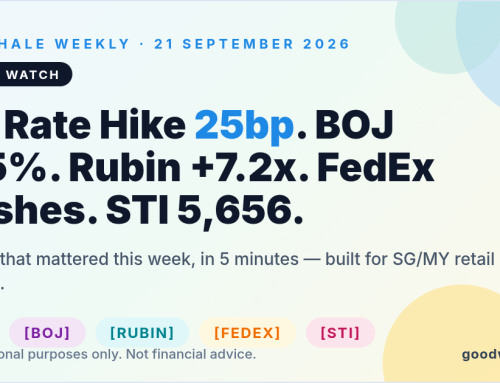
For educational purposes only. Not financial advice. Always do your own research. Catch up on last week’s issue: GoodWhale Weekly: Fed Rate Hike Lands 25bp, BOJ to 1.25%, Nvidia Rubin +7.2x, FedEx Crushes.





Leave a Reply