
The Week in 30 Seconds
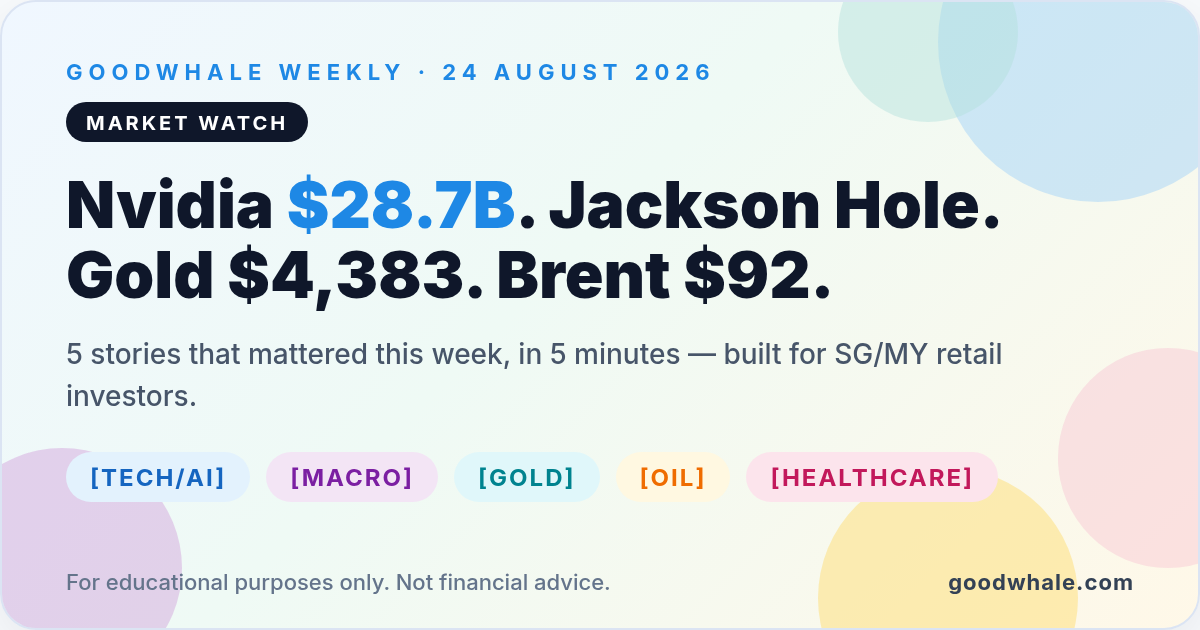
- [TECH] Nvidia earnings preview — $28.7B est on Aug 26. Data-center ~$25B, +92% YoY, ~80% of total. Q3 guide is what matters. Whole tape positioned for it.
- [MACRO] Jackson Hole this week — Warsh’s first speech as Chair. S&P closed 7,674. 10Y yields hit multi-decade highs mid-week. September cut priced.
- [GOLD] Gold hit record $4,383/oz. Fed cut bets + US debt worries + central-bank buying. +35% YTD. Regime change is real.
- [OIL] Brent slipped to $92.20. OPEC+ adds 188k bpd for September. J.P. Morgan forecasts $86 Q3, $78 year-end. Direction friendly for airlines.
- [HEALTHCARE] Moderna-Merck mRNA cancer trial succeeded. Health Care sector +4% — best week since June 26. mRNA second act is here.
1. Nvidia earnings: Nvidia Earnings on Aug 26: The Print the Whole Tape Is Positioned For

Meanwhile, the single event that matters most this week lands after the US close on Wednesday: Nvidia earnings for the July quarter. Street consensus sits around $28.7 billion in revenue, roughly 50% year-on-year growth, with the data-center segment alone forecast near $25 billion — up about 92% YoY and now accounting for roughly 80% of total company revenue. The setup is unusual because the whole tape is already positioned for it. The S&P 500 spent the week grinding sideways around 7,674 as investors held fire ahead of the print, and every AI-adjacent name — from hyperscaler REITs to networking suppliers — has been trading on the working assumption that Nvidia delivers.
The two lines that actually matter are the Q3 guide and the data-center segment breakdown. A Q2 beat without a Q3 guide raise gets sold; a $30B+ Q3 guide with clean data-center commentary is what the bull case needs to stay intact. HBM memory supply remains the binding constraint on how many racks Nvidia can actually ship, and hyperscaler capex guides from Meta, Microsoft, Google and Amazon continue to point higher — so the demand-side signal is not the worry. For SG/MY investors, the read-across is direct and broad. UMS Holdings, AEM, Frencken, Aztech Global, Inari Amertron, Venture Corp and Vitrox all sit somewhere in the AI-server assembly, test and back-end complex that ultimately depends on Nvidia rack volume. Position sizing into Wednesday should respect this being a two-way event: a beat-and-raise re-rates the whole regional chip complex; a beat-only guide caps valuations right where they are.
2. Jackson Hole 2026: Warsh’s First Speech as Chair Sets the September Path

Notably, the macro calendar this week was dominated by Treasury yield volatility and the run-up to Jackson Hole. The S&P 500 finished at 7,674.37 for a +0.43% Friday, the Nasdaq closed at 26,180 also +0.43%, and the Dow added 518 points or 0.98% — but the week was anything but smooth. The S&P fell hard on Tuesday as sovereign bond yields ran to multi-decade highs on persistent inflation and elevated oil prices, then stocks slipped again Thursday when Treasury yields reversed a sharp Wednesday decline following the Treasury Department’s announcement of increased long-dated bond buybacks. Friday’s bounce was largely investors squaring positions ahead of the weekend and the Jackson Hole symposium.
Fed Chair Kevin Warsh is the headline act this year, and it’s his first Jackson Hole speech in the top seat. The market has priced in a September rate cut and every syllable of Warsh’s tone will get parsed for whether that pricing holds. Areas to watch closely: language on central bank independence (an ongoing political flashpoint), the balance between the still-above-target inflation print and the softening labour data, and any explicit reference to the September FOMC meeting. For SG/MY investors, the read-across matters as much as the US tape. Both MAS and Bank Negara Malaysia have been navigating the imported-inflation and rate-differential channel, and a dovish Warsh gives them the room to hold policy steady without the SGD or MYR breaking wider. The direct local plays on any dovish read: CICT, MPACT, Keppel DC REIT, Digital Core REIT and the Singapore bank complex of DBS, OCBC and UOB, plus the Malaysian bank names that have lagged the regional rally. Any hawkish surprise from Warsh is the most obvious way the current melt-up setup breaks — until then, the direction of travel is friendly.
3. Gold at $4,383: The Regime Change Is Real

However, gold pushed through to a fresh all-time high of $4,383.76 per ounce this week, extending a rally that has now delivered north of 35% year-to-date and put the metal in a genuinely different regime than the one investors have priced for the last decade. The immediate driver is the same set of factors that has been in place all year — renewed September Fed rate-cut bets compressing real yields, persistent US fiscal and debt-sustainability concerns keeping the dollar bid soft, and continued heavy physical buying from emerging-market central banks looking to diversify reserves away from the dollar system. What’s new this week is the pace: XAU/USD has cleared multiple technical levels with almost no meaningful pullback, which typically signals that the marginal buyer is not tactical but structural.
For SG/MY investors, the practical question is not whether gold is expensive — it is, by any historical multiple — but whether the drivers still point in the same direction. The honest answer is yes: the Fed is still expected to cut in September, US debt trajectory has not improved, and central-bank physical buying continues to set a floor. Local vehicles worth knowing include the SPDR Gold Shares ETF (O87 on SGX), the SGX-listed gold ETFs, and physical gold through local dealers for those who prefer bullion. Position sizing matters more than entry timing at this level. A 3-5% portfolio allocation to gold is defensible as a genuine diversifier; going overweight from here is chasing a trade that has already moved. The Nvidia earnings print on Wednesday and Warsh’s Jackson Hole speech both matter for gold — a dovish Warsh extends the rally, a hawkish surprise triggers the first real pullback of the year.
4. Brent at $92: OPEC+ Adds Barrels, Prices Drift Lower
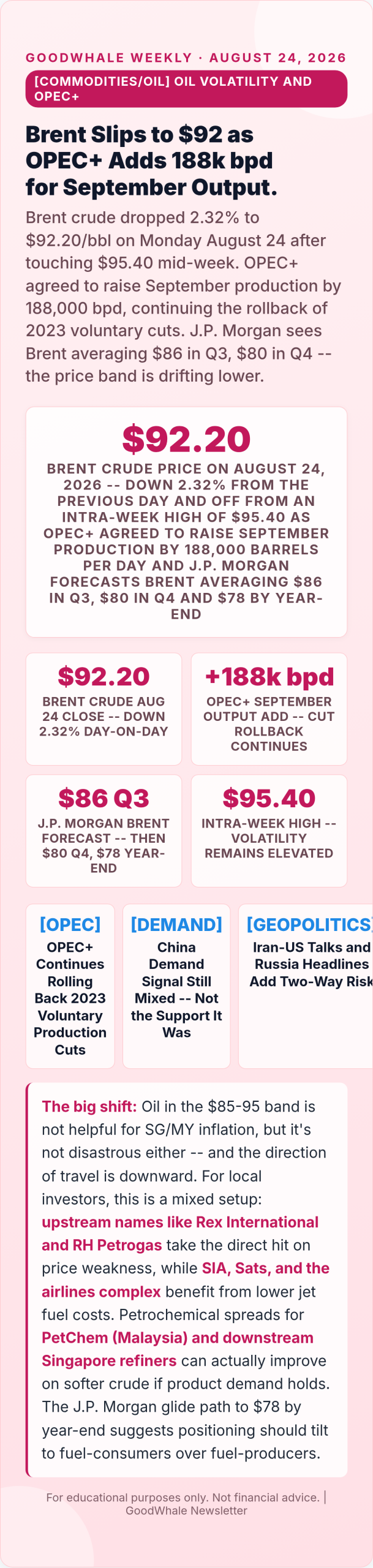
Additionally, oil markets were volatile all week and closed with Brent crude at $92.20 per barrel on Monday August 24, down 2.32% from the previous day and well off the intra-week high of $95.40 reached earlier in the week. The proximate driver of Monday’s slide was the confirmation that OPEC+ had agreed to raise September production by 188,000 barrels per day, continuing the gradual rollback of the voluntary production cuts introduced back in 2023. The direction of travel is now clearly downward on the OPEC+ supply side, and J.P. Morgan’s latest research forecasts Brent averaging $86 in Q3, $80 in Q4 and $78 by year-end — a coherent glide path lower.
For SG/MY investors, the read-across is genuinely mixed and worth thinking through carefully. Oil in the $85-95 band is not helpful for regional inflation but is not disastrous either, and the trajectory is friendly. On the direct hit side, upstream Singapore names like Rex International and RH Petrogas lose direct exposure on price weakness. On the beneficiary side, Singapore Airlines, Sats and the broader regional airlines complex pick up meaningful jet-fuel tailwinds — SIA jet-fuel hedging cycles roll off through Q4 and the incremental price break flows to margin. Petrochemical spreads for PetChem (Malaysia) and Singapore’s downstream refiners can actually improve on softer crude if product demand holds. The J.P. Morgan glide path to $78 suggests positioning should tilt to fuel-consumers over fuel-producers into year-end — with a modest hedge in case the Iran-US or Russia-Ukraine headlines produce a supply scare that briefly reverses the direction of travel.
| Signal | Nvidia Preview | Jackson Hole | Gold | Brent Oil |
|---|---|---|---|---|
| Headline Number | $28.7B est | S&P 7,674 | $4,383 record | $92.20 |
| Change vs Prior | +50% YoY exp | +0.43% Fri | Fresh ATH | -2.32% DoD |
| Key Forward Signal | Q3 guide $30B+ | Sept cut path | $4,500 next | $78 year-end |
| SG/MY Read-Across | UMS, AEM, Frencken | REITs, banks | SPDR Gold O87 | SIA, PetChem |
| Verdict | Two-Way | Priced Dovish | Regime Change | Drifting Lower |
5. Moderna-Merck mRNA Win: The Post-COVID Second Act Is Here

On the other hand, the healthcare story of the week — and arguably the most important non-macro readout of the summer — landed on Wednesday when Moderna and Merck announced their jointly developed personalised mRNA cancer treatment succeeded in its late-stage clinical trial. The read was clean enough that the S&P 500 Health Care sector index jumped more than 4% on the week — its best week since June 26 — as investors re-rated not just Moderna and Merck but the entire mRNA-platform and personalised-medicine complex. The trial win matters because it validates the long-awaited mRNA cancer vaccine thesis that both Moderna and BioNTech have been building around since 2021: mRNA is not just a COVID vaccine platform, it’s a modality that can be applied to personalised oncology, autoimmune disease and rare-disease indications where traditional biologics have struggled.
For SG/MY investors, direct listed exposure to the mRNA-oncology trade is limited — there are no listed peers in the Singapore or Malaysia market that directly track the modality. But the sector-rotation read-across is real. Riverstone Holdings, Top Glove, Hartalega, IHH Healthcare and Raffles Medical may see a modest positioning tailwind as global healthcare gets re-rated and generalist money flows into the space looking for beta. The bigger structural point worth noting is that this trial success is real evidence the biotech capex cycle from 2020-2022 — funded largely by pandemic-era balance sheets — is finally producing pivotal readouts. Expect more late-stage cancer, autoimmune and rare-disease prints through year-end. For a portfolio still heavily positioned in AI, adding a modest healthcare weight into any Nvidia-earnings-driven tape wobble is a defensible way to broaden risk without giving up growth exposure.
What I’m Watching Next Week
Key data and events — August 25 to 29
- Wed 26 Aug — Nvidia Q2 FY27 earnings after US close. The single biggest single-stock catalyst of the tape. Q3 guide is more important than the Q2 beat.
- Fri 28 Aug — Jackson Hole Warsh keynote. First Jackson Hole speech as Chair — language on September FOMC path is what markets need.
- Thu 28 Aug — US PCE inflation print for July. The Fed’s preferred inflation gauge — confirms or complicates the September cut narrative.
- All week — OPEC+ compliance headlines and Iran-US talks. Any surprise moves Brent back to $95 or under $85 quickly.
- Local names — STI chip complex (AEM/UMS/Frencken/Venture) into Nvidia; REITs (CICT/MPACT/Keppel DC) into Jackson Hole; SIA and PetChem on oil weakness; SPDR Gold O87 on any Warsh dovishness.
Bottom Line
Five stories, one clean setup: this is the most binary week of the summer. Nvidia earnings on Wednesday August 26 is the single biggest single-stock event of the entire tape, with Street looking for roughly $28.7 billion in revenue and a data-center segment near $25 billion — but the number that actually moves things is the Q3 guide, and a $30 billion+ Q3 guide is what the bull case needs to stay intact. Jackson Hole two days later is the macro book-end, with Kevin Warsh’s first symposium speech as Fed Chair setting the tone for the September FOMC path that markets have already priced. Gold at $4,383 is a genuine regime change, not a spike — rate cuts, US debt worries and central-bank buying all still point the same direction. Brent at $92 with OPEC+ adding 188k barrels per day for September and J.P. Morgan forecasting $78 by year-end is a friendly drift lower for regional airlines and downstream refiners. And Moderna-Merck’s mRNA cancer trial success is real evidence the post-COVID biotech capex cycle is finally producing readouts worth owning. For SG/MY investors, the practical playbook: size Nvidia-adjacent chip supply-chain exposure (UMS, AEM, Frencken, Venture, Inari, Vitrox) for a two-way outcome; hold or add to REITs and rate-sensitive banks (CICT, MPACT, Keppel DC, DBS, OCBC, UOB) into a dovish Warsh; keep a defensible 3-5% gold allocation as diversifier; tilt oil exposure toward fuel-consumers (SIA, Sats) over fuel-producers; and add modest healthcare weight (IHH, Raffles Medical, Riverstone) on any Nvidia-driven tape wobble. Two events, four days, a whole tape positioned around them.
For educational purposes only. Not financial advice. Always do your own research. Catch up on last week’s issue: GoodWhale Weekly: Alphabet Tesla Earnings Shock, Oil Tops $100, FOMC on Tuesday.
Source: CNBC market wrap for the week







Leave a Reply