
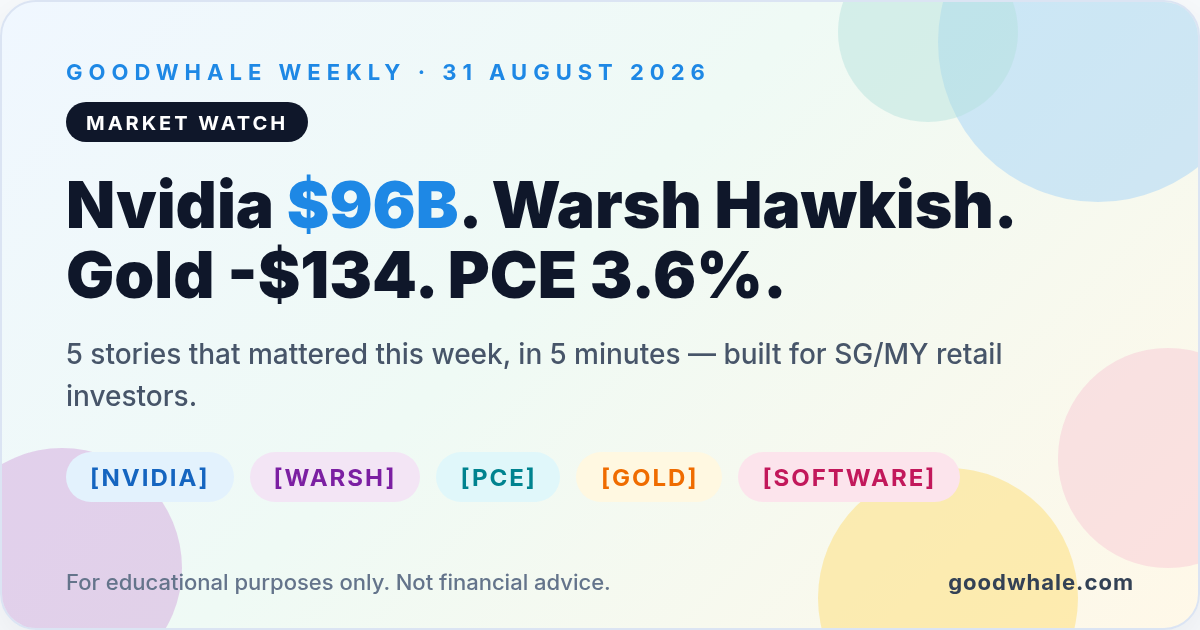
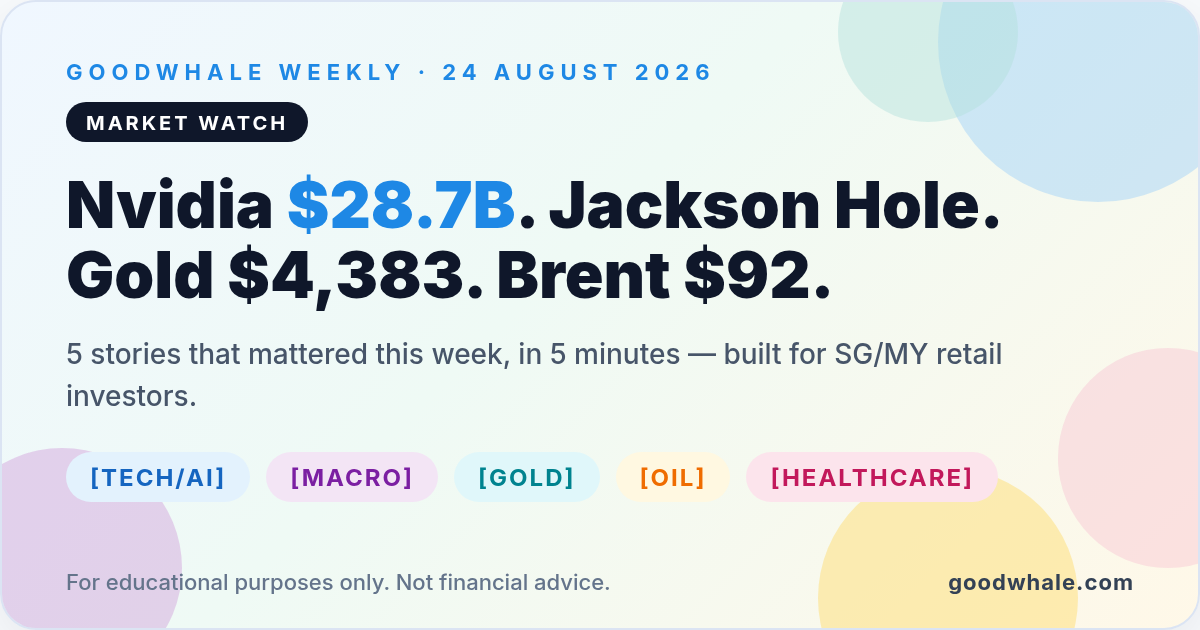
The Week in 30 Seconds
- [TECH] Nvidia earnings 2026 blowout — $96.2B revenue (+106% YoY). Data-center $89B, Q3 guide $108B vs $104B est. Stock +8.7% Thursday. Bull case fully confirmed.
- [MACRO] Warsh hawkish at Jackson Hole. Called core PCE at 3.7% concerning. Rate HIKE odds jumped to 64%. Complete reversal of dovish-cut narrative.
- [MACRO] PCE hot: 5.3% headline, 3.6% core. Both revised UP 0.2pp. Super-core at 3.8%. This is what handed Warsh the ammunition.
- [GOLD] Gold plunged $134 or -2.88% Friday. After hitting record $4,530s. Silver -3.49%. First real regime-change test. Structural bull intact.
- [TECH] Salesforce, CrowdStrike, Okta surged. Enterprise software AI wave confirmed. ‘SaaSpocalypse’ narrative dead. Marvell beat but dipped.
1. Nvidia earnings 2026: Nvidia Earnings 2026: The $96B Beat That Rewrote the AI Baseline

Meanwhile, nvidia delivered arguably the most important earnings print of the entire AI cycle on Wednesday August 26. Q2 FY27 revenue landed at $96.2 billion, up 106% year-on-year, comfortably clearing the roughly $94 billion Street consensus. Data-center revenue — the segment that actually matters — came in near $89 billion versus $85.7 billion expected, with networking revenue nearly doubling on strength across NVLink, InfiniBand, and Ethernet for AI deployments. Non-GAAP EPS of $2.22 beat the $2.09 estimate. Gross margin held at 75% for the second straight quarter — a genuinely stunning number for a hardware company. And the Q3 guide of $108 billion cleared the $104.2 billion consensus by a wide margin, signalling that management sees no end to hyperscaler capex through year-end.
NVDA rallied 8.7% on Thursday, its biggest one-day gain in more than a year, and the whole AI complex rerated with it. The read-across for Singapore and Malaysia is direct: UMS Holdings, AEM, Frencken, Aztech Global, Inari Amertron, Venture Corp and Vitrox all sit in the AI-server assembly, test and back-end supply chain that ultimately depends on Nvidia rack volume. This print confirms the multi-year demand runway. The complication came Friday: even with the print in hand, the Nasdaq slid 0.52% and Nvidia gave some back as Fed Chair Kevin Warsh’s hawkish Jackson Hole speech triggered a broad risk-off across semis. The Nvidia earnings 2026 result is the fundamental bull case; the macro backdrop is what determines whether you get to enjoy it in a straight line or with volatility. Own the demand thesis, size for the macro. Any pullback in the local chip complex is an add opportunity — the demand data is stronger, not weaker, after this print.
2. Warsh’s Hawkish Jackson Hole: The Cut Is Off the Table
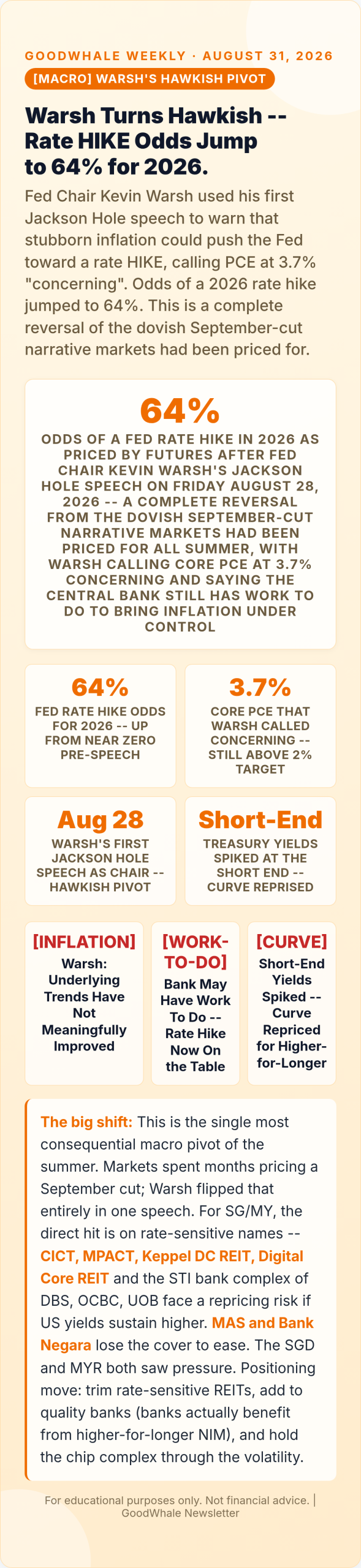
Notably, the macro story of the week — and arguably the summer — was Fed Chair Kevin Warsh’s first Jackson Hole speech as Chair on Friday August 28. Markets had spent months pricing in a September rate cut, with futures-implied September cut odds sitting near 94% at their peak earlier in August. Warsh flipped that entirely. He called core PCE at 3.7% “concerning”, said “underlying trends have not meaningfully improved”, and warned the central bank may still have “work to do” to bring inflation back to the 2% target. The implication was explicit: rate hikes are back on the table. Futures repriced within minutes — odds of a 2026 rate hike jumped to roughly 64%, and short-end Treasury yields spiked as the curve repriced for higher-for-longer.
For SG/MY investors, this is the single most consequential macro pivot of the summer and every portfolio decision made through August has to be revisited against it. The direct hit lands on rate-sensitive names. Singapore REITs — CICT, MPACT, Keppel DC REIT, Digital Core REIT — face genuine repricing risk if US 10Y yields sustain at multi-decade highs. The MAS and Bank Negara Malaysia lose the cover to ease policy; the SGD and MYR saw pressure into Friday’s close as rate differentials repriced against Asian currencies. The counter-intuitive positioning move is quality banks — DBS, OCBC, UOB and the Malaysian bank complex actually benefit from higher-for-longer through net interest margin, and have been unfairly sold in prior rate-cut narratives. Practical playbook: trim rate-sensitive REITs on any bounce, add to quality banks on any dip, and hold the chip complex through the macro volatility because the fundamental Nvidia demand thesis is unchanged. Do not fight this pivot — Warsh has drawn a very clear line.
3. Hot PCE and Upward Revisions: Warsh’s Ammunition
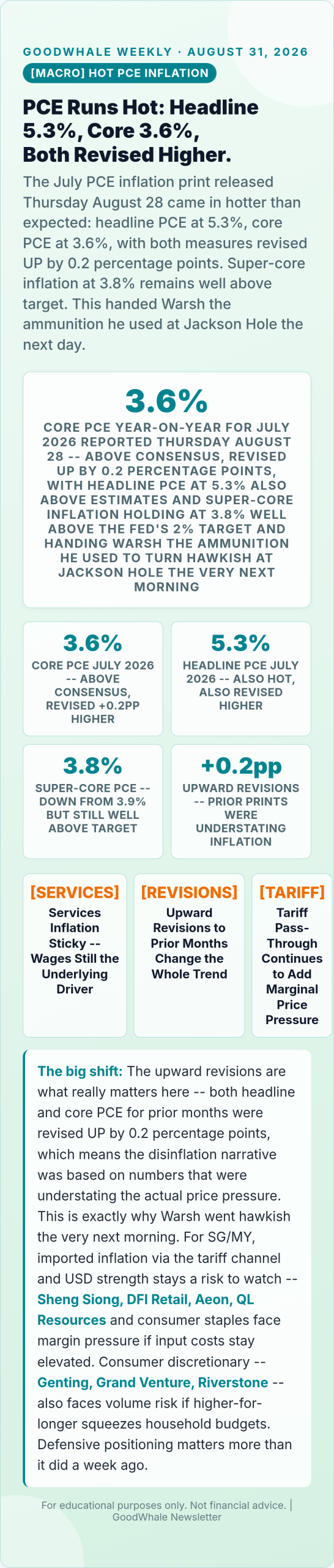
However, the July PCE inflation print released Thursday August 28 was the data that handed Kevin Warsh the ammunition for his hawkish Jackson Hole turn on Friday. Headline PCE came in at 5.3% year-on-year, core PCE at 3.6%, and — crucially — both measures were revised UP by 0.2 percentage points versus prior prints. Super-core inflation (services ex-housing) held at 3.8%, down from 3.9% but still running well above the Fed’s 2% target and above trend since the pandemic. The upward revisions are the real story: the market’s disinflation narrative through the summer was built on prints that turned out to be understating actual price pressure. When you revise the recent history up, the trajectory changes — and that’s what Warsh sees.
For Singapore and Malaysia investors, the read-across works through two channels. First, imported inflation via the tariff pass-through and USD strength continues to be a genuine risk if the Fed stays higher-for-longer. Consumer staples — Sheng Siong, DFI Retail Group, Aeon Malaysia, QL Resources — face margin pressure when input costs stay elevated because the ability to pass through prices to local consumers is limited. Second, consumer discretionary — Genting Singapore, Grand Venture Technology, Riverstone Holdings — faces volume risk if higher-for-longer squeezes household budgets across the region. Defensive positioning matters more this week than it did last week. Quality dividend names, cash-flow-generative businesses, and companies with pricing power are what to lean into. The disinflation trade is on hold until we see two or three consecutive prints that meaningfully break lower — and after these upward revisions, that’s a bigger ask than it was a month ago.
4. Gold Down $134 in a Session: Volatility Returns to Commodities

Additionally, commodities had a two-day narrative this week. Gold set a fresh record near $4,530 per ounce mid-week as investors positioned for what they thought would be a dovish Warsh at Jackson Hole. Then Friday’s speech landed, real yields spiked as rate-hike odds jumped to 64%, and December gold futures plunged $134.10 or -2.88% to settle at $4,529.90. Silver dropped even harder, down 3.49% or $2.45 to $67.79. This is the first real test of the gold regime-change thesis all year, and it revealed exactly what the trade is vulnerable to — a hawkish real-yield shock. The structural drivers (central bank buying, US debt sustainability concerns) remain intact, but the daily volatility just came back.
For SG/MY investors, this is actually constructive. Gold at $4,530 that fell to $4,530 the same day is at least a level worth adding to for the first time all year, via SPDR Gold Shares (O87 on SGX) or physical bullion via local dealers. A 3-5% strategic allocation remains defensible and any further pullback into the $4,400s should be added into rather than sold. On oil, the picture is different: Brent settled at $89.31 per barrel Friday (down 0.43%), with WTI at $83.40, as OPEC+ continued the rollback of its 2023 voluntary production cuts. The trajectory is still friendly to SIA and Sats through lower jet fuel and to airlines regionally. Upstream Rex International and RH Petrogas continue to face the direct price pressure. Petrochemical spreads for PetChem Malaysia improve if product demand holds. The commodity playbook: add to gold on weakness, tilt oil exposure to consumers over producers, and expect more two-way volatility now that the macro is no longer priced one-directionally.
| Signal | Nvidia | Warsh | PCE | Gold |
|---|---|---|---|---|
| Headline Number | $96.2B rev | 64% hike odds | 3.6% core | $4,529.90 |
| vs Expectations | Beat + Q3 guide | Full reversal | Revised +0.2pp | -$134 in day |
| Direction Signal | $108B Q3 guide | Hikes on table | Sticky services | Two-way now |
| SG/MY Read-Across | UMS, AEM, Frencken | REITs down, banks up | Staples pressured | O87 add on dip |
| Verdict | Bull Confirmed | Regime Shift | Higher-for-Longer | Volatile Bull |
5. AI’s Second Act: Enterprise Software Joins the Party

On the other hand, the other big story this week — easy to miss under the Nvidia and Warsh headlines — was the enterprise software earnings wave that hit Wednesday and Thursday. CrowdStrike reported what management called its best quarter in company history, on the back of platform consolidation and AI-driven security demand. Salesforce cleared earnings and revenue expectations and expanded a series of AI partnerships, sending the stock double-digits higher after hours. Okta also surged double-digits on a clean beat and strong forward guide. Even Marvell, which dipped in the immediate aftermath despite beating and guiding Q3 at $3.15B (above Street’s $3.03B) and adjusted EPS at $1.10 (above $1.08), showed AI-driven networking chip demand accelerating.
The ‘SaaSpocalypse’ narrative — the argument that AI would disintermediate traditional enterprise SaaS — got decisively dispelled by this print cycle. What the numbers actually show is that AI is accelerating enterprise software demand, not replacing it: customers are consolidating on AI-enhanced platforms, expanding seat counts, and paying up for higher-tier features. For SG/MY investors, direct listed exposure to enterprise software is limited, but the read-across is meaningful for anyone assessing the durability of the AI cycle. Local names with genuine AI, software or cloud exposure — Silverlake Axis, ISDN Holdings, Grand Venture Technology, Nanofilm, iFAST Corporation — deserve a fresh look through this lens. The bigger structural point is that the AI capex cycle is now visibly monetising through both the hardware layer (Nvidia $96B revenue) and the software layer (Salesforce, CrowdStrike, Okta), which is exactly what a genuine multi-year cycle looks like — not just chip volume but real end-customer spending on AI-enhanced products. Dell reports next week and will complete the picture on the enterprise server side.
What I’m Watching Next Week
Key data and events — September 1 to 5
- Tue 2 Sep — US ISM Manufacturing PMI. Post-Warsh, any softening reads as growth risk rather than cut catalyst.
- Wed 3 Sep — Dell Technologies earnings after close. Completes the enterprise AI server picture after Nvidia. Watch backlog and Blackwell-related order commentary.
- Fri 5 Sep — US Non-Farm Payrolls August print. First labour data post-Warsh — a weak print re-opens the cut debate; a strong print cements the hike narrative.
- All week — Fed speakers post-Jackson Hole. Every FOMC voter’s tone matters more than usual — watch for pushback or confirmation of Warsh.
- Local names — STI chip complex (UMS/AEM/Frencken/Venture) on Nvidia strength; DBS/OCBC/UOB on higher-for-longer; CICT/MPACT/Keppel DC into any yield pullback; SPDR Gold O87 on further gold dips; Sheng Siong/DFI for defensive rotation.
Bottom Line
Five stories, one clean macro pivot: this was the week the tape flipped from dovish-cut to hawkish-hike in 48 hours. Nvidia earnings 2026 delivered the print of the year — $96.2 billion in revenue up 106% YoY, data-center at $89 billion, and a Q3 guide of $108 billion that cleared the Street bar by nearly $4 billion. The AI hardware bull case is fully confirmed and the read-across to the SG/MY chip complex (UMS, AEM, Frencken, Aztech, Inari, Venture, Vitrox) is direct and positive. But then Fed Chair Kevin Warsh used his first Jackson Hole speech to call core PCE at 3.7% concerning, said the central bank has work to do, and pushed rate-hike odds for 2026 to 64% — a complete reversal of the September-cut narrative that had been the base case all summer. The July PCE print on Thursday (headline 5.3%, core 3.6%, both revised up 0.2 percentage points) handed Warsh the ammunition. Gold plunged $134 in a single session, silver -3.49%, and the whole real-yield-sensitive complex repriced. Enterprise software delivered the other structural read of the week: Salesforce, CrowdStrike and Okta all surged double-digits post-earnings, killing the ‘SaaSpocalypse’ narrative and confirming that AI monetisation is now flowing through both hardware and software layers. For SG/MY investors, the practical playbook has changed. Trim rate-sensitive REITs (CICT, MPACT, Keppel DC) on any bounce given repricing risk. Add to quality banks (DBS, OCBC, UOB and Malaysian banks) which actually benefit from higher-for-longer through NIM. Hold and add to the chip complex on any Warsh-driven volatility — the fundamental Nvidia demand thesis is stronger, not weaker, after this week. Take gold weakness as a chance to add to a defensive 3-5% allocation via O87. Rotate modestly defensive into consumer staples (Sheng Siong, DFI, Aeon, QL) given imported-inflation risk. And do not fight the macro pivot — Warsh has drawn a very clear line, and the market took him seriously.
For educational purposes only. Not financial advice. Always do your own research. Catch up on last week’s issue: GoodWhale Weekly: Alphabet Tesla Earnings Shock, Oil Tops $100, FOMC on Tuesday.




Leave a Reply