
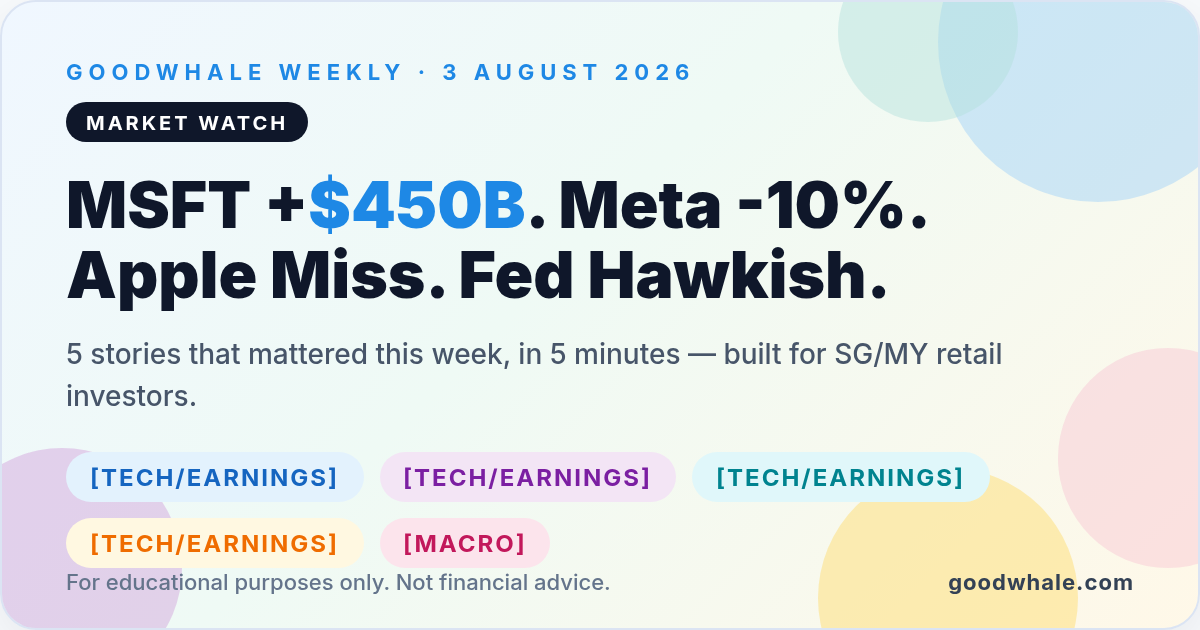
The Week in 30 Seconds
- [TECH/EARNINGS] Microsoft made history. MSFT +16% on Thursday added a record $450B in one day. Azure +40% at $100B annual run-rate. Copilot passed 30M paid seats.
- [TECH/EARNINGS] Amazon confirmed the AI-cloud winner trade. Q2 revenue $200.6B (first ever $200B quarter). AWS +37% at 39.4% op margin. Stock +12% Friday.
- [TECH/EARNINGS] Meta cratered 10%. Revenue beat, EPS missed. But the killer was FY26 capex guide raised to $145B. Roughly $150B in market cap wiped in hours.
- [TECH/EARNINGS] Apple fell 8% on a Services miss. Record iPhone (+21.7%) and record $109.4B total revenue, but Services $30.74B missed $31.22B. Barclays cut PT to $245.
- [MACRO] Fed hawkish hold, Dow -1,153. FOMC 9-3 hold with 3 hike dissents. Worst Dow session since April 2025. 30Y yield at 5.28% — highest since 2007.
1. Big Tech earnings: Microsoft’s $450B Day: The Big Tech Earnings Winner That Rescued the Tape
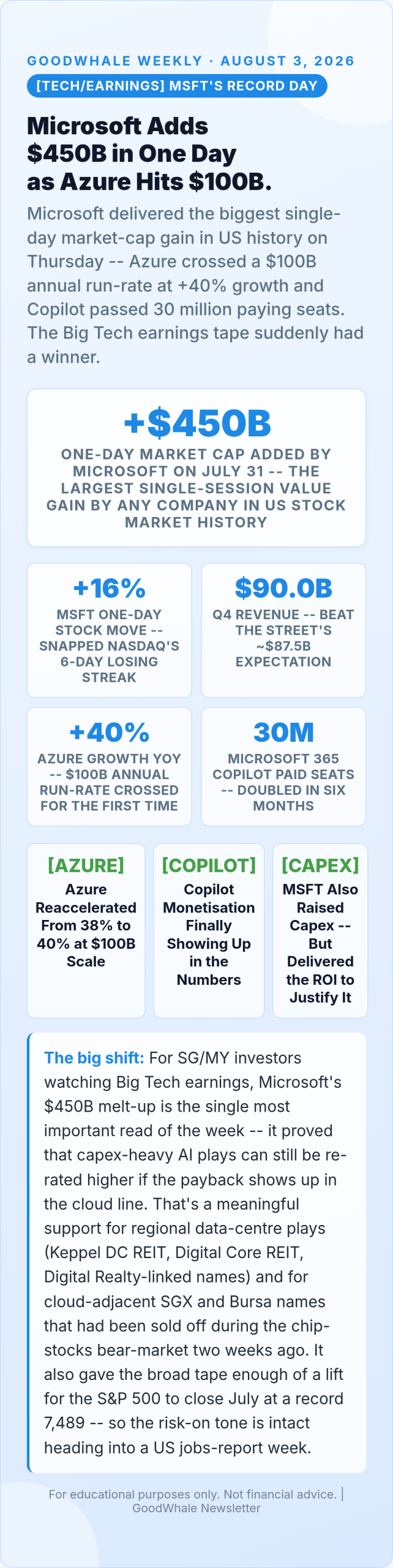
Meanwhile, the most stunning single moment of the Big Tech earnings week belonged to Microsoft. On Thursday, MSFT stock jumped 16% and added roughly $450 billion in market value in a single trading session — the largest one-day market-cap gain by any company in US stock market history. It single-handedly snapped the Nasdaq out of a six-day losing streak and reset the mood on a week that had been dominated by capex fear.
The numbers behind the move were unambiguously strong. Q4 revenue came in at $90.0 billion, ahead of the roughly $87.5 billion Street expectation. Azure grew 40% year-on-year and crossed a $100 billion annual run-rate for the first time. And Microsoft 365 Copilot paid seats reached 30 million, roughly doubling in six months — the clearest evidence yet that enterprise AI monetisation is finally showing up in real revenue rather than pilots. For SG/MY investors, this is the read-across that matters: MSFT also raised capex guidance, but instead of getting punished (like Alphabet the week before or Meta the next day), the stock ripped — because the cloud growth line justified the spend. Regional data-centre REITs and cloud-adjacent supply-chain names (Keppel DC REIT, Digital Core REIT, Sea Limited on the AWS side) got a sentiment tailwind out of it, and the broad tape closed July at a fresh S&P 500 record of 7,489.
2. Amazon’s AWS Blowout: The Other Big Tech Earnings Winner of the Week
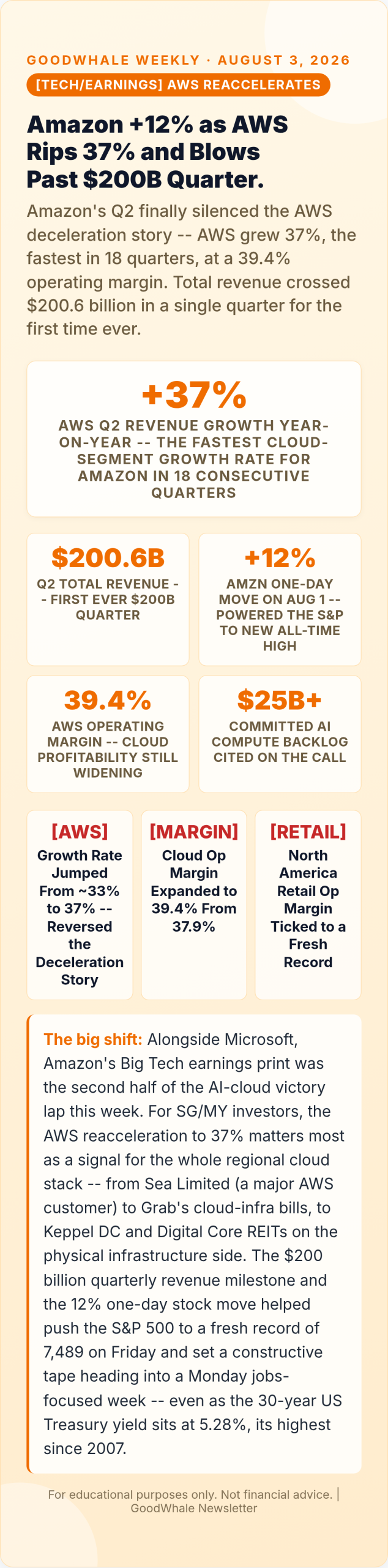
Notably, if Microsoft’s Thursday was the headline, Amazon’s Friday was the confirmation. Amazon posted Q2 revenue of $200.6 billion — the first ever $200 billion quarter in the company’s history — but the real story was AWS. Amazon Web Services grew 37% year-on-year, the fastest rate in 18 quarters, and did it while expanding operating margin to 39.4% from 37.9%. That combination — reaccelerating growth AND widening margin at $100B+ scale — was exactly what bears had said couldn’t happen.
The stock reaction told you all you needed to know: AMZN jumped roughly 12% on Aug 1, adding to Microsoft’s tape-saving rally the day before and pushing the S&P 500 to a fresh record 7,489.72. Together, the two prints reset how the market was pricing AI capex — from “unsustainable” to “defensible” almost overnight. For SG/MY investors, the AWS acceleration is the read-across that matters — Sea Limited runs a huge AWS bill, Grab’s cloud-infra costs are AWS-heavy, and the regional data-centre REIT complex (Keppel DC REIT, Digital Core REIT) benefits when the hyperscalers commit fresh capacity. The one shadow on the setup is that the 30-year US Treasury yield closed at 5.28%, its highest since 2007 — a headwind for anything rate-sensitive, and something to watch as we head into Friday’s US jobs report.
3. Meta’s $145B Capex Shock: The Big Tech Earnings Loser of the Week
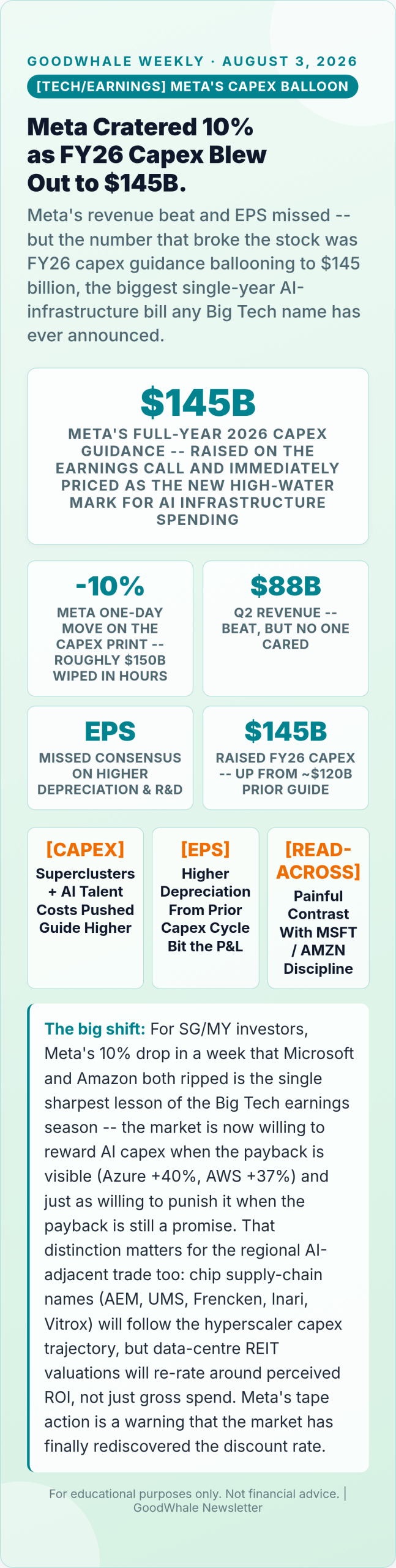
However, the night before Microsoft’s record-setting move, Meta walked into the week with a print that looked fine on the surface and turned catastrophic on the guide. Q2 revenue came in at roughly $88 billion, comfortably ahead of estimates — but adjusted EPS missed on higher depreciation and R&D. The real damage came on the call: Meta raised full-year 2026 capex guidance to $145 billion, up from the previously implied ~$120 billion, citing supercluster buildout and AI talent costs.
The market’s verdict was immediate and brutal — META fell roughly 10% in after-hours, wiping about $150 billion in market cap in hours, and the loss set a hawkish tone into the Fed decision the same day. What made it especially painful was the contrast that played out in the next 48 hours: Microsoft raised capex too and gained $450B, Amazon spent enormous capex and gained ~$275B, but Meta got punished for the exact same behaviour. The difference was the growth line. For SG/MY investors, the takeaway matters beyond Meta — the market has finally rediscovered a discount rate for AI capex. Regional data-centre REIT valuations (Keppel DC REIT, Digital Core REIT) and chip supply-chain names (AEM Holdings, UMS Holdings, Frencken, Inari Amertron, Vitrox) will move on perceived capex ROI, not just gross hyperscaler spend, from here on.
4. Apple’s Services Miss: The Big Tech Earnings Print That Broke the Bull Case
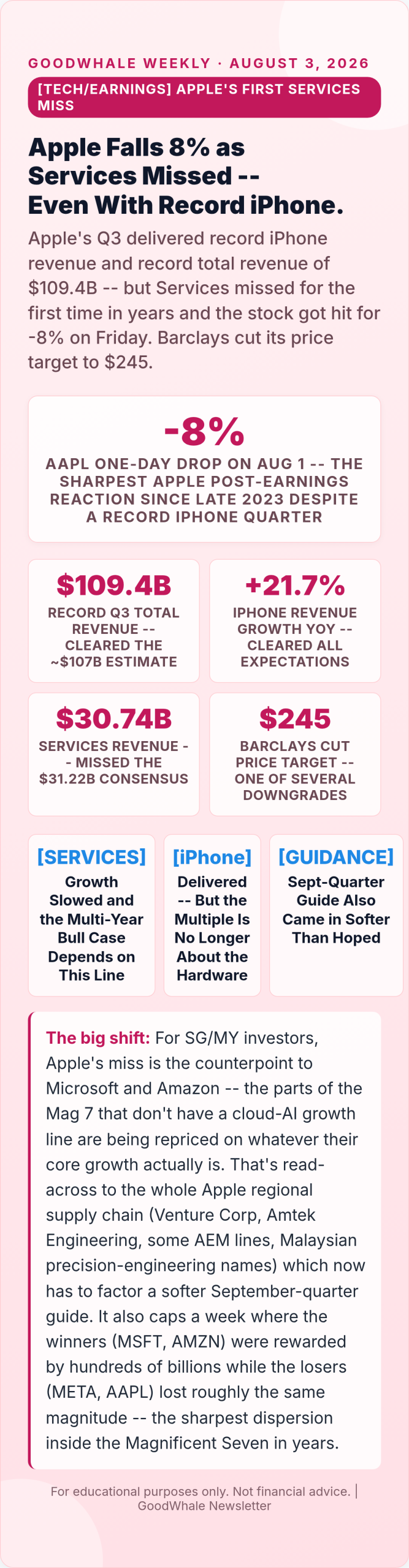
Additionally, the final chapter of the Big Tech earnings week was Apple — and it was the story that broke a piece of the multi-year bull thesis. Apple’s Q3 came in at a record $109.4 billion in revenue, comfortably ahead of the roughly $107 billion Street expectation, with iPhone revenue up 21.7% YoY — a genuinely strong hardware print. But that wasn’t the number the market cared about.
The number that mattered was Services. Services revenue of $30.74 billion missed the $31.22 billion consensus — the first Services miss in years — and given that the entire Apple multiple has been re-rated over the past decade on the promise of Services becoming the durable, high-margin growth line, a soft print there breaks the story arc. The stock fell roughly 8% on Aug 1, one of the sharpest post-earnings drops since late 2023, and Barclays cut its price target to $245 alongside several other downgrades. For SG/MY investors, the read-across is squarely on the regional Apple supply chain (Venture Corp, Amtek Engineering, precision engineering names on Bursa) — the September-quarter guide also came in softer than hoped, so component orders and mix could reset. Zooming out, Apple + Meta losing ~10% and 8% while Microsoft + Amazon gained $450B and $275B in market cap is the sharpest dispersion inside the Magnificent Seven in years — a reporting season that finally had winners and losers instead of a single-block rally.
| Signal | Microsoft | Amazon | Meta | Apple |
|---|---|---|---|---|
| Stock Reaction | +16% | +12% | -10% | -8% |
| 1-Day Market Cap Move | +$450B (record) | +$275B | -$150B | -$240B |
| Cloud/AI Growth | Azure +40% | AWS +37% | Reels ok | Services miss |
| Capex Signal | Raised, justified | Raised, justified | FY26 $145B | Steady |
| Verdict | Winner | Winner | Loser | Loser |
5. Hawkish FOMC + 5.28% 30Y: The Macro Backdrop to Big Tech Earnings Week
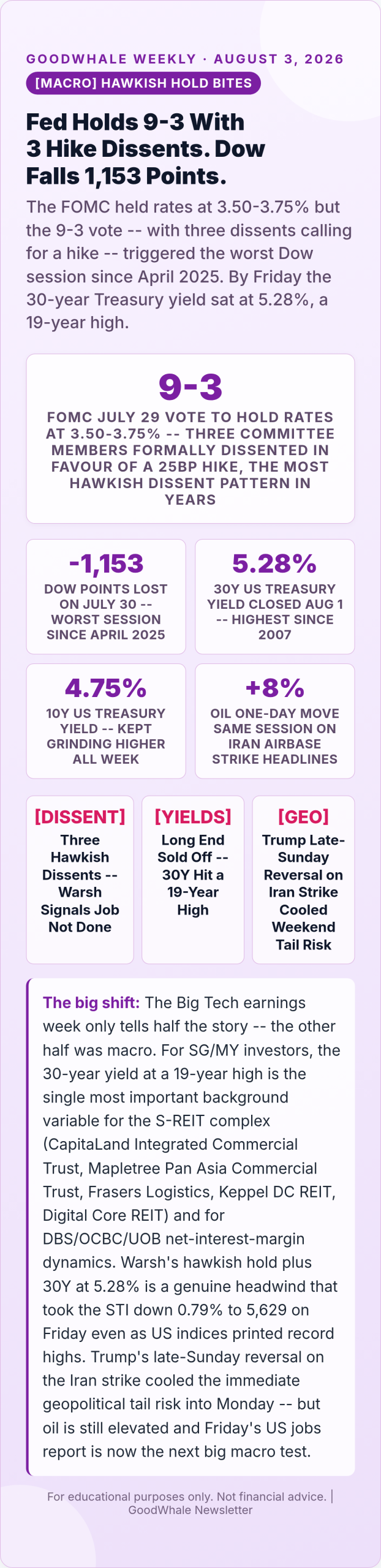
On the other hand, the Big Tech earnings tape didn’t happen in a vacuum — it happened against a genuinely hawkish macro backdrop. On Wednesday, the FOMC held rates at 3.50-3.75% on a 9-3 vote, but the three dissents — all calling for a 25bp hike — signalled that Chair Warsh’s “prices are too high” line wasn’t rhetorical. The market’s reaction was immediate: the Dow fell 1,153 points on July 30, its worst single-session drop since April 2025, and both Meta’s after-hours capex miss and the FOMC hawkish tilt compounded each other into a nasty close.
By Friday, the long end of the US Treasury curve had absorbed the message. The 30-year Treasury yield closed at 5.28%, its highest level since 2007, and the 10-year sat at 4.75% having ground higher all week. In parallel, geopolitics kept adding to the mix: oil ripped 8% intraday on July 30 after Iran struck a US airbase in Jordan, and Trump’s late-Sunday reversal on a planned retaliation strike cooled the weekend tail risk into Monday. For SG/MY investors, this is the crucial context for the S-REIT complex (CapitaLand Integrated Commercial Trust, Mapletree Pan Asia Commercial Trust, Frasers Logistics, Keppel DC REIT, Digital Core REIT) and for DBS/OCBC/UOB net-interest-margin dynamics — the higher-for-longer trade just got fresh confirmation. STI closed Friday -0.79% at 5,629 even with US indices at record highs, KLCI eked out +0.26% on the oil bid, and Friday’s US non-farm payrolls print is now the next macro test that could either extend or break the current setup.
What I’m Watching Next Week
Key data and events — August 4 to 8
- Fri 8 Aug — US non-farm payrolls for July. The single most important macro print of the month, especially with 30Y at 5.28% and the Fed’s hawkish hold still fresh.
- Tue-Wed 5-6 Aug — ISM Services + ADP employment for July. Cross-checks on the labour and services setup ahead of NFP.
- All week — Big Tech earnings aftershocks. Watch analyst target moves and buyback pace at MSFT / AMZN / META / AAPL after the dispersion this week.
- All week — Oil and Iran. Trump’s Sunday reversal cooled the tail risk but WTI still $86+ and geopolitics remains a live tape driver.
- Local names — STI-listed REITs (CICT, MPACT, Keppel DC, Frasers Logistics), DBS/OCBC/UOB NIM sensitivity, Sea/Grab cloud read-across, and SGX/Bursa tech supply-chain (AEM, UMS, Frencken, Inari, Vitrox).
Bottom Line
Five stories, one theme: the Big Tech earnings tape finally had winners AND losers. Microsoft and Amazon proved that capex-heavy AI infrastructure spending can still be rewarded — if the growth line justifies it. Azure at $100B annual run-rate growing 40%, and AWS reaccelerating to 37% at a 39.4% operating margin, are the two data points that reset how the market prices AI capex. Meta and Apple learned the opposite lesson — Meta got punished for a $145B capex guide without a comparable growth story, and Apple got repriced for a Services miss that broke a piece of its multi-year bull thesis. Underneath it all, the Fed’s 9-3 hawkish hold, the -1,153 Dow session on July 30, and the 30-year yield closing at a 19-year high of 5.28% quietly moved the discount rate higher. For SG/MY investors, the practical playbook: lean into the AI-infra beneficiaries where the payback is visible (Keppel DC REIT, Digital Core REIT, Sea Limited on AWS, chip supply-chain names that follow hyperscaler capex), stay disciplined on rate-sensitive REIT valuations while the long end is at 5.28%, and treat Friday’s US jobs print as the next macro pivot. The Big Tech earnings dispersion is a healthier tape than a single-block rally — but it also means stock selection just started to matter a lot more than sector-wide bets.
For educational purposes only. Not financial advice. Always do your own research. Catch up on last week’s issue: GoodWhale Weekly: Alphabet Tesla Earnings Shock, Oil Tops $100, FOMC on Tuesday.




Leave a Reply