
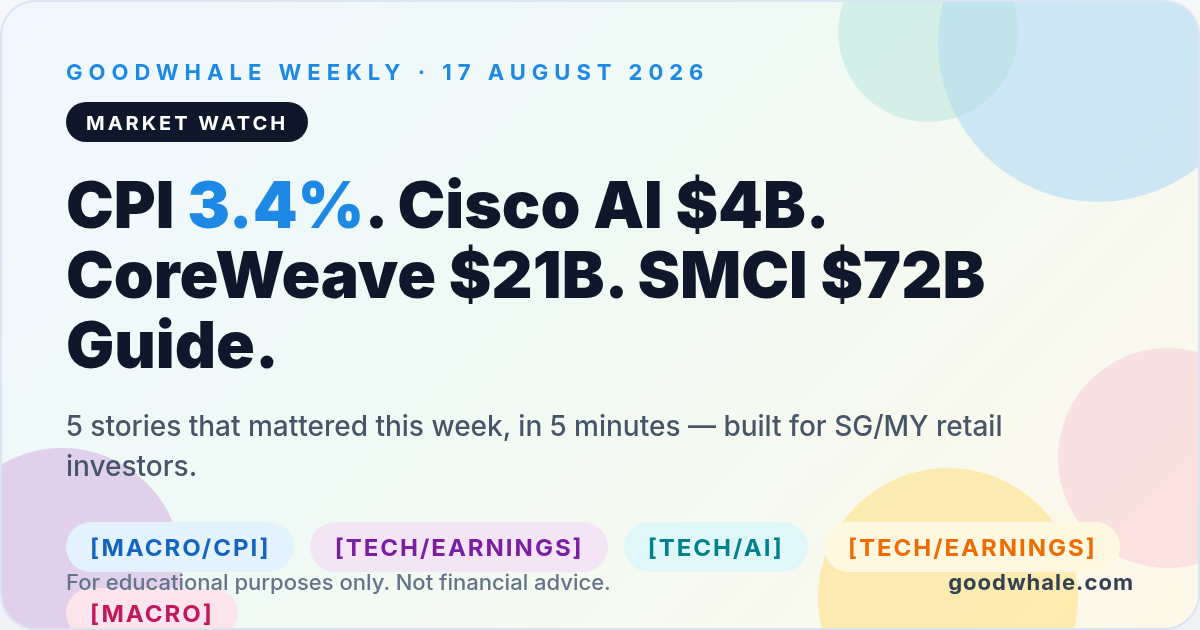
The Week in 30 Seconds
- [MACRO] July CPI cooled to 3.4%. Headline +0.1% MoM, core +0.2%, both a tenth below June. September rate-cut odds revived. Friendliest US macro print of the summer.
- [TECH] Cisco booked $4B AI hyperscaler orders in Q4. Revenue $17.25B (+18% YoY), full-year AI orders $9.3B vs ~$1B prior year. Q1 guide $18-18.2B vs $16.8B consensus.
- [TECH] CoreWeave signed $21B Meta deal on top of $14B existing. Q2 revenue +112% to $2.58B, backlog reached $104B (+246% YoY). Stock jumped 13.5%.
- [TECH] SMCI printed $11.1B Q4, guided FY27 to $65-72B. Full-year FY26 $39.1B (+78%). Gross margin doubled to 17.5% from 9.5%.
- [MACRO] S&P 500 closed 7,785, third weekly gain. Russell 2000 hit record 3,068. VIX at 14.85. Trump-Putin summit ended without a deal but markets stayed calm.
1. CPI cools rate cut: July CPI at 3.4%: The Print That Reset the Rate-Cut Clock

Meanwhile, the single biggest macro release of the week was the July US inflation print on Tuesday. Headline CPI cools rate cut hopes back to life: prices rose just 0.1% month-on-month and 3.4% year-on-year, both a tenth below June and in line with the Dow Jones consensus. Core CPI, stripping out food and energy, was similarly well-behaved at +0.2% monthly and 2.5% annual. Nothing scary in the mix — shelter finally cooled to +0.1%, energy stayed soft after the Iran de-escalation bled out the oil premium, and the sticky components (airline fares +2.2%, medical +0.4%) were the outliers rather than the story.
The market reaction was immediate and mechanical. Rate-cut odds for the September FOMC jumped, the 10-year yield eased, and the S&P 500 pushed to a fresh all-time high above 7,800 by mid-week before Friday’s Michigan sentiment print pulled it back a touch. For SG/MY investors, this is the print that matters most. A cooling US CPI eases the imported-inflation channel that has been quietly pressuring both MAS and Bank Negara Malaysia; it lets them hold policy steady without SGD or MYR blowing wider on rate-differential trades. The direct read-across is squarely into the region’s rate-sensitive complex — CICT, MPACT, Keppel DC REIT, Digital Core REIT, SGX-listed developers, and the Malaysian banking complex. If the CPI direction holds through the September FOMC and the Fed actually cuts, the SGX and Bursa yield-and-duration trades that have been in the penalty box for eighteen months finally get a real tailwind. This is the setup to watch.
2. Cisco’s $4B AI Quarter: The AI Capex Cycle Is Still Expanding
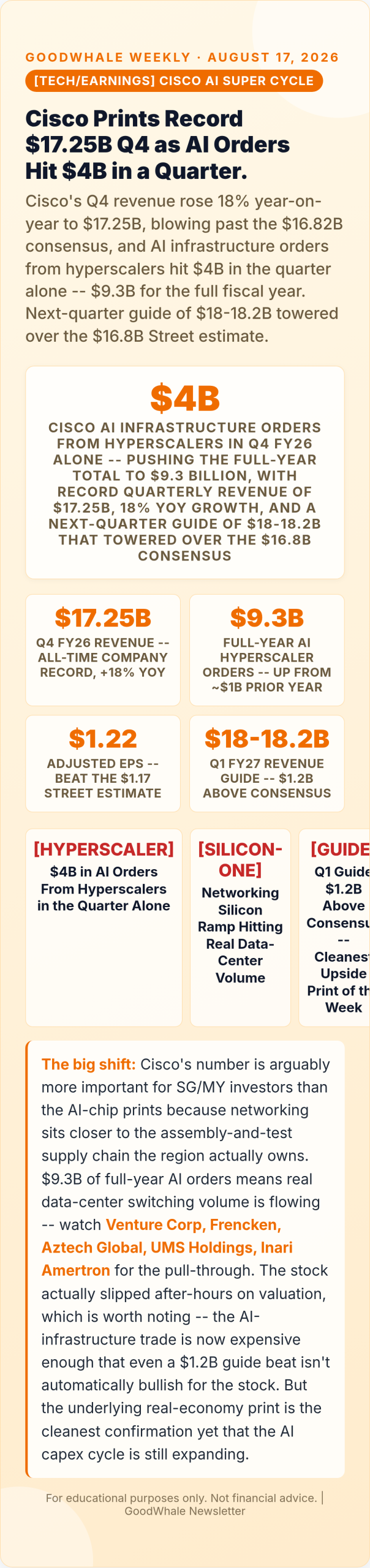
Notably, cisco delivered the quiet-but-important AI-infrastructure print of the week on Wednesday. Q4 FY26 revenue hit an all-time company record of $17.25 billion, up 18% year-on-year, comfortably clearing the $16.82B Street estimate and adjusted EPS of $1.22 beat the $1.17 consensus. GAAP net income jumped 51% to $3.9 billion. But the headline that mattered was buried in the release: $4 billion of AI infrastructure orders from hyperscalers in this quarter alone, pushing the full-year AI hyperscaler order book to $9.3 billion versus roughly $1 billion the prior year. That’s a ninefold jump in twelve months in a real, backlog-visible AI networking business.
The forward guide was the second surprise — Cisco projected Q1 FY27 revenue of $18-18.2 billion versus the $16.8B consensus, a $1.2 billion upside gap that’s the cleanest guide beat of any large-cap earnings this week. Despite the print, Cisco stock actually slipped in after-hours trading as some investors reassessed valuation after the earlier post-earnings surge — worth noting that the AI-infrastructure trade is now expensive enough that a clean beat-and-raise isn’t automatically bullish for the stock. But for SG/MY investors, the more important signal is what a $9.3B AI networking order book means for the local supply chain. Cisco’s Silicon One switches, high-radix routers, and optical modules pull disproportionately on the assembly, test and precision-engineering capacity that Venture Corp, Frencken, Aztech Global, UMS Holdings, and Inari Amertron collectively own. If the September-quarter order books at those names reflect even a fraction of the Cisco pull-through, the STI and KLCI tech complex has a real earnings-catalyst path into year-end — separate from and additive to the Nvidia-and-AMD story that has dominated the AI supply-chain narrative all year.
3. CoreWeave’s $21B Meta Deal: AI Compute Demand Is Not Slowing

However, the most spectacular growth print of the week came from AI cloud provider CoreWeave. Q2 revenue grew 112% year-on-year to $2.58 billion, beating the $2.56B consensus, and adjusted loss per share of $1.03 was tighter than the $1.20 loss the Street expected. But the numbers around the earnings were even more striking than the earnings themselves. CoreWeave signed a fresh $21 billion multi-year AI cloud capacity agreement with Meta through 2032, layered on top of an existing $14 billion Meta commitment, and added a multi-year Anthropic deal to supply compute for Claude model training. The revenue backlog at quarter-end reached $104 billion, up 246% year-on-year.
The signal is the loudest single confirmation yet that the AI-compute build-out is still accelerating rather than plateauing. A hyperscaler like Meta — which owns its own massive GPU footprint — signing an incremental $21B through 2032 says the internal capacity is not enough, and the industry is still under-built rather than over-built. For SG/MY investors, that read-across is direct: the regional data-center REIT complex and hyperscaler-adjacent engineering names are the primary local expression of the AI-compute demand trade. Keppel DC REIT, Digital Core REIT, Mapletree Industrial Trust’s US and Singapore data-center portfolio all trade on the same underlying question CoreWeave’s backlog just answered. The catch is real — CoreWeave’s net loss widened to $626 million as debt-financing costs climbed, and the stock’s 13.5% pop reflects a market pricing growth first and capital intensity second. But if the July CPI print keeps rate-cut hopes alive, the discount-rate math on 200%+ backlog growth gets more forgiving, not less.
4. SMCI Guides FY27 to $72B: The AI Server Ramp Is Still Vertical

Additionally, super Micro Computer’s Q4 FY26 print on Monday closed the week’s earnings run with the sharpest single-company demand signal of the season. Q4 revenue hit a record $11.1 billion versus $5.8 billion a year ago, nearly doubling year-on-year. But the more important line was gross margin — 17.5% versus 9.9% in Q3 FY26 and 9.5% in Q4 FY25. Margins nearly doubled in twelve months, which is the number that answers the biggest bear question on the whole AI-server complex: is this business commoditising into a hardware race-to-the-bottom, or does SMCI actually have pricing power? Q4 FY26 says the latter, at least for now.
The full-year picture cements it. FY26 revenue reached $39.1 billion, up 78% from $22 billion in FY25. And the FY27 outlook is where the signal gets loud: management guided to $65-72 billion in revenue for the coming fiscal year, implying roughly 85% growth at the midpoint. Very few large-cap technology companies are guiding to accelerating growth in FY27 — SMCI just did. For SG/MY investors, the read-across is the same real-economy story as the Cisco $9.3B AI order book: SMCI’s rack volume flows directly through the region’s chip-back-end and precision-engineering complex. UMS Holdings, AEM Holdings, Frencken, Aztech Global, Inari Amertron and Vitrox all sit in the physical supply chain that ultimately assembles the AI-compute rack. Two independent, non-Nvidia demand signals — Cisco’s networking book and SMCI’s server guide — pointing in the same direction is exactly what the STI and KLCI tech complex needed to justify a re-rate through year-end.
| Signal | July CPI | Cisco | CoreWeave | SMCI |
|---|---|---|---|---|
| Headline Number | 3.4% YoY | $17.25B rev | $2.58B rev | $11.1B rev |
| Change vs Prior | -0.1 point | +18% YoY | +112% YoY | +91% YoY |
| Key Forward Signal | Sept cut alive | $9.3B AI orders | $104B backlog | FY27 $65-72B guide |
| SG/MY Read-Across | REITs, banks | Venture, Frencken | Keppel DC, MPACT | UMS, AEM, Inari |
| Verdict | Friendly | Strong | Blowout | Blowout |
5. S&P 7,785: The Melt-Up Setup Heading Into Jackson Hole

On the other hand, the tape action wrapped the week in the strongest US setup of the summer. The S&P 500 closed at 7,785.76 for a 0.4% weekly gain — the third consecutive weekly advance — after touching fresh all-time highs mid-week on the July CPI print. The Nasdaq Composite settled at 26,729, also positive on the week. Most notably, the Russell 2000 surged 3.15% to a record 3,068.42 as small-caps finally joined the mega-cap rally — an important breadth signal after months of narrow AI-driven leadership. The VIX faded to a multi-month low near 14.85, and the CBOE volatility complex generally reflected a textbook low-volatility melt-up regime.
The bull case is straightforward and internally consistent this week. Q2 S&P 500 earnings growth is tracking at roughly +31% year-on-year according to Bloomberg Intelligence — the best print outside of recession-recovery rebounds going back to 1992. AI-infrastructure demand kept expanding across Cisco, CoreWeave and SMCI. The July CPI print eased discount-rate concerns. And the Trump-Putin Alaska summit — which had been the tail-risk event of the week — ended without a formal deal but also without an escalation, letting oil dip modestly and gold hold steady. For SG/MY investors, this is about as clean a risk-on backdrop as it gets. The STI closed near 5,774 for a 1.58% weekly gain, and the KLCI at 1,735.75 was roughly flat but held its recent range. Both indices have visible room to catch up to US highs if the CPI-plus-earnings narrative holds. The next two catalysts to watch are Deere earnings on August 20 for real-economy demand read-through into the agricultural and industrial complex, and the Jackson Hole symposium in late August, where the Fed’s language on the September cut path will get its final test before the actual FOMC decision. A hawkish Powell at Jackson Hole is the most obvious way this setup breaks — until then, the direction of travel is friendly.
What I’m Watching Next Week
Key data and events — August 18 to 22
- Wed 20 Aug — Deere Q3 earnings. Real-economy read-through into agricultural, industrial and construction demand. Big for the SG/MY commodities-exposure trade.
- Wed 20 Aug — FOMC July meeting minutes. Dissents on the 9-3 hold get more colour — confirms or complicates the September cut path.
- Thu 21 – Sat 23 Aug — Jackson Hole Economic Symposium. Fed Chair Powell’s opening remarks are the marquee — this is where the September cut narrative either gets validated or reset.
- All week — Trump-Putin follow-through headlines and Iran-US talks. Any progress on either front moves oil back through $85 in either direction.
- Local names — STI banks (DBS/OCBC/UOB) on rate-cut discount, REIT complex (CICT/MPACT/Keppel DC/Digital Core), chip supply-chain (AEM/UMS/Frencken/Inari/Vitrox), Malaysian banks and glove complex.
Bottom Line
Five stories, one clean theme: this was the week the CPI print reset the rate-cut clock and the AI-infrastructure earnings cycle confirmed that demand is still expanding faster than the bear case allows. July CPI at 3.4% headline and 2.5% core is not victory over inflation — but the direction is friendly, and September cut odds jumped after the release. Cisco’s $4 billion of hyperscaler AI orders in a single quarter — with a full-year book of $9.3 billion versus roughly $1 billion the prior year — is a ninefold expansion of AI-networking demand in twelve months. CoreWeave’s fresh $21 billion Meta contract on top of the existing $14 billion, alongside 112% revenue growth and a $104 billion backlog, is the loudest evidence yet that hyperscalers with their own massive GPU footprints still need to rent more capacity through 2032. And SMCI’s $65-72 billion FY27 guide implying another 85% growth on top of a $39.1 billion FY26 is one of the few large-cap technology outlooks pointing to accelerating rather than decelerating growth. For SG/MY investors, the practical playbook: lean into the rate-sensitive names on any CPI-driven yield relief — CICT, MPACT, Keppel DC, Digital Core, SGX developers and Malaysian banks — and stay long the AI supply-chain read-across into Venture, Frencken, UMS, AEM, Inari and Vitrox where two independent non-Nvidia demand signals (Cisco networking + SMCI servers) now point the same direction. The setup heading into Jackson Hole is friendly. A hawkish Powell is the most obvious way it breaks — but until then, the direction of travel is up.
For educational purposes only. Not financial advice. Always do your own research. Catch up on last week’s issue: GoodWhale Weekly: Alphabet Tesla Earnings Shock, Oil Tops $100, FOMC on Tuesday.
Source: CPI inflation report: prices rose 0.1% in July, annual rate 3.4%




Leave a Reply