

The Week in 30 Seconds
- [TECH/AI] Chip stocks bear market. Philly Semi Index down 20% from its June peak after China’s Moonshot AI unveiled Kimi K3, a 2.8T-parameter open-weight model — $1.3T in value erased.
- [OIL/GEO] Oil tops $80. Iran widened attacks across five Gulf states after fresh US strikes; the Strait of Hormuz ceasefire has fully unravelled.
- [BANKS] JPMorgan, Goldman smash Q2. JPMorgan hit record $57.3B revenue; Goldman EPS surged 92% YoY. Bank of America, Citi and Wells Fargo also beat.
- [TECH/EARNINGS] TSMC, ASML raise guidance. TSMC lifted full-year growth guidance past 40% and raised capex to $60-64B; ASML raised 2026 sales outlook to EUR43-45B — despite the chip-stock panic.
- [MACRO] CPI cools, Warsh stays hawkish. June inflation fell to 3.5% (vs 3.8% expected), but the Fed Chair’s testimony offered little on the rate-cut path.
1. Chip stocks bear market: Chip Stocks Bear Market: Kimi K3 Shock Wipes Out $1.3 Trillion
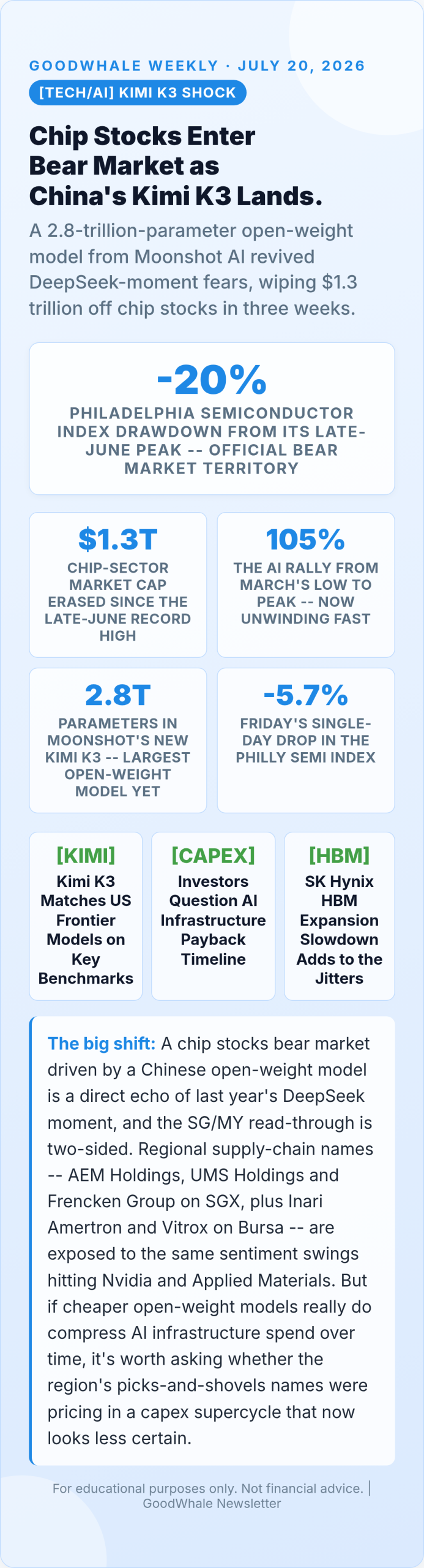
Meanwhile, the week’s biggest story was a chip stocks bear market that arrived almost overnight. On Friday, Moonshot AI — the Alibaba-backed Chinese startup now valued at roughly $31.5 billion — unveiled Kimi K3, a 2.8-trillion-parameter open-weight model that reportedly matched or beat several leading US models on benchmark tests, trailing only the very top tier of frontier AI. The announcement immediately revived comparisons to last year’s “DeepSeek moment,” when a similarly cheap, similarly capable Chinese model first forced Wall Street to question whether hundreds of billions in US AI infrastructure spending would ever pay off as expected.
The market reaction was swift and severe. The Philadelphia Semiconductor Index fell as much as 5.7% on Friday alone, bringing its drawdown from the late-June record high to 20% — the technical threshold for a bear market — and erasing roughly $1.3 trillion in value from a 30-stock chip benchmark that had soared 105% between its March low and last month’s peak. Nvidia, Applied Materials, Intel and SanDisk all fell on the news, while Taiwan’s market dropped 6% and Japan’s slid 4%. Adding fuel to the fire, reports that SK Hynix is slowing its high-bandwidth memory expansion and a newly hawkish Fed under Chair Kevin Warsh compounded the selling. For SG/MY investors holding regional semiconductor-supply-chain names, this is a reminder that the AI trade can reprice violently on a single weekend product launch — worth watching whether Kimi K3’s real-world enterprise adoption actually materialises before reading too much into one volatile week.
| Signal | Chip Stocks (Sentiment) | TSMC / ASML (Hard Data) |
|---|---|---|
| Direction This Week | Bear Market (-20%) | Guidance Raised |
| Full-Year Outlook | Investors Skeptical | 40%+ Revenue Growth |
| Capex Signal | Payback Questioned | Capex Raised to $60-64B |
| Driver | Kimi K3 Shock | “Extremely Strong” Orders |
2. Oil Surges Past $80 as Iran Widens Attacks Across the Gulf
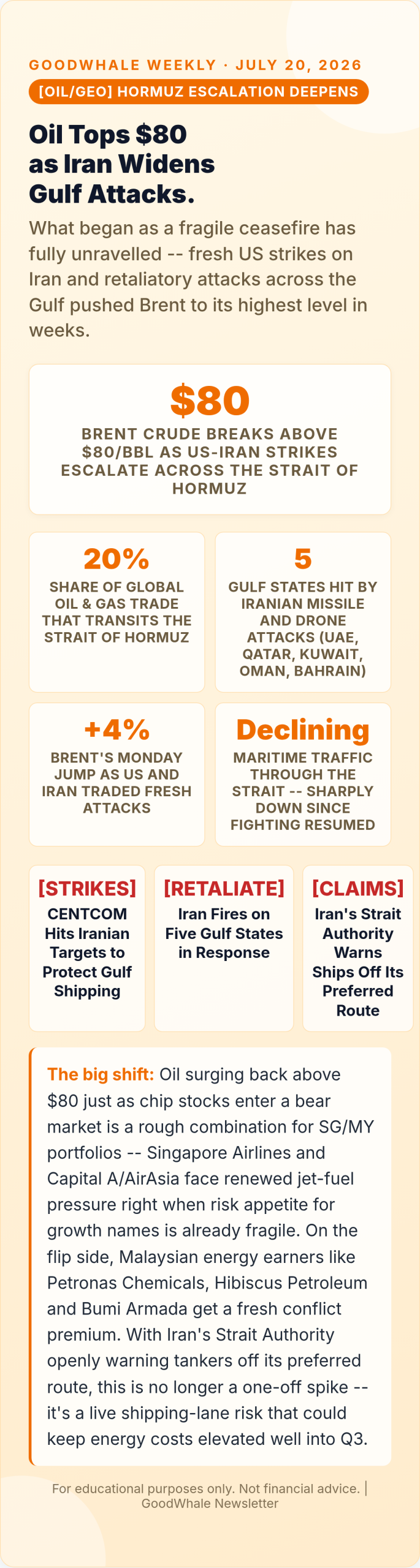
Notably, the Strait of Hormuz crisis that first flared up two weeks ago has escalated sharply. US Central Command carried out dozens of fresh strikes on Iranian targets to degrade Tehran’s ability to threaten shipping through the strait — hours after a separate round hit hundreds of targets across the country, following accusations that Iranian forces attacked a Cyprus-flagged container ship transiting the waterway. Iran responded with a wave of missile and drone attacks against five Gulf states — the UAE, Qatar, Kuwait, Oman and Bahrain — in a sharp widening of the conflict beyond a bilateral US-Iran exchange.
Brent crude broke above $80 a barrel, jumping more than 4% as the two sides traded attacks, its highest level since the crisis first began reversing the earlier ceasefire. Roughly 20% of global oil and gas trade moves through the Strait of Hormuz, and maritime traffic has declined sharply as tankers avoid the area — not helped by Iran’s Persian Gulf Strait Authority reiterating that vessels crossing without using its preferred route “would not be covered by safe passage guarantees.” For SG/MY investors, the combination of a chip stocks bear market and a widening Gulf conflict makes this a genuinely two-front risk week: airlines and fuel-intensive sectors face cost pressure from oil, while regional tech names face sentiment pressure from the AI selloff. Energy names in Malaysia are the clearest relative winner if the standoff persists.
3. JPMorgan and Goldman Sachs Smash Q2 Estimates on a Trading and Dealmaking Boom
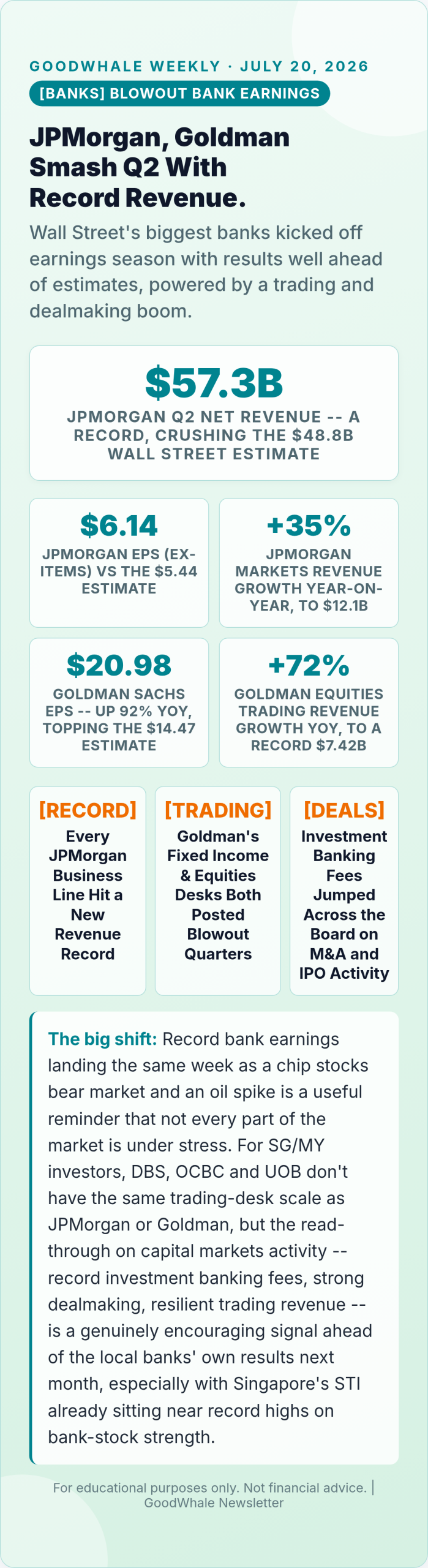
However, while chip stocks and oil dominated the macro headlines, Wall Street’s biggest banks quietly delivered one of the strongest earnings weeks in years. JPMorgan Chase reported Q2 net revenue of $57.3 billion, smashing the $48.8 billion Wall Street estimate, with adjusted EPS of $6.14 against a $5.44 forecast. Every single business line hit a new revenue record: Markets revenue surged 35% year-on-year to $12.1 billion, and investment banking fees climbed 30% to $3.3 billion, the highest level since 2021.
Goldman Sachs was even more dramatic: EPS of $20.98, up 92% year-on-year and well past the $14.47 estimate, on total net revenues of $20.34 billion versus $14.58 billion a year earlier. Goldman’s equities trading desk posted a record $7.42 billion, up 72%, while fixed income, currencies and commodities revenue climbed 32% to $4.59 billion and investment banking fees jumped 55% to $3.40 billion, fuelled in part by underwriting fees from mega-deals like the SpaceX IPO. Bank of America, Citigroup and Wells Fargo also cleared estimates. For SG/MY investors, this is a strong signal that despite the volatility hitting tech and energy this week, capital markets activity — IPOs, M&A, trading volume — remains genuinely robust, a healthy backdrop heading into DBS, OCBC and UOB’s own results next month.
4. TSMC and ASML Raise Guidance Even as Chip Stocks Slide Into a Bear Market
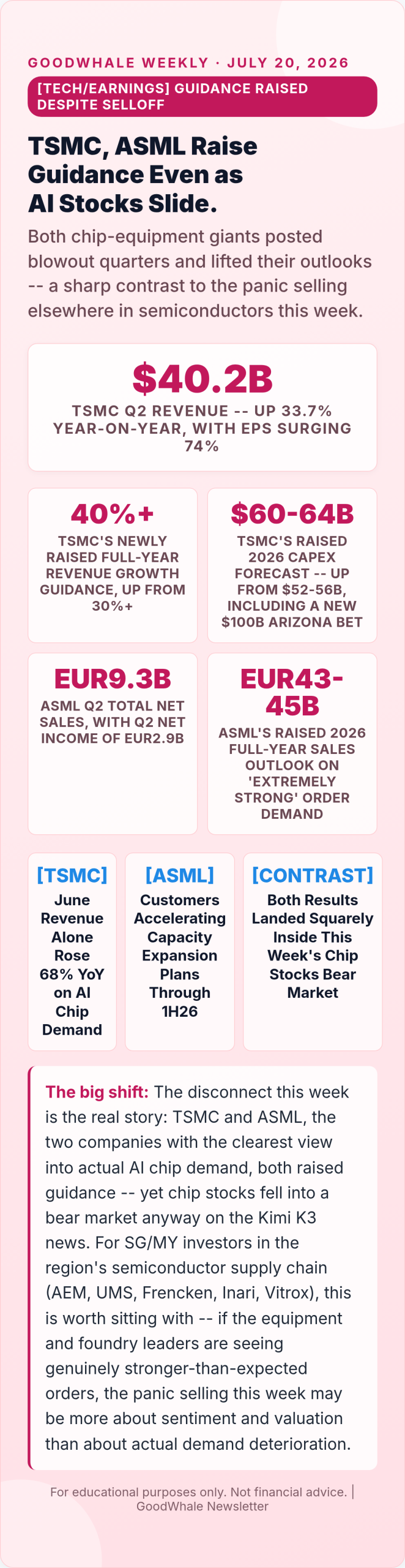
Additionally, in a week defined by a chip stocks bear market, the two companies best positioned to know actual AI chip demand told a very different story. TSMC posted Q2 revenue of $40.2 billion, up 33.7% year-on-year, with earnings per ADR surging roughly 74% to $4.31. The company raised its full-year revenue growth guidance to slightly more than 40%, up from its prior 30%-plus outlook, and lifted its 2026 capex forecast to $60-64 billion — up from $52-56 billion — including an additional $100 billion investment in its Arizona fabs. June revenue alone jumped 68% year-on-year.
ASML told a similar story: EUR9.3 billion in Q2 total net sales and EUR2.9 billion in net income, with management describing order momentum as “extremely strong” as customers accelerate capacity expansion plans. The lithography giant raised its 2026 full-year sales outlook to EUR43-45 billion. Both results landed in the same week that Moonshot’s Kimi K3 model triggered a broad semiconductor selloff — meaning the two companies with arguably the best real-time visibility into AI infrastructure spending are seeing accelerating demand, even as the stock market questions whether that spending will ever pay off. For SG/MY investors in the region’s chip-equipment and testing supply chain, that gap between hard order data and market sentiment is the thing to watch most closely over the coming weeks.
5. June CPI Cools to 3.5%, But Fed Chair Warsh’s Testimony Stays Hawkish

On the other hand, just as markets absorbed a chip stocks bear market and a fresh oil spike, the week’s macro data delivered a genuine surprise: June headline CPI fell to 3.5%, down from 4.2% in May and well below the 3.8% consensus forecast, with prices actually falling 0.4% on the month — the sharpest monthly drop since April 2020. Core inflation, excluding food and energy, came in at 2.6% against a 2.9% forecast. The improvement was driven largely by energy: the energy index slumped 5.7% for the month, even though it remains up 15.7% year-on-year on the back of a 26.7% annual gain in gasoline prices.
Ordinarily, an inflation print that undershoots forecasts by this much would send rate-cut odds sharply higher. Instead, Fed Chair Kevin Warsh’s Congressional testimony this week gave markets little to celebrate — he reaffirmed the Fed’s commitment to bringing inflation back to 2% but offered few concrete clues on the rate path, a deliberate low-guidance style that Fed watchers continue to read as leaning hawkish rather than dovish. The next actual rate decision doesn’t land until the July 28-29 FOMC meeting. For SG/MY investors, the disinflation trend in June’s data is genuinely encouraging, but it arrived the same week oil jumped back above $80 on the Iran conflict — meaning July’s inflation numbers could look very different, and MAS’s own policy stance on the S$NEER will likely stay cautious until the rate picture clarifies.
What I’m Watching Next Week
Key data and events — July 21 to July 24
- Tue 21 Jul — General Motors reports before the bell; watch for read-through on consumer demand and tariff cost pressure.
- Wed 22 Jul — Alphabet and Tesla report after the bell — Tesla’s numbers will give an early signal on where the AI/semis trade goes next after this week’s chip stocks bear market.
- Thu 23 Jul — Intel reports, alongside ServiceNow and T-Mobile; nearly 80 S&P 500 companies report this week in total.
- All week — Watch whether oil holds above $80 as the Gulf conflict develops, and whether regional chip-supply-chain names (AEM, UMS, Frencken, Inari, Vitrox) stabilise or keep falling with US peers.
- Ongoing — July’s inflation data will be the real test of whether June’s cooling trend survives a fresh oil spike.
Bottom Line
Five stories, and a genuine split-screen week. The chip stocks bear market triggered by China’s Kimi K3 model is a sentiment shock, not obviously a demand shock — TSMC and ASML, the two companies with the clearest real-time view into AI chip orders, both raised guidance in the same week. Oil breaking above $80 as Iran widens its attacks across the Gulf is the more concrete risk, with real cost implications for Singapore Airlines, Capital A/AirAsia and a real tailwind for Malaysian energy earners. Record results from JPMorgan and Goldman Sachs are a reminder that capital markets activity remains genuinely healthy beneath the volatility, a good sign heading into DBS, OCBC and UOB’s own results next month. And June’s cooler CPI print is encouraging, but Fed Chair Warsh’s hawkish, low-guidance style means SG/MY investors shouldn’t get ahead of themselves on rate-cut hopes — especially with oil now working against the disinflation trend. Practical playbook: don’t overreact to one volatile week in chip stocks without checking the hard order data, keep an eye on how long the Gulf conflict runs, and treat the July 28-29 FOMC meeting as the next real catalyst.
For educational purposes only. Not financial advice. Always do your own research. Catch up on last week’s issue: GoodWhale Weekly: Oil Surges Iran Strikes, SK Hynix’s Record IPO, a Divided Fed.
Source: chip stocks tumbling into a bear market as the 105% AI rally fizzles







[…] Previous […]