
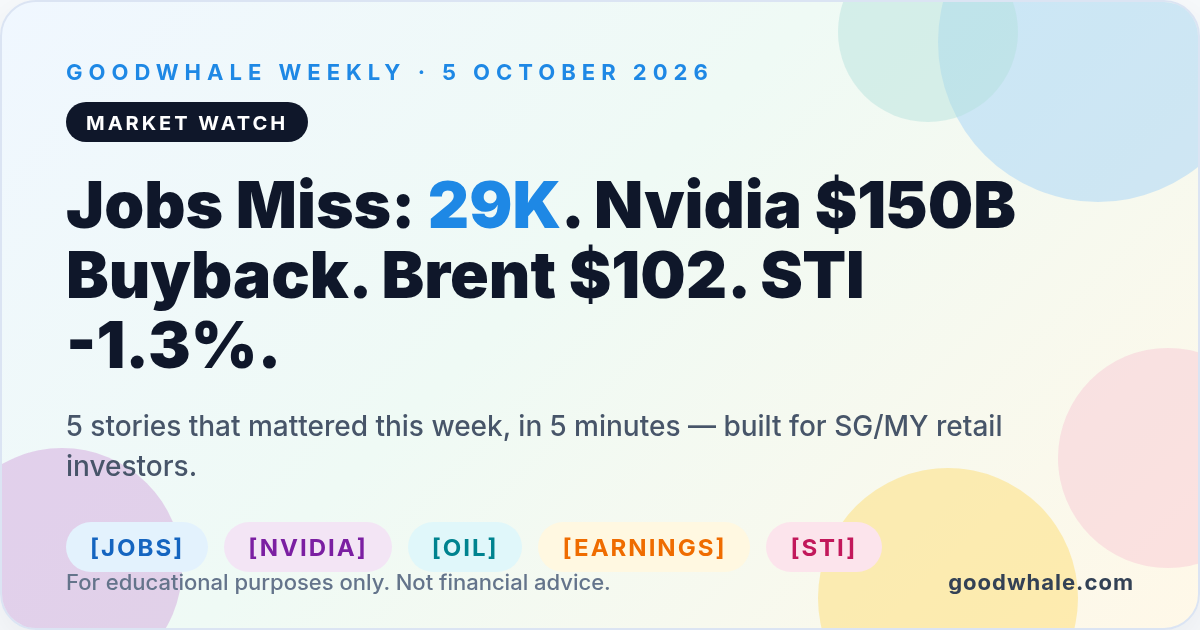
The Week in 30 Seconds
- [MACRO] September jobs report misses: +29,000. Unemployment rose to 4.2%, October Fed hike odds fell from ~64% to ~16%, and the S&P 500 closed at 7,722.72. The 10-year Treasury yield is still ~5.28%.
- [CHIPS/AI] Nvidia adds a record $150B buyback. Remaining authorisation ~$235B, dividend lifted to $0.25, record high on Friday at ~$5.72T. Micron’s quarter: $54.23B revenue, +379%.
- [OIL] Brent holds $102.25 as the G7 releases 100M barrels. WTI fell 1.9% to $91.11; the squeeze has moved to diesel and refined fuels.
- [STOCKS] Tesla and Carnival beat, Nike misses. Tesla delivered 486,532 vehicles; Carnival posted record revenue of ~$8.44B; Nike missed on revenue and announced job cuts.
- [SG/MY] STI slides 1.3% to 5,634.82. Property and retail names plunged (CDL -8.1%, DFI Retail -8.8%); OCBC was the only local bank to end higher.
1. September jobs report: September Jobs Report Misses Badly, and Fed Hike Odds Collapse
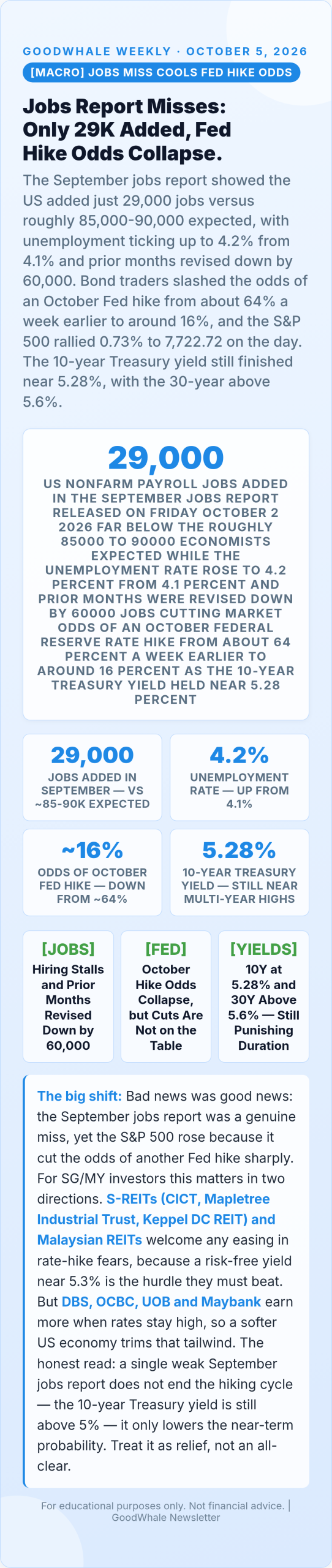
Meanwhile, the September jobs report landed on Friday with a thud: the US economy added just 29,000 jobs, far below the roughly 85,000 to 90,000 economists had forecast. The unemployment rate rose to 4.2% from 4.1%, and prior months were revised down by a combined 60,000 jobs. Markets, which had spent weeks bracing for another Fed hike, reacted with relief rather than fear. Bond traders cut the odds of an October rate hike from about 64% a week earlier to roughly 16%, and the S&P 500 gained 0.73% to close at 7,722.72, with the Nasdaq up 1.19% and the Dow up 0.49%. Even so, the 10-year Treasury yield finished near 5.28% and the 30-year held above 5.6% — still among the highest levels in a generation. Over the full week, the picture was more mixed: the Nasdaq edged up, while the S&P 500 and Dow finished slightly lower.
For Singapore and Malaysia investors, the September jobs report cuts both ways. Fading hike odds are a relief for rate-sensitive income plays such as CICT, Mapletree Industrial Trust, Keppel DC REIT and Malaysian REITs and utilities, whose valuations are weighed down by a risk-free rate above 5%. But DBS, OCBC, UOB and Maybank benefit from higher-for-longer rates, so a weaker US economy trims some of that net-interest-margin upside. The practical takeaway is to avoid over-reading one data point: a soft print lowers the probability of an October hike, it does not signal rate cuts, and the 10-year Treasury yield remains a hurdle for long-duration assets. Keep an eye on the next inflation data and on Fed speakers for confirmation before changing your portfolio mix.
2. Nvidia’s Record $150 Billion Buyback and Micron’s $54 Billion Quarter

Notably, nvidia kicked off the week with a record: its board added $150 billion to its share repurchase authorisation on September 28, the largest increase in corporate history and well above Apple’s previous $110 billion record from 2024. The move lifts Nvidia’s remaining buyback capacity to about $235 billion through fiscal 2028, and the company also raised its quarterly dividend from $0.01 to $0.25 per share. The shares rose about 2.8% on the day and finished the week roughly 4% higher, touching an all-time intraday high on Friday for a market value of about $5.72 trillion. Later in the week, Micron reported record fiscal fourth-quarter revenue of $54.23 billion, up 379% year-on-year and well above the $51.07 billion analysts expected, with adjusted EPS of $31.61. Full-year fiscal 2026 revenue reached $133.2 billion, driven by demand for AI-linked high-bandwidth memory.
For Singapore and Malaysia investors, this is another confirmation of the AI supply-chain story that runs through Venture Corporation, AEM, UMS Holdings and Frencken in Singapore and Inari Amertron, ViTrox and MPI in Malaysia. When the world’s most valuable chipmaker is generating enough cash to fund a record buyback, and a memory maker is printing a 379% revenue jump, orders for test, packaging and assembly equipment tend to follow. Still, a buyback is a signal of cash generation, not a guarantee of future growth, and at a market cap above $5.7 trillion much of the good news is already priced in. With the 10-year Treasury yield hovering near 5.3%, long-duration tech remains sensitive to any hawkish surprise, including from the next September jobs report revisions. Track order books and guidance at the regional names rather than chasing the headline.
3. Brent Holds Above $102 as the G7 Taps Emergency Oil Reserves
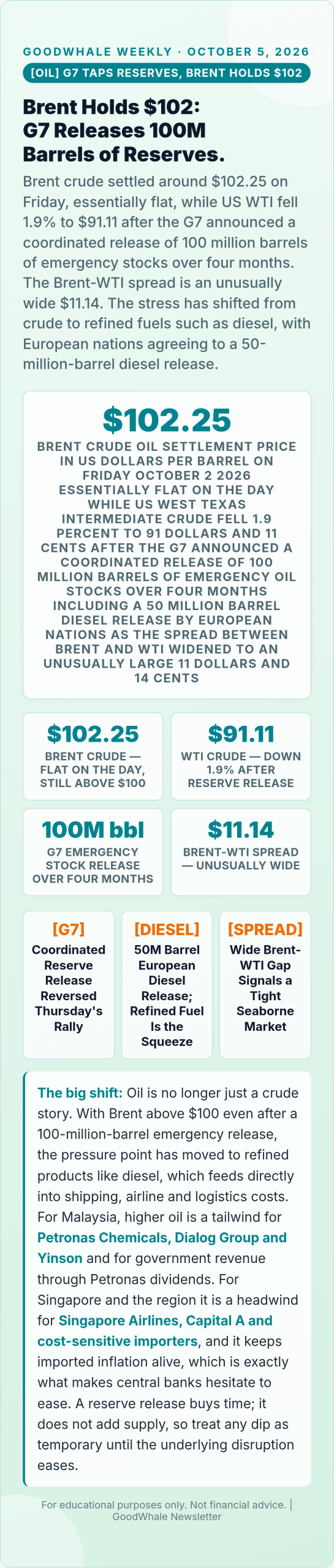
However, oil ended the week under pressure from policymakers rather than from the market itself. The G7 announced a coordinated release of 100 million barrels of emergency stocks over four months, including a 50 million barrel diesel release by European nations. The announcement knocked US crude lower: WTI fell 1.9% to $91.11 on Friday, reversing a rally from the previous session, while Brent settled around $102.25, essentially flat. That left the Brent-WTI spread at an unusually wide $11.14, a sign that physical tightness is concentrated in seaborne barrels and refined fuels rather than US crude. Reported supply disruptions, including China’s suspension of petroleum-product exports and strikes on Russian refineries, have added to the squeeze on diesel specifically.
For Singapore and Malaysia investors, the lesson from the September jobs report week is that energy sits on both sides of the portfolio. Petronas Chemicals, Dialog Group and Yinson Holdings benefit from Brent above $100, and Petronas dividends flow into Malaysian government revenue. On the other side, Singapore Airlines and Capital A face heavier fuel bills, and transport and logistics firms are exposed to diesel costs. Singapore, as a bunkering and refining hub, also sits close to the refined-product story, so watch margins rather than just crude. A coordinated reserve release is a short-term bandage; if prices stay near $100 into year-end, expect imported inflation to stay sticky and rate cuts to stay off the table.
4. Tesla and Carnival Beat, Nike Misses and Cuts Jobs
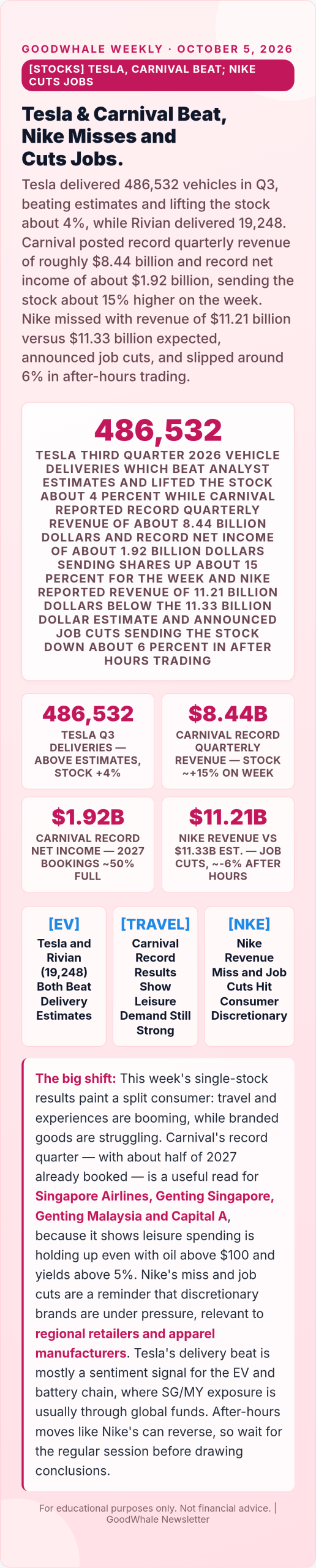
Additionally, earnings and delivery numbers gave a mixed read on consumers this week. Tesla reported Q3 deliveries of 486,532 vehicles, above estimates, and the stock rose about 4%; Rivian also beat with 19,248 deliveries versus roughly 18,000 expected. Carnival posted record quarterly revenue of about $8.44 billion and record net income of roughly $1.92 billion, with 2027 bookings about half complete and customer deposits near $7.6 billion; the stock gained about 15% over the week. On the other side, Nike reported revenue of $11.21 billion versus $11.33 billion expected, announced job cuts, and fell around 6% in after-hours trading. The split is telling: spending on trips and experiences remains strong while demand for branded goods is softer.
For Singapore and Malaysia investors, Carnival’s record is a helpful cross-check for the region’s travel and leisure names such as Singapore Airlines, Genting Singapore, Genting Malaysia and Capital A, even though fuel costs remain a headwind. Nike’s miss carries a different message for regional retailers and apparel manufacturers: consumers are being choosy, and higher borrowing costs are biting on big-ticket and discretionary items. Remember that the September jobs report showed hiring has stalled, which can weigh on discretionary spending later if it persists. Tesla’s beat matters mostly as a sentiment signal for the EV and battery supply chain. As always, after-hours reactions can reverse, so wait for confirmation in the regular session.
5. STI Slides 1.3% for the Week as Banks, Property and Retail Weigh

On the other hand, the Straits Times Index had a soft week, falling 76.30 points, or 1.3%, to close at 5,634.82 on Friday after losing ground in four of five sessions. Elevated crude above US$100 a barrel, rising US Treasury yields and persistent inflation concerns kept monetary-policy expectations tight. Property and consumer names took the heaviest hits: City Developments tumbled 8.1% on September 28, Hongkong Land fell 6% on September 29, and DFI Retail plunged 8.8% on October 2. Among the banks, UOB and DBS ended the week with declines, while OCBC was the only local bank to finish higher. Market breadth was negative, with 335 decliners outnumbering 223 gainers.
For Singapore and Malaysia investors, the key question is whether the September jobs report marks a turning point for yields. If hike odds keep fading, S-REITs and developers such as CDL could see some relief, since they are among the most sensitive to the 10-year Treasury yield. But a persistent oil price near $100 and stalled US hiring are a tricky mix for consumer names like DFI Retail, which also face their own company-specific pressures. For the banks, leadership has become more selective, with OCBC holding up better than DBS and UOB this week. A reasonable approach is to stay diversified across banks, AI-linked industrials and defensive income, and avoid concentrating on any one rate-sensitive theme until the data confirms a direction.
What I’m Watching Next Week
Key themes — October 5 to October 9
- Fed speak and minutes — After the September jobs report, listen for whether officials confirm that an October hike is off the table or keep the option open; the 10-year Treasury yield near 5.3% is the number to track.
- Oil and diesel — Watch whether the G7 reserve release holds Brent near $100, and whether refined-fuel prices ease. Malaysian energy names and Singapore’s airlines trade on this.
- AI chain follow-through — Nvidia at a record and Micron’s blowout quarter set a high bar for regional chip names; watch Venture, AEM, UMS, Inari and ViTrox.
- Start of the next earnings cycle — Big US banks typically open the season in the following week; consumer names will show whether Nike’s miss was company-specific.
- Local names — CDL, Hongkong Land and DFI Retail after last week’s sharp falls; DBS, OCBC and UOB for bank leadership; CICT and Mapletree Industrial Trust for yield sensitivity.
Bottom Line
This was a week where weak data helped markets and strong corporate cash flow did the heavy lifting. The September jobs report showed the US adding just 29,000 jobs against roughly 85,000 to 90,000 expected, with unemployment up to 4.2% and prior months revised down, and bond traders cut the odds of an October Fed hike from about 64% to roughly 16%. Wall Street rallied on Friday, with the S&P 500 closing at 7,722.72, though the 10-year Treasury yield remained near 5.28% and the 30-year above 5.6%. Beneath the macro noise, AI demand kept showing up in cash: Nvidia added a record $150 billion to its buyback, lifted its dividend to $0.25 and touched a record market value near $5.72 trillion, while Micron reported $54.23 billion of quarterly revenue, up 379%. Oil stayed elevated, with Brent at $102.25 and WTI at $91.11 after the G7 announced a 100-million-barrel emergency release, with the squeeze now showing up in diesel. The consumer picture was split: Carnival posted record results and Tesla beat on deliveries, while Nike missed and announced job cuts. In Singapore, the STI fell 1.3% to 5,634.82, with CDL, Hongkong Land and DFI Retail among the hardest hit and OCBC the only local bank to finish the week higher. For Singapore and Malaysia investors, the playbook is selective rather than directional: keep exposure to the AI supply chain (Venture, AEM, UMS, Frencken, Inari, ViTrox) but size it with Nvidia’s valuation in mind; stay diversified across the local banks rather than assuming they move together; treat S-REITs and property as a rate-relief trade that still needs the 10-year Treasury yield to fall; and watch Petronas Chemicals, Dialog and Yinson against Singapore Airlines and Capital A for how the oil regime evolves. One weak September jobs report is relief, not a regime change.
For educational purposes only. Not financial advice. Always do your own research. Catch up on last week’s issue: GoodWhale Weekly: Oil Jumps, AMD Hits $1 Trillion, Treasury Yield Near 19-Year High.







Leave A Comment