
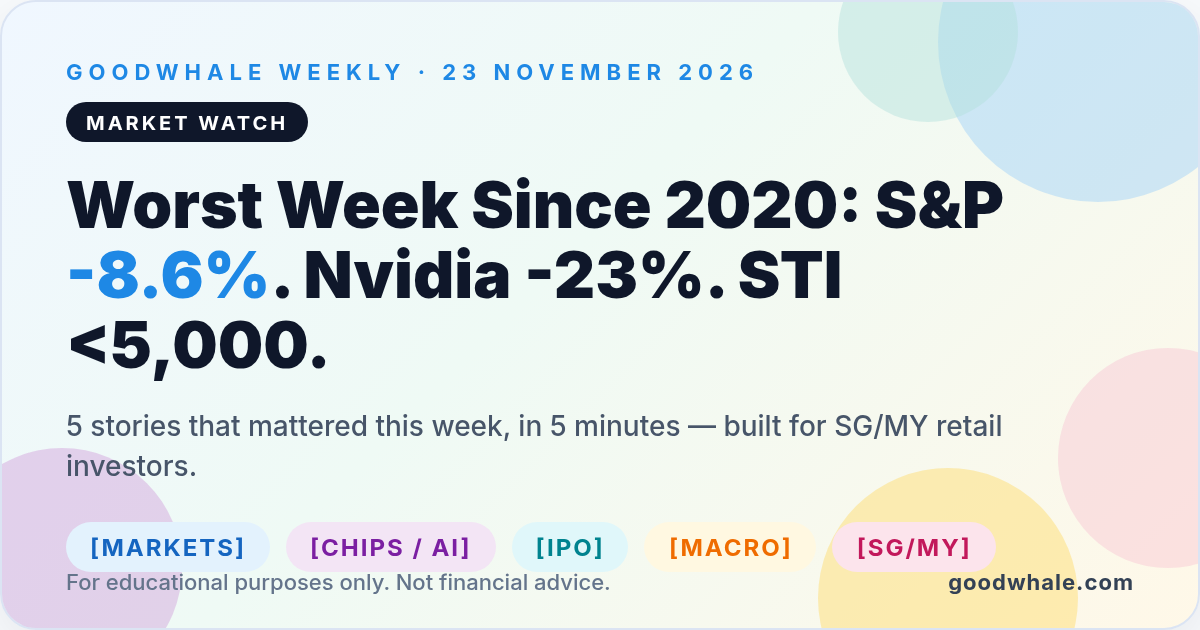
The Week in 30 Seconds
- [MARKETS] Worst week since 2020. S&P 500 -8.61%, Nasdaq -10.02% and Dow -8.02%; the VIX rose to 35.89.
- [CHIPS / AI] Nvidia beats, stock -22.9%. Revenue $115.8B (+103%), Q4 guide $130B, but SEC and California probes hit the shares.
- [IPO] Anthropic raises $81.3B at $83. Largest IPO ever; +17% on day one, then -8.5% on Friday to $88.91.
- [MACRO] December hike odds 92%. 10-year yield fell to 4.91%; gold -8.9% and bitcoin near $56,000.
- [SG/MY] STI -4.9% to 4,975.17. First close below 5,000 since June; KLCI down about 1.6% to 1,556.51.
1. Wall Street worst week: Wall Street Worst Week Since 2020: What Happened
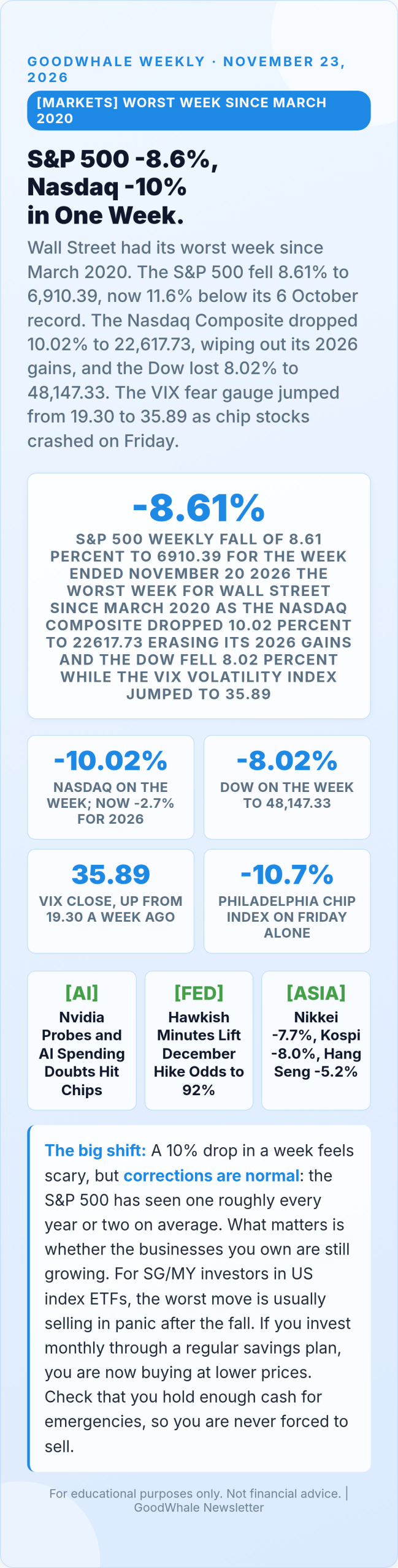
Meanwhile, this was Wall Street’s worst week since March 2020. The S&P 500 fell 8.61% to 6,910.39, leaving it 11.6% below its record close of 7,818.93 on 6 October. The Nasdaq Composite dropped 10.02% to 22,617.73, which wiped out all of its 2026 gains, and the Nasdaq-100 briefly fell into a bear market on Friday, down 20% from its high. The Dow lost 8.02% to 48,147.33 after closing below 50,000 on Thursday for the first time since June. The VIX, Wall Street’s fear gauge, rose from 19.30 to 35.89 and touched 40 intraday on Friday.
The selling centred on chips. On Friday alone, the Philadelphia Semiconductor Index fell 10.7%, with AMD down 13.3%, Micron 13.9% and Broadcom 12.1%. Several worries piled up at once: new US probes into Nvidia, profit-taking after the Anthropic IPO, doubts about how long the AI spending boom can last, and hawkish Fed minutes that lifted the odds of a December rate hike. Asia was hit too, with Japan’s Nikkei down 7.7% and Korea’s Kospi down 8.0% for the week. For Singapore and Malaysia investors, the lesson of the Wall Street worst week is to check your position sizes, not to guess the bottom.
2. Nvidia Delivers Record Numbers but Loses Investor Trust

Notably, on Tuesday 17 November, Nvidia reported third-quarter revenue of $115.8 billion, up 103% on the year and ahead of analyst estimates of about $109 billion. Data centre sales rose 110% to $107.6 billion, gross margin was 74.9%, and the company guided fourth-quarter revenue to $130 billion, plus or minus 3%, above the roughly $125 billion analysts expected. Interim CEO and CFO Colette Kress led the call, and board chair Harvey Jones said the board does not intend to reinstate Jensen Huang, with recruiter Heidrick & Struggles running the CEO search. Shares rose in after-hours trading.
The gain did not last. The Wall Street Journal reported on Tuesday that the SEC had opened a civil probe; on Thursday California’s attorney general served a subpoena asking about chips reaching China and whether investors were misled; and on Friday Reuters reported SEC staff were examining possible accounting issues. The SEC declined to comment, and none of these is a finding of wrongdoing. Nvidia closed the week at $125.53, down 22.9%, and is now down nearly 40% in November. For Singapore and Malaysia investors, keep single-stock positions small while the legal picture is unclear.
3. Anthropic IPO: Record Raise, Bumpy First Days
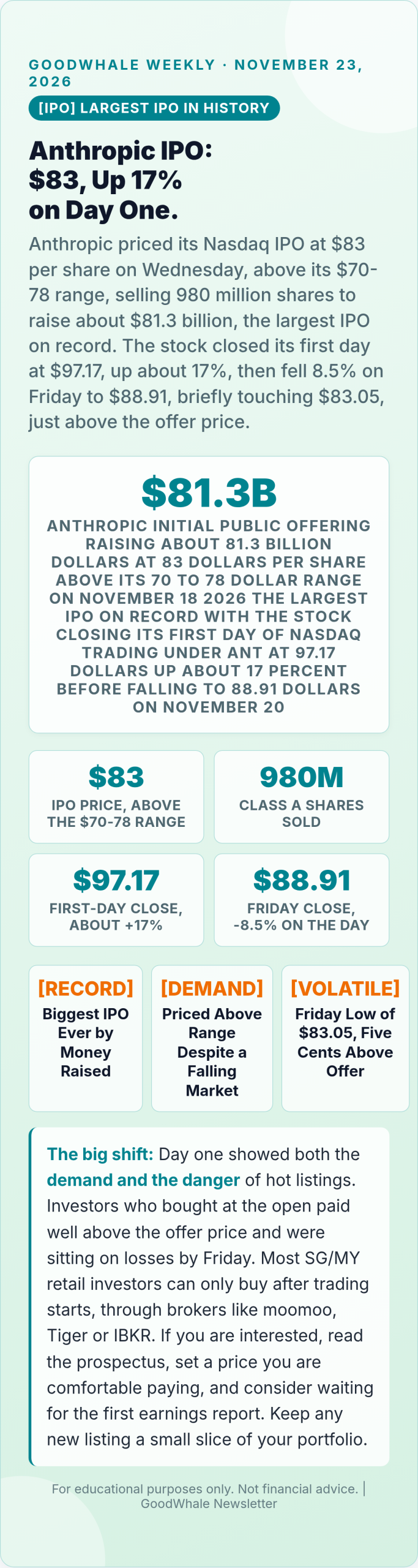
However, Anthropic, the company behind the Claude AI models, priced its IPO on Wednesday 18 November at $83 per share, above its $70-78 range. It sold 980 million Class A shares to raise about $81.3 billion, the largest IPO on record, with reports putting its valuation well above $1 trillion. The stock started trading on Nasdaq under the ticker ANT on Thursday and closed its first day at $97.17, up about 17%, in a volatile session.
The timing was tough. As the wider market sold off, Anthropic shares fell 8.5% on Friday to $88.91 and touched an intraday low of $83.05, just five cents above the offer price, and some analysts said profit-taking around the debut added to the broader AI selling. For Singapore and Malaysia investors, the practical point is that big first-day moves can reverse quickly. Treat any new listing as a small, speculative position, decide on a valuation in advance, and remember that index funds will add the stock over time if it becomes a large company. Disclosure: this newsletter is written with the help of Claude, an Anthropic product.
4. The Fed Leans Hawkish While Safe Havens Stumble

Additionally, the Federal Reserve added to the pressure. Minutes from the last meeting were hawkish, Governor Christopher Waller called for aggressive action on inflation and Governor Lisa Cook said policy is not restrictive enough. By Friday, CME FedWatch showed a 92% chance of a rate hike at the 8-9 December meeting, including about a 10% chance of a half-point move. Even so, the 10-year Treasury yield fell 24 basis points to 4.91% as investors bought government bonds for safety, and University of Michigan one-year inflation expectations eased to 3.7%.
Other so-called safe havens did not hold up. Gold fell 8.94% to about $3,539 an ounce and silver lost 16%, as investors facing losses sold whatever they could. Bitcoin dropped to around $56,000, its lowest since September 2024, and Brent crude fell about 4% to $92.57. Next week brings Q3 GDP and core PCE inflation on Wednesday, ahead of the US Thanksgiving holiday on Thursday. For Singapore and Malaysia investors, keep an emergency buffer in cash or T-bills and avoid borrowing to invest while rates may still rise.
5. STI Breaks 5,000 as the Sell-Off Reaches SG and MY
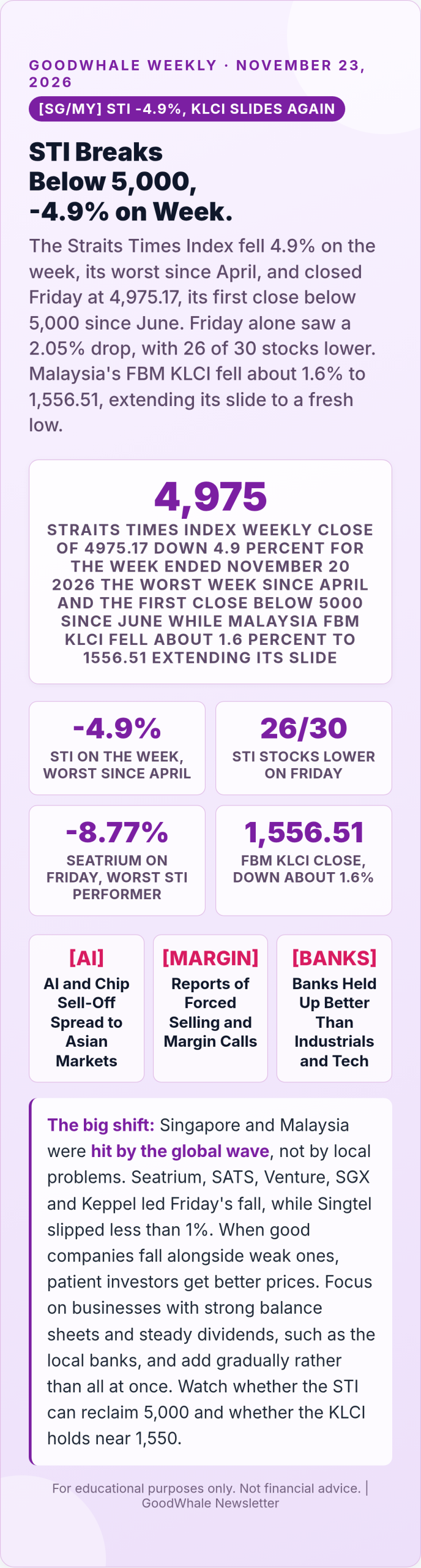
On the other hand, the sell-off reached our region. The Straits Times Index closed Friday 20 November at 4,975.17, down 2.05% on the day and 4.9% on the week, its worst week since April and its first close below 5,000 since June. Twenty-six of the 30 index stocks fell on Friday, led by Seatrium (-8.77%), SATS (-5.29%), Venture (-3.32%), SGX (-3.14%) and Keppel (-3.07%), while Singtel slipped just 0.95%. Traders pointed to the AI and chip rout, doubts about AI spending and reports of forced selling and margin calls.
Malaysia’s FBM KLCI fell about 1.6% on the week to 1,556.51, extending a slide that had already taken it to a 14-month low the week before, and KLCI futures fell about 34 points. For Singapore and Malaysia investors, this is the time to separate price from value. Banks such as DBS, OCBC, UOB, Maybank and Public Bank pay solid dividends and have held up better than tech. Rather than trying to time the bottom, consider adding to quality names in small steps and keeping cash ready in case the market falls further.
What I’m Watching Next Week
Key themes — November 23 to November 27
- Q3 GDP and core PCE inflation (Wednesday 25 November) — The Fed’s favourite inflation gauge will shape whether December brings a 25 or 50 basis point hike.
- Nvidia probes — Any update from the SEC, the California attorney general or the CEO search could move chips worldwide, including AEM, UMS, Frencken, ViTrox and Inari.
- Earnings — Dell, HP, HPE, Analog Devices, Deere, Best Buy, Dollar Tree and Abercrombie report in a shortened week.
- Thanksgiving (Thursday 26 November) — US markets close Thursday and trade a half day Friday, so thin volumes can exaggerate moves.
- Singapore and Malaysia — Whether the STI can reclaim 5,000, whether the KLCI holds around 1,550, and how banks and REITs hold up.
Bottom Line
This was the Wall Street worst week since March 2020. The S&P 500 fell 8.61% to 6,910.39, the Nasdaq lost 10.02% and wiped out its 2026 gains, and the VIX nearly doubled to 35.89 as chip stocks crashed. Nvidia showed how a strong business can still fall: revenue rose 103% to $115.8 billion and guidance beat, yet the stock dropped 22.9% on reports of an SEC probe and a California subpoena, while the board said Jensen Huang will not return. Anthropic raised about $81.3 billion at $83 a share in the largest IPO on record and closed its first day up 17%, before slipping to $88.91 on Friday. The Fed leaned hawkish, with December hike odds at 92%, and gold and bitcoin fell sharply instead of acting as safe havens. In our region, the STI fell 4.9% to 4,975.17, its first close below 5,000 since June, and the KLCI slid to 1,556.51. For Singapore and Malaysia investors, the playbook is calm and practical: keep an emergency buffer in cash or T-bills, avoid selling quality holdings in a panic, keep single-stock and new-listing bets small, and add to strong dividend payers gradually. Sell-offs reward the patient, not the fearful.
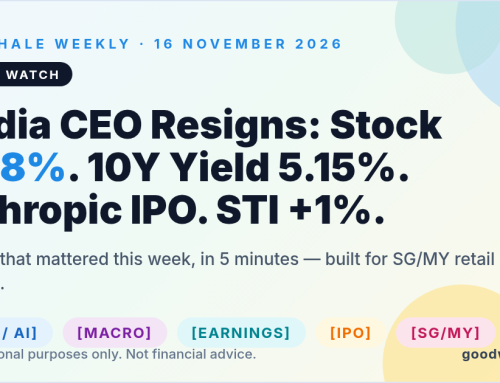
For educational purposes only. Not financial advice. Always do your own research. Catch up on last week’s issue: GoodWhale Weekly: Nvidia CEO Resigns, US 10-Year Yield Tops 5%, Anthropic Sets IPO Terms, KLCI Hits 14-Month Low.








Leave A Comment