

The Week in 30 Seconds
- [CHIPS / AI] Nvidia CEO resigns. Jensen Huang quit after 33 years, Colette Kress is interim CEO and the stock fell 12.75% on the week.
- [MACRO] 10-year yield 5.15%, hike priced in. CPI +0.4% and PPI +6.5% on the year; gold -4.65% and bitcoin about -10%.
- [EARNINGS] AI spending is broadening. CoreWeave sales +168%, Cisco and Applied Materials post records; the S&P 500 rose 2.51%.
- [IPO] Anthropic sets a $70-78 range. Up to about $64.4B raised; Nasdaq trading under ANT expected from 19 November.
- [SG/MY] STI +1.02% to 5,231.84; KLCI at a 14-month low. Malaysia is probing Megaspeed’s local unit over Nvidia chips.
1. Nvidia CEO resigns: Nvidia CEO Resigns: What Changes and What Does Not

Meanwhile, the biggest story of the week: Nvidia CEO resigns. Jensen Huang, who co-founded the company and led it for 33 years, stepped down with immediate effect, Nvidia announced on Thursday 12 November, after the board accepted his resignation the day before. Chief financial officer Colette Kress is interim CEO while remaining CFO, and director Harvey C. Jones becomes the company’s first board chair and will lead the search for a permanent successor. The exit followed days of reports about Huang’s personal conduct and national-security questions. Nvidia shares closed the week at $162.85, down 12.75%, and the company’s market value slipped below $4 trillion.
In addition, the story reaches straight into our region. Singapore-based cloud firm Megaspeed has been accused by US officials of helping Nvidia chips reach Chinese users, and on Friday Malaysia’s trade ministry said it is checking whether chips imported by Megaspeed’s Malaysian unit, Speedmatrix, were re-exported. Prime Minister Anwar Ibrahim said there is no sign so far that the chips left Malaysia. For Singapore and Malaysia investors, the key date is Tuesday 17 November, when Nvidia reports Q3 results. Strong numbers would ease fears; any guidance cut would hit chip suppliers such as AEM, UMS, Frencken, ViTrox and Inari. Keep position sizes modest until the leadership picture is clearer.
2. Hot Inflation Pushes the US 10-Year Yield Above 5%

Notably, the inflation data ran hot. October CPI rose 0.4% on the month, with core prices up 0.3%. On Friday, October producer prices rose 0.3% on the month but 6.5% on the year, the largest 12-month gain since November 2022, with core producer prices up 4.9%. As a result, bond markets reacted fast: the 10-year Treasury yield rose about 30 basis points to 5.15%, touching 5.17% intraday, and the 30-year moved to about 5.48%. Futures now fully price at least a quarter-point Fed hike at the 8-9 December meeting, and Governor Christopher Waller said a 50 basis point hike should be considered.
Meanwhile, other assets felt the squeeze. The dollar index rose 1.1% to about 103.4, gold fell 4.65% to around $3,885 an ounce and bitcoin dropped about 10% to roughly $68,000, its first move below $70,000 in nearly three months. For Singapore and Malaysia investors, higher US yields matter for REITs such as Keppel DC REIT and Mapletree Pan Asia Commercial Trust, for bank bond portfolios and for the ringgit. Rather than guessing the Fed’s next step, balance your portfolio: keep an emergency buffer in cash or T-bills, favour dividend payers with strong balance sheets and avoid heavy borrowing to invest while rates are rising.
3. AI Earnings Show Spending Is Broadening Beyond Nvidia
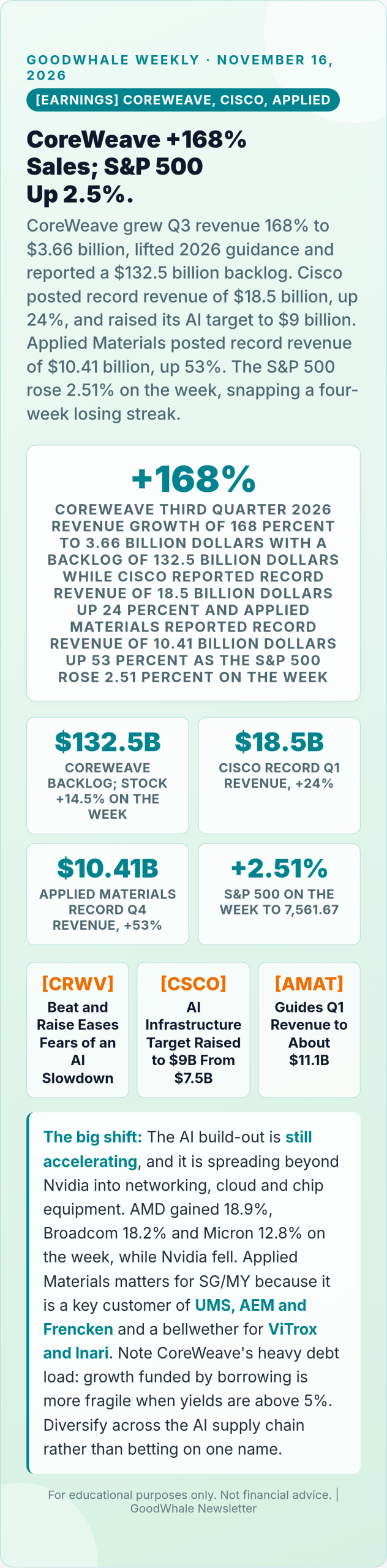
However, even so, earnings reminded investors that AI demand is real. CoreWeave reported Q3 revenue up 168% to $3.66 billion, ahead of estimates, raised its full-year guidance and said its backlog reached $132.5 billion; the stock jumped about 24% on Wednesday and ended the week up 14.5%. Cisco posted record fiscal Q1 revenue of $18.5 billion, up 24%, with networking up 43%, and raised its fiscal 2027 AI infrastructure revenue target to $9 billion from $7.5 billion and its full-year revenue outlook to $74.8-75.8 billion.
Applied Materials reported record quarterly revenue of $10.41 billion, up 53%, and guided next quarter to about $11.1 billion as chipmakers keep buying equipment. At the same time, the money rotated within chips: AMD rose 18.9%, Broadcom 18.2% and Micron 12.8% while Nvidia fell 12.75%. The S&P 500 rose 2.51% to 7,561.67 and the Nasdaq-100 3.53%, snapping a four-week losing streak, and the VIX fell about 25% to 19.30. For Singapore and Malaysia investors, strong equipment demand supports suppliers like UMS, AEM, Frencken, ViTrox and Inari, though their shares swing sharply with US chip sentiment.
4. Anthropic IPO: A Mega Listing Lands in a Volatile Week

Additionally, anthropic, the company behind the Claude AI models, set terms for its Nasdaq IPO. It plans to sell 825 million Class A shares at $70 to $78 each, which could raise up to about $64.4 billion at the top of the range, plus a separate private placement of about $26 billion in which Nvidia is expected to buy roughly $10 billion. At the top end, the valuation is about $1 trillion on basic shares. Pricing is expected on Wednesday 18 November and trading under the ticker ANT on Thursday 19 November, and Bloomberg reported orders of about six times the shares available.
However, the timing is notable: the deal prices the day after Nvidia’s results and in a market already nervous about AI valuations and rising yields. For Singapore and Malaysia investors, the practical point is that you will most likely buy, if at all, on the open market after listing. Large first-day jumps are common and can reverse. A sensible approach is to treat any new listing as a small, speculative slice of your portfolio, set a price you would pay in advance, and remember that broad index funds will add the stock over time if it becomes a large company. Disclosure: this newsletter is written with the help of Claude, an Anthropic product.
5. Singapore Rebounds While Malaysia Slides to a 14-Month Low

On the other hand, singapore had a better week. The Straits Times Index closed Friday 13 November at 5,231.84, up 52.67 points or 1.02% in a four-day week after Monday’s Deepavali holiday, taking its year-to-date total return to about 12.6%. DBS, OCBC and UOB led gains on Tuesday and Wednesday, and Venture led on Wednesday as the AI trade recovered. The index slipped 1% on Friday as Nvidia worries returned, with Genting Singapore and the banks among the decliners, and analysts see support at 5,100-5,200 and resistance at 5,200-5,300.
By contrast, Malaysia struggled. The FBM KLCI fell for five straight sessions to 1,582.59 on Friday, down more than 2% on the week and at its lowest since September 2025. Investors trimmed data-centre-related stocks such as Gamuda, rising bond yields weighed on banks, and tech names including ViTrox, MPI and MI Technovation fell with US chips. Some analysts call the market oversold, pointing to bank valuations near trough levels and dividend yields around 6%, and see a possible return above 1,600 by year-end. For Singapore and Malaysia investors, dividends offer a cushion, but keep an eye on Nvidia’s results and the Megaspeed probe this week.
What I’m Watching Next Week
Key themes — November 16 to November 20
- Nvidia Q3 results (Tuesday 17 November, after the US close) — The first report without Jensen Huang as CEO. Guidance and any comment on leadership and China will move chips worldwide, including AEM, UMS, Frencken, ViTrox and Inari.
- Anthropic IPO (pricing Wednesday 18, trading Thursday 19 November) — Watch where it prices within the $70-78 range and how it trades on day one.
- FOMC minutes (Wednesday 18 November) and Fed speakers — Hints on whether December’s hike is 25 or 50 basis points.
- US retail earnings and data — Home Depot (Tue), Target, Lowe’s and TJX (Wed), Walmart (Thu), plus October retail sales on Tuesday.
- Singapore and Malaysia — Whether the STI holds 5,100-5,200, whether the KLCI holds 1,575, and any update on Malaysia’s Megaspeed probe.
Bottom Line
This was a week of shocks and contrasts. The Nvidia CEO resigns headline dominated: Jensen Huang stepped down after 33 years, CFO Colette Kress became interim CEO and Nvidia shares fell 12.75% to $162.85, below a $4 trillion market value, with results due Tuesday. Inflation ran hot, with October CPI up 0.4% and producer prices up 6.5% on the year, pushing the US 10-year yield up about 30 basis points to 5.15% and putting a December Fed hike fully in the price. Even so, the wider market rose: strong results from CoreWeave, Cisco and Applied Materials showed AI spending broadening beyond Nvidia, AMD and Broadcom gained more than 18%, and the S&P 500 rose 2.51% to snap a four-week losing streak. Anthropic set its IPO range at $70 to $78, with trading expected from 19 November. In our region, the STI rose 1.02% to 5,231.84 while Malaysia’s KLCI fell to a 14-month low of 1,582.59, and Malaysia is checking whether chips imported by Megaspeed’s local unit were re-exported. For Singapore and Malaysia investors, the playbook is practical: avoid concentrating in any single AI name, respect what 5% US yields mean for REITs and dividend stocks, keep idle cash earning in T-bills or Savings Bonds, and treat new listings as small, speculative positions. Position size, not prediction, is the edge.
For educational purposes only. Not financial advice. Always do your own research. Catch up on last week’s issue: GoodWhale Weekly: AI Stock Selloff Sends the Nasdaq Into Correction, Jobs Beat Lifts Fed Hike Odds, STI Slides 2.2%.







Leave A Comment