

The Week in 30 Seconds
- [BIG TECH] Alphabet -12.6%, its worst day ever. Free cash flow of negative $9.07B shocked the market; Meta lifted capex to about $145B and Microsoft was the winner.
- [CHIPS] Intel -29%, worst day since 1974. A weak Q4 guide dragged the chip complex lower; the Nasdaq fell 5.3% in October.
- [MACRO] Fed holds 10-2 with two hike dissents. December hike odds are about 85%; Q3 GDP grew 3.4% and PCE inflation is 3.6%.
- [OIL] Brent near $118. Fourth straight monthly gain, with Brent up 13.6% and WTI up 15.2% in October.
- [SG/MY] STI at 5,376.74, down 5.27% in October. Bank downgrades and a haze probe weighed; bank results are next.
1. Big tech earnings: Big Tech Earnings Spark a Cash-Burn Scare as Alphabet Plunges

Meanwhile, the Nasdaq Composite fell about 2.9% on Friday to 25,437 and lost 5.3% in October, its worst month since March 2025, as big tech earnings turned the AI trade from a growth story into a funding question. Alphabet dropped 12.64% on Thursday, its worst day as a public company, wiping out roughly $500 billion of market value. Revenue rose 25% to $127.6 billion and operating income rose 30% to $40.6 billion, but free cash flow was negative $9.07 billion, far worse than expected, and EPS of $2.12 missed the $2.99 forecast. Capex guidance stayed at $195-205 billion. Search revenue grew 12% to $63.35 billion, short of estimates.
The rest of the group told a similar story. Meta beat on revenue at $64.6 billion and raised 2026 capex to about $145 billion, then announced a new non-voting Class C share, which investors read as a sign that operating cash flow alone cannot fund the build-out; the stock fell about 4.3% on Friday. Amazon posted EPS of $1.89 against $1.96 expected, with AWS growing 39.3% but trailing free cash flow near negative $42.4 billion. Microsoft was the standout: EPS of $4.89 against $4.73 and cloud revenue of $63.9 billion. For Singapore and Malaysia investors, the lesson is to separate a healthy business from a healthy share price and to size US tech holdings carefully. Apple reports tonight after the US close.
2. Intel Suffers Its Worst Day Since 1974 as Chips Sell Off
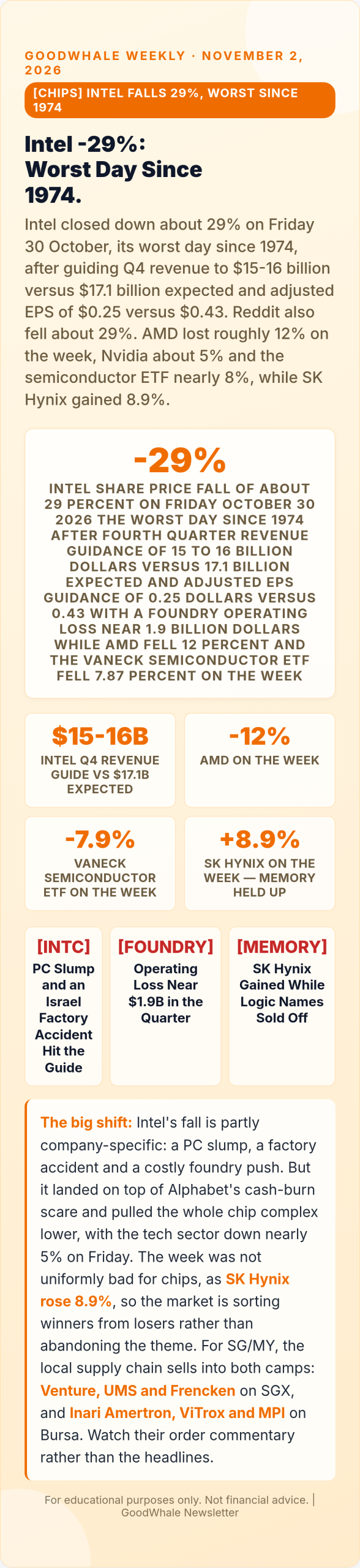
Notably, intel closed down roughly 29% on Friday, its worst day since 1974, after a weak fourth-quarter forecast. It guided revenue to $15-16 billion against $17.1 billion expected and adjusted EPS of $0.25 against $0.43, citing a PC slump and a factory accident in Israel, with a foundry operating loss near $1.9 billion. Reddit fell about 29% as well on a soft Q4 outlook. The damage spread: AMD lost about 12% on the week, Nvidia about 5% and the VanEck Semiconductor ETF 7.87%, while the S&P 500 tech sector fell nearly 5% on Friday and about 70% of US stocks declined.
Not everything fell. SK Hynix gained 8.9% on the week and Eli Lilly rose 11%, a reminder that money is rotating rather than leaving. For Singapore and Malaysia investors, this matters because Venture, UMS, AEM and Frencken and Inari Amertron, ViTrox and MPI are tied to chip equipment and test demand, and the Nasdaq’s October slide dragged regional tech with it. The VIX jumped to around 20, which is elevated but not panic territory. A practical approach is to avoid selling into a single bad Friday, keep position sizes modest in single-theme names, and let the next round of order data, including AMD on Tuesday, guide you.
3. Fed Holds With Two Dissenters Leaning Toward a Hike
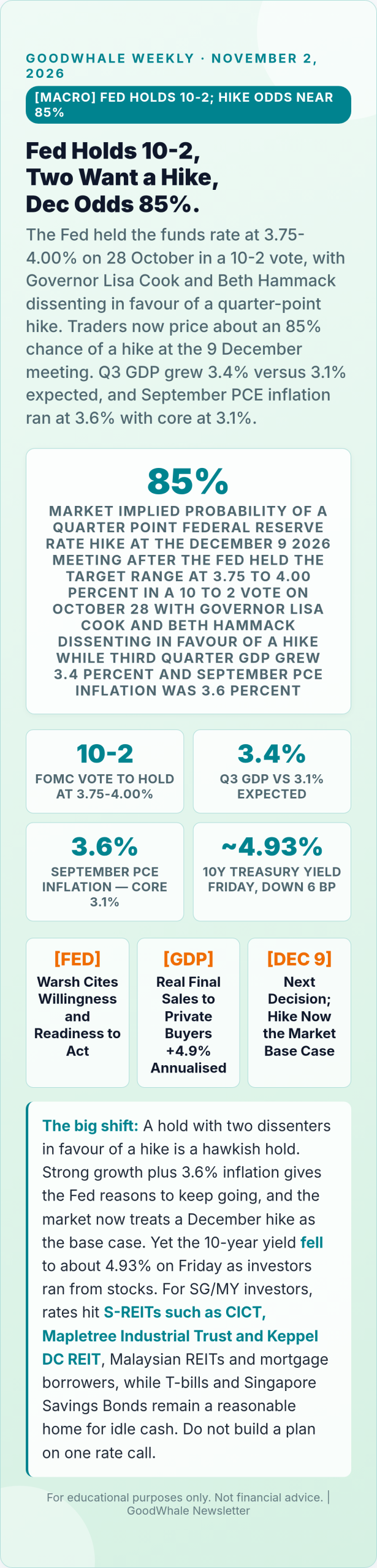
However, the Federal Reserve held its benchmark rate at 3.75-4.00% on Wednesday 28 October in a 10-2 vote. Governor Lisa Cook and Beth Hammack dissented, preferring a quarter-point increase. Chair Kevin Warsh cited a willingness and readiness to act, and St. Louis Fed’s Alberto Musalem and Richmond’s Tom Barkin said higher rates could be needed. Traders now put roughly 85% on a hike at the 9 December meeting. The data backs the hawks: Q3 GDP grew 3.4% against 3.1% expected, September PCE inflation was 3.6% year on year with core at 3.1%, and consumer confidence recovered to 91.7 from 84.2.
Even so, bond yields eased on Friday, with the 10-year around 4.93% and the 2-year near 4.56%, as the stock selloff drove buyers to safety. For Singapore and Malaysia investors, the practical effect is on income assets and borrowing costs. CICT, Mapletree Industrial Trust and Keppel DC REIT are priced against the risk-free yield, and floating-rate mortgage holders feel rate expectations quickly. The October jobs report on Friday, expected near 55,000 jobs with unemployment around 4.2%, is the next big input. A mix of cash, dividend payers and growth is more resilient than a bet on one outcome.
4. Oil Posts a Fourth Straight Monthly Gain With Brent Near $118

Additionally, oil finished October strongly. The expiring December Brent contract settled at $117.64 on Friday, up 2.4% on the day and the highest settle since late April, while the more active January contract closed at $113.43. West Texas Intermediate settled at $104.12. For the month, Brent gained 13.6% and WTI 15.2%, a fourth straight monthly advance. Energy shares benefited, with Exxon and Chevron higher, while gold fell more than 3% to around $3,893 and bitcoin dropped to about $76,700 as risk assets were sold.
For Singapore and Malaysia investors, energy sits on both sides of the portfolio. Petronas Chemicals, Dialog Group and Yinson gain from firm prices, and Malaysia’s budget benefits too, while Singapore Airlines, Capital A and transport companies carry the fuel cost. The bigger effect is on inflation: US PCE at 3.6% leaves little room for central banks to ease, which is why oil links straight back to the Fed story. Singapore also announced about S$5.3 billion in energy infrastructure spending over five years. Keep sizing sensible, and treat large single-day oil moves with caution; oil has reversed on headlines before.
5. Singapore Stocks Extend Their Correction as Tech and Banks Slip

On the other hand, singapore had a soft finish to October. The Straits Times Index closed the week of 26-30 October at 5,376.74, down 45.42 points or 0.84%, with one gaining day and four declining days. For the month, the STI fell 299.13 points or 5.27%, a second consecutive month of correction, although year-to-date total return remains about +15.7%. Investment banks repeatedly downgraded bank stocks early in the month, plantation stocks fell on haze-related investigations, and tech followed the US lower. Real estate and REITs held up better, and Mapletree Logistics Trust led gainers on Friday while Wilmar and the three major banks led decliners.
On the policy side, Singapore and Indonesia sent diplomats to discuss cross-border haze, and Singapore summoned listed plantation companies operating in Indonesia to assist the investigation. Analysts see support around 5,300-5,400 and resistance at 5,400-5,500. For Singapore and Malaysia investors, DBS, OCBC and UOB report Q3 results in early November, with Maybank, CIMB and Public Bank to follow, and these are the next catalysts. With US tech wobbling and the Fed leaning hawkish, a balanced portfolio of income, banks and selective growth is more resilient than a single bet. Check your concentration before the results land.
What I’m Watching Next Week
Key themes — November 2 to November 6
- Apple and Palantir (Monday, after the close) — Apple is the last megacap to report; AMD, Super Micro and Arista follow Tuesday, and Qualcomm and Uber on Wednesday. Watch order commentary for Venture, UMS and Inari.
- US midterm elections (Tuesday) — Policy and tariff headlines can move markets quickly.
- US October jobs report (Friday) — Consensus is near 55,000 jobs and 4.2% unemployment, a key input for the 9 December hike odds.
- Singapore bank results — DBS, OCBC and UOB Q3 results are expected in early November after a month of downgrades; Malaysian banks follow.
- Oil and the Fed speakers — Whether Brent holds above $110 and what Hammack, Barkin and Williams say about December.
Bottom Line
This was a week where good businesses met a harder question: who pays for AI? Big tech earnings showed strong sales but heavy cash burn, with Alphabet down 12.64% on its worst day as a public company, Meta raising capex to about $145 billion and Amazon’s trailing free cash flow near negative $42.4 billion, while Microsoft’s cloud strength was the clear exception. Intel’s roughly 29% fall, its worst since 1974, pulled the chip complex down and left the Nasdaq 5.3% lower for October. The Fed held at 3.75-4.00% in a 10-2 vote with two dissenters favouring a hike, with December hike odds near 85% after Q3 GDP of 3.4% and PCE inflation of 3.6%. Brent settled near $118 on the expiring contract and WTI at $104.12, a fourth straight monthly gain. In Singapore, the STI closed at 5,376.74, down 5.27% in October but still up about 15.7% year to date. For Singapore and Malaysia investors, the playbook is practical: separate a healthy business from a healthy share price, check how much of your portfolio rides on five US tech names or on banks alone, remember energy producers and airlines sit on opposite sides of an oil spike, and keep some cash in T-bills or Savings Bonds while rates stay high. Position size, not prediction, is the edge this week.
For educational purposes only. Not financial advice. Always do your own research. Catch up on last week’s issue: GoodWhale Weekly: Chip Stock Selloff Hits 8 Days, Oil Nears $110, Singapore Exports Surge 68%.
Source: Alphabet investor relations







Leave A Comment