
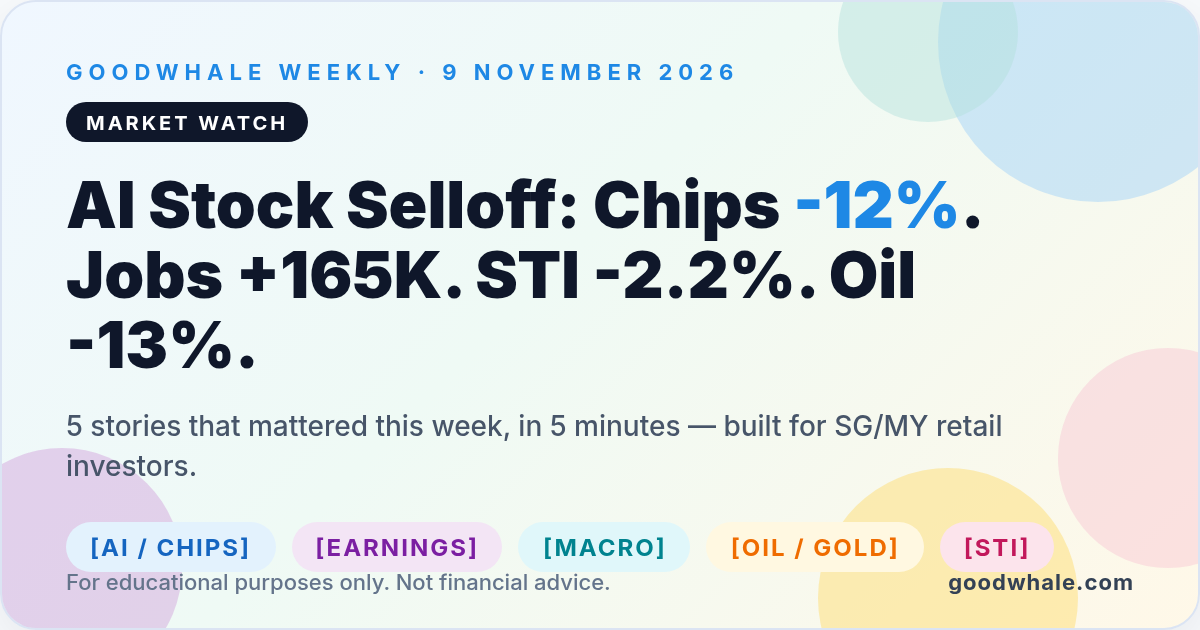
The Week in 30 Seconds
- [AI / CHIPS] Chips -12.2% in a day, $2.9T wiped. The S&P 500 fell 4.36% and the Nasdaq entered correction on AI data-centre regulation fears.
- [EARNINGS] Good results, weak reactions. Palantir sales +96%, Apple beat and AMD raised, yet all three fell on the week; AppLovin jumped 71%.
- [MACRO] Jobs +165K, Fed hike odds above 77%. The BoE and RBA both raised rates; US CPI is due Tuesday.
- [OIL / GOLD] WTI -13% to about $90, gold +4.6%. Middle East risk premium faded; energy was the worst sector.
- [SG/MY] STI -2.2% to 5,179.17. DBS and UOB missed on Q3, and UMS and Frencken fell with the Asian chip rout.
1. AI stock selloff: AI Stock Selloff Sends the Nasdaq Into Correction

Meanwhile, the AI stock selloff hit hard on Thursday 5 November, a day after markets had rallied on the US midterm results. The S&P 500 fell 4.36%, its worst day since April 2025, the Nasdaq Composite lost 5.52% to enter correction territory, and the Dow dropped about 1,833 points. The Philadelphia Semiconductor Index fell roughly 12.2%, its biggest one-day fall since 2020, and Nvidia lost about 9%. S&P 500 companies shed a record $2.9 trillion of market value in one session. Data-centre operators such as IREN, Applied Digital and Nebius fell more than 14%.
The trigger was political. Investors worried that Democratic midterm wins could mean tougher rules on AI data centres, with rising electricity prices turning construction into a political issue and some lawmakers calling for pauses. Doubts about when AI spending will pay off and higher borrowing costs added to the mood. Stocks steadied on Friday, with the Nasdaq up 1.09% and the VIX easing to 25.64, but the week still finished with the Nasdaq down 3.37% and the S&P 500 down 2.68%. For Singapore and Malaysia investors, the sensible response is to know your exposure, keep position sizes modest in single-theme names and avoid forced selling.
2. Strong Earnings Could Not Save AI Stocks This Week

Notably, earnings season delivered solid results and weak reactions. Palantir reported Q3 revenue up 96% to $2.313 billion, with US commercial revenue up 148% to $984 million, passing US government revenue for the first time, and raised 2026 revenue guidance to about $8.53 billion. The stock still fell 12.89% on the week as investors questioned its valuation. Apple reported fiscal Q4 revenue of $114.5 billion, up 12%, and EPS of $2.10, both ahead of expectations, but guided gross margin to 45-46% from 47.9%, citing memory costs and Siri-related expenses; the stock slipped 0.66% on the week.
AMD beat and raised its outlook, yet finished the week down about 11% after the chip rout, though it rebounded roughly 11% on Friday. AppLovin was the standout, up about 71% after a beat and raise, and Airbnb gained about 15.6% after raising its full-year outlook. On the downside, Seagate, Marvell, Western Digital, SanDisk, Dell and Micron each lost more than 20% on the week. For Singapore and Malaysia investors, the lesson is to separate quality from price: a great business bought at a stretched valuation can still fall sharply. Next up, CoreWeave reports Tuesday and Cisco and Applied Materials report Thursday.
3. A Hot Jobs Report Keeps a December Fed Hike in Play
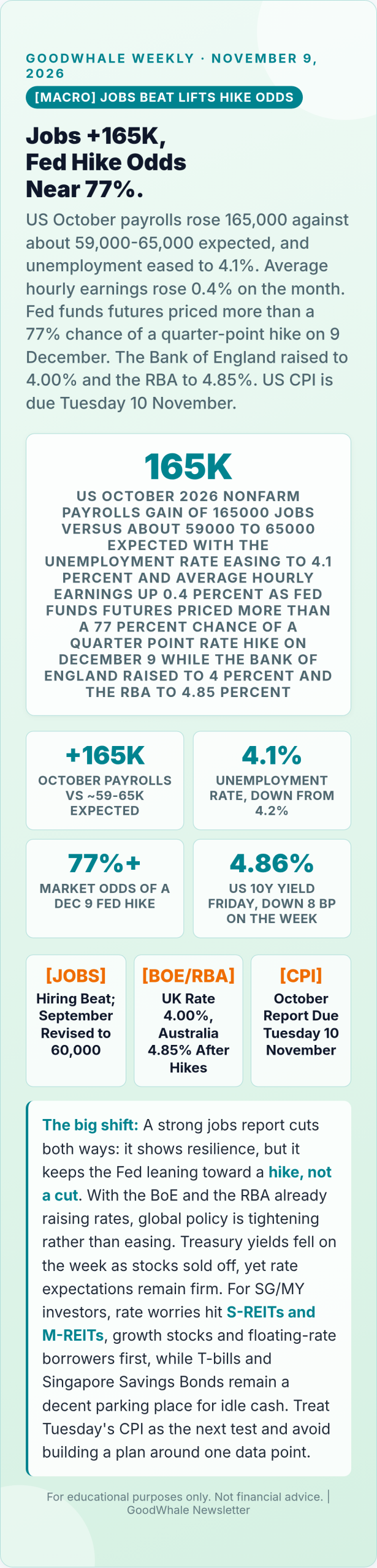
However, the US added 165,000 jobs in October against forecasts of roughly 59,000 to 65,000, and the unemployment rate eased to 4.1% from 4.2%. Average hourly earnings rose 0.4% on the month and 3.1% on the year, and September was revised to 60,000. After the report, fed funds futures priced more than a 77% chance of a quarter-point hike at the 9 December meeting, following the Fed’s 10-2 hold at 3.75-4.00% on 28 October with two dissenters favouring a hike. The 10-year Treasury yield ended the week at 4.86%, down 8 basis points, as stock-market stress pulled money into bonds.
Global central banks are moving the same way. The Bank of England raised Bank Rate by 25 basis points to 4.00% on 5 November, and the Reserve Bank of Australia raised to 4.85% on 3 November. This week’s key data point is US CPI on Tuesday 10 November, with headline expected near +0.3% on the month and core near +0.2%, followed by PPI on Friday. For Singapore and Malaysia investors, higher-for-longer rates matter for REITs such as CICT and Mapletree Industrial Trust, for bank margins and for mortgage costs. A balanced mix of cash, dividend payers and selective growth is more resilient than a bet on a single rate outcome.
4. Oil Slumps and Gold Climbs as Risk Premiums Shift
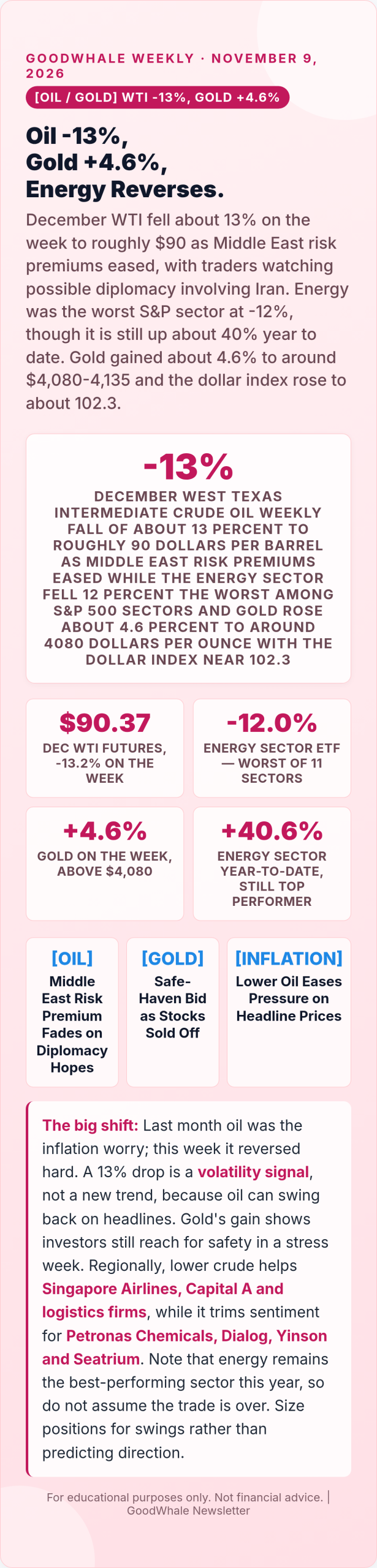
Additionally, commodities flipped the script. December West Texas Intermediate fell about 13% on the week to roughly $90 as traders priced in lower Middle East risk, including possible diplomacy involving Iran. The energy sector was the worst of the 11 S&P 500 sectors at about -12%, although it remains up around 40% year to date. At the same time, gold rose about 4.6% to above $4,080 an ounce and traded near $4,120 early Monday as investors sought safety, while the dollar index edged up to about 102.3. Bitcoin slipped to roughly $75,000 to $76,000.
For Singapore and Malaysia investors, cheaper oil is a mixed signal. It helps fuel-sensitive names like Singapore Airlines, Capital A and transport firms, and it eases inflation pressure, but it weighs on sentiment for energy-linked names such as Petronas Chemicals, Dialog and Yinson. Gold has become a bigger conversation among retail investors, and a small allocation can diversify a stock-heavy portfolio, though it carries its own volatility. Single-week moves of this size, in either direction, are best treated as noise until a trend confirms. Keep your sizing sensible.
5. Singapore Stocks Slide as Banks Miss and Asian Chips Rout

On the other hand, singapore had a rough week. The Straits Times Index fell 117.08 points or 2.2% to 5,179.17 on Friday 6 November, and every STI constituent except SATS declined. The three banks led the damage after Q3 results. DBS reported profit down 5% to S$2.81 billion, below estimates, with markets trading income down 65% to S$152 million, and closed at S$69.72. UOB posted profit of S$1.25 billion, up 182% on the year thanks to far lower provisions but 15% below the prior quarter and under the S$1.38 billion consensus, and fell 10.27% on the week. OCBC reported record nine-month profit of S$6.24 billion, but Great Eastern’s quarterly profit fell 72% and the stock slipped 4.28%.
Tech suppliers suffered from the regional chip rout: UMS Integration fell 18.9% and Frencken 16.2% on the week, while Japan’s Nikkei and South Korea’s KOSPI each dropped about 6% on Friday and SK Hynix lost 10.4%. Grab was a bright spot, raising 2026 guidance to about US$4.20 billion revenue and US$800 million adjusted EBITDA after Q3 revenue grew 27%. For Singapore and Malaysia investors, the next catalysts are the CPI print on Tuesday and Maybank, CIMB and Public Bank results later in the month. Check whether your portfolio leans too heavily on banks, REITs and chip suppliers at once.
What I’m Watching Next Week
Key themes — November 9 to November 13
- US CPI (Tuesday 10 November) — Headline is expected near +0.3% and core near +0.2% on the month; a hot print would firm up December hike bets.
- AI earnings (CoreWeave Tuesday; Cisco and Applied Materials Thursday) — Guidance on AI spending and financing costs could either calm or restart the selloff. Watch Applied Materials for read-through to Singapore equipment names.
- US PPI (Friday 13 November) — Forecast near +0.4% headline and +0.3% core on the month.
- AI data-centre policy headlines — State pauses and the proposed federal moratorium were the trigger for Thursday’s rout.
- Singapore and Malaysia — Whether the STI holds near 5,100-5,200 after the bank results, and Maybank, CIMB and Public Bank results later this month.
Bottom Line
This was the week the AI trade met politics. The AI stock selloff peaked on Thursday when the Philadelphia Semiconductor Index fell about 12.2%, the S&P 500 dropped 4.36% and a record $2.9 trillion of market value vanished, as investors worried that Democratic midterm wins could slow AI data-centre construction. Friday brought a partial rebound, but the Nasdaq still finished the week down 3.37% and the S&P 500 down 2.68%. Earnings did not rescue sentiment: Palantir grew revenue 96% and still fell 12.89%, Apple guided margins lower on memory costs, and AMD beat and raised yet fell about 11%. US payrolls rose 165,000, unemployment eased to 4.1% and December Fed hike odds rose above 77%, while the Bank of England and the RBA both raised rates. Oil fell about 13% and gold gained 4.6%. In Singapore, the STI fell 2.2% to 5,179.17 as DBS and UOB missed on Q3 and UMS and Frencken sold off with Asian chips. For Singapore and Malaysia investors, the playbook is practical: know how much of your portfolio really rides on AI spending, avoid forced selling after a single violent day, keep some cash in T-bills or Savings Bonds while rates stay high, and let Tuesday’s CPI and the week’s AI earnings guide the next move. Position size, not prediction, is the edge.
For educational purposes only. Not financial advice. Always do your own research. Catch up on last week’s issue: GoodWhale Weekly: Big Tech Earnings Rattle the Nasdaq, Intel Has Its Worst Day Since 1974, Brent Hits $117.
Source: Palantir Q3 2026 press release







Leave A Comment