

The Week in 30 Seconds
- [CHIPS/AI] Chip stock selloff: eight straight down days. The semiconductor index logged its longest losing streak since 2008; the Nasdaq fell 4.5% to 26,140.03 and the S&P 500 lost 2%.
- [EARNINGS] TSMC profit up nearly 69%. ASML booked record sales of EUR 11.7B; demand is intact even as share prices fell.
- [MACRO] Hot inflation, silent Fed. US CPI 3.7% and PPI +1.3% on the month; Fed Chair Warsh gave no signal ahead of the 27-28 October meeting.
- [OIL] Brent nears $110. Hormuz tanker mine reports and Saudi attacks pushed oil about 8% higher on the week.
- [SG/MY] STI up 0.25% to 5,415.53. September NODX jumped 68.4%, the strongest since February 1980.
1. Chip stock selloff: Chip Stock Selloff Runs Eight Days as the Nasdaq Sheds 4.5%
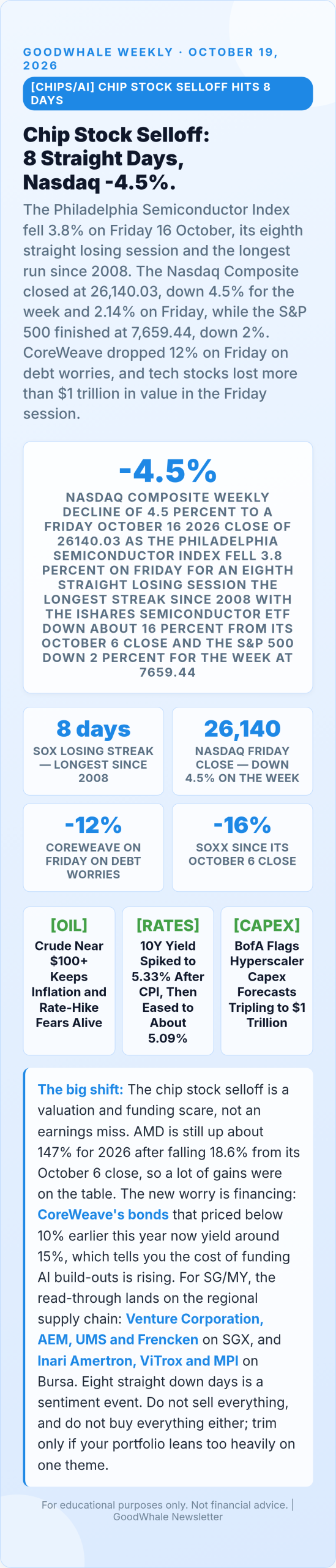
Meanwhile, wall Street had its worst week since June, and chips led the way down. The Philadelphia Semiconductor Index fell 3.8% on Friday, its eighth straight losing session and the longest streak since 2008. The iShares Semiconductor ETF has dropped roughly 16% from its 6 October close. The chip stock selloff pushed the Nasdaq Composite down 2.14% on Friday to 26,140.03, a 4.5% weekly loss that ended a four-week winning streak. The S&P 500 closed at 7,659.44, down 2% for the week, while the Dow was a relative bright spot at 52,002.41, up 0.7%. On Friday, AMD fell 5.95%, Intel 5.79%, Micron 5.63%, Marvell 5.56%, Lam Research 4.87% and Nvidia 1.43%, while CoreWeave sank 12% on debt concerns and Meta fell nearly 4%.
Analysts pointed to several overlapping worries: oil above $100 and hot inflation prints raising the odds of another Fed hike, a 10-year Treasury yield hovering around 5.1%, and questions over how much AI infrastructure spending can be financed. Bank of America’s Sebastian Raedler noted that hyperscaler capex forecasts have tripled from about $330 billion in early 2025 to around $1 trillion, and warned that most big capital cycles have ended in disappointment. For Singapore and Malaysia investors, this matters because Venture, AEM, UMS, Frencken, Inari Amertron, ViTrox and MPI all sell into the same demand chain. The VIX was still only around 16 to 20, so this looks like a sharp rotation, not a panic. Size your AI exposure sensibly and let the earnings, not the headlines, guide you.
2. TSMC and ASML Post Record Results Into the Chip Selloff

Notably, while chip share prices tumbled, the companies themselves reported excellent numbers. TSMC posted its sixth straight record quarterly profit on Thursday, with net profit up nearly 69% and revenue up about 51%. It guided current-quarter sales to as much as $54.3 billion, above analyst estimates, and kept 2026 capital spending at $60-64 billion, adding that 2026-2028 spending will be significantly higher than the prior three years. ASML reported record third-quarter sales of EUR 11.7 billion, with customers already discussing equipment orders for 2029 and 2030 and capacity plans pointing to roughly 30% growth in both 2027 and 2028.
For Singapore and Malaysia investors, the useful takeaway is that the selloff did not come from the supply chain’s own results. TSMC’s capex is the revenue of the regional test, packaging and equipment firms, so Venture, UMS, AEM, Inari Amertron and ViTrox are the names to watch for follow-through. SGX also added five depository receipts on 16 October including TSMC and SK Hynix, bringing the total to 43. The risk is that a company can report a record quarter and its shares can still fall if investors worry about the cost of capital or AI funding. That is why position size matters more than prediction. Lam Research, Texas Instruments and IBM report on Wednesday, which will give the next read.
3. Hot US Inflation Meets a Silent Fed Ahead of the October Meeting
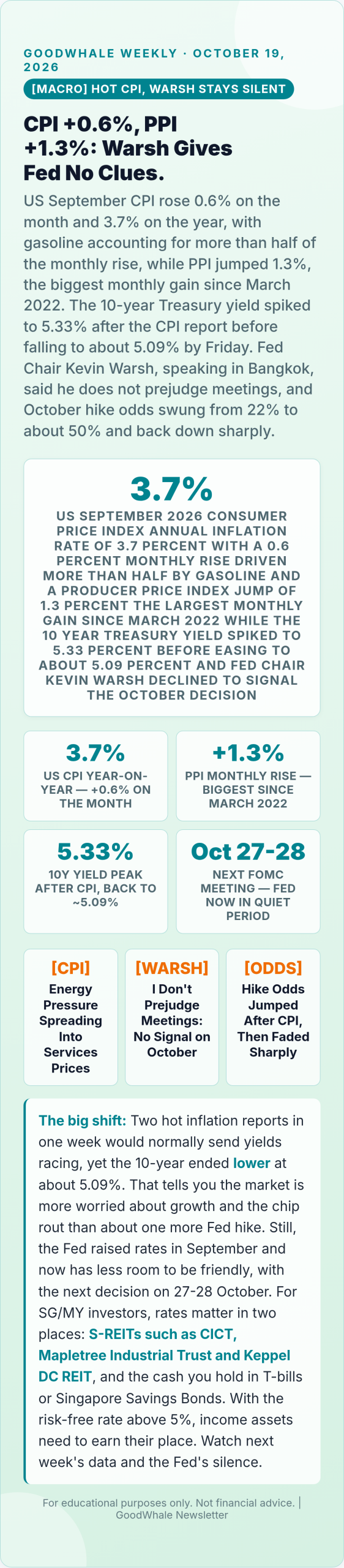
However, uS inflation came in hot. September CPI rose 0.6% on the month and 3.7% on the year, with gasoline making up more than half of the monthly increase, and the producer price index jumped 1.3%, the largest monthly gain since March 2022. The 10-year Treasury yield spiked to 5.33% after the CPI report, then reversed as investors rotated into safer assets, and finished the week around 5.09%. On Friday, Fed Chair Kevin Warsh, speaking in Bangkok, said the economy has largely matched the Fed’s expectations since September’s rate hike, called the AI investment surge a bumpy transition, and declined to signal October’s decision, saying he does not prejudge meetings. Market odds of an October hike jumped to about 50% after CPI, then fell back sharply.
The Fed enters its quiet period with the next meeting on 27-28 October, and the market consensus is a hold. For Singapore and Malaysia investors, the practical effect is on income assets. CICT, Mapletree Industrial Trust and Keppel DC REIT, and Malaysian REITs, are priced against the risk-free yield, so a 10-year above 5% keeps pressure on valuations. At the same time, short-dated T-bills and Singapore Savings Bonds look appealing for idle cash. Energy-driven inflation is the common thread, which is why oil is the next story. Be wary of building a portfolio on a single rate call; a mix of cash, dividend payers and growth is more resilient.
4. Brent Nears $110 as Hormuz Risks Escalate
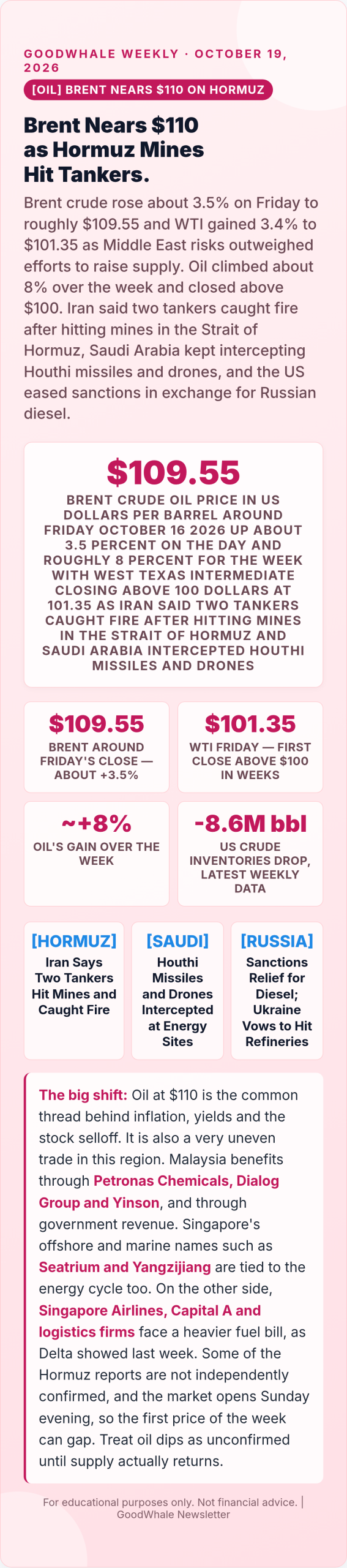
Additionally, oil rallied hard into the weekend. Brent rose about 3.5% on Friday to roughly $109.55 and WTI gained 3.4% to $101.35, a first close above $101 in about a month, as Middle East risks outweighed efforts to raise supply. For the week, oil gained about 8% and finished above $100. Over the weekend, Iran said two tankers caught fire after hitting mines in the Strait of Hormuz, a report that has not been independently confirmed. Saudi Arabia kept intercepting Houthi missiles and drones, Ukraine vowed to hit Russian refineries, and the US eased sanctions in exchange for Russian diesel supply. US crude inventories fell 8.6 million barrels in the latest weekly report.
For Singapore and Malaysia investors, energy sits on both sides of the portfolio. Petronas Chemicals, Dialog Group and Yinson gain from higher prices, and Malaysia’s budget benefits too. Singapore Airlines, Capital A and transport firms carry the fuel cost, while Singapore’s role as a bunkering hub and the offshore marine sector tie the island to the energy cycle. The bigger effect is on inflation: with CPI at 3.7% in the US, higher oil keeps central banks from easing. The first oil price of the week may gap when markets reopen, and China’s third-quarter GDP on Monday, expected near 4.4%, matters because China is the largest crude importer. Keep your sizing sensible; oil can reverse in a single headline.
5. Singapore Holds Steady as Exports Surge and US Banks Report
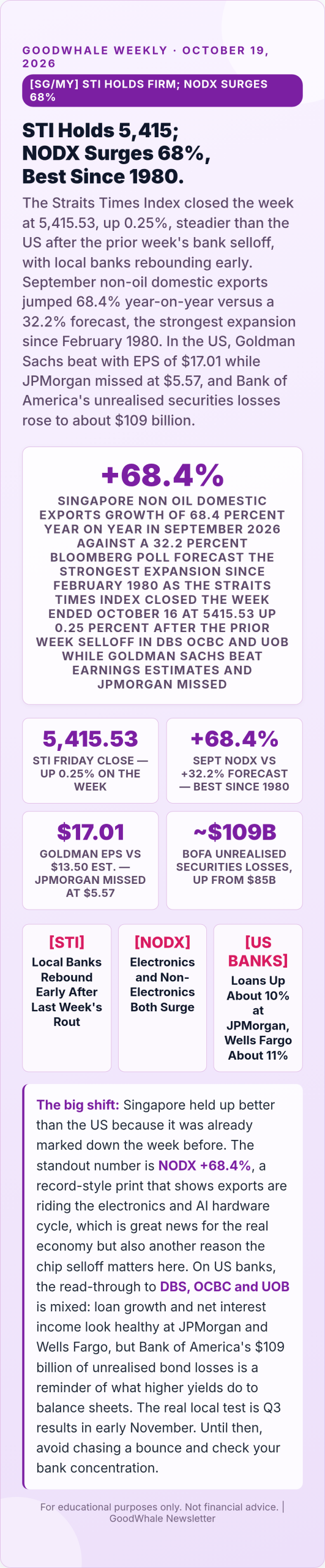
On the other hand, singapore was a calm corner this week. The Straits Times Index closed on Friday at 5,415.53, up 12.03 points on the day and 0.25% for the week, after a rough prior week for DBS, OCBC and UOB. Local banks rebounded early in the week, though Thursday’s global chip rout pulled the index down 0.4%. The bigger news was trade: September non-oil domestic exports rose 68.4% year-on-year, far above the 32.2% forecast and the strongest expansion since February 1980, with both electronics and non-electronics shipments contributing. Breadth on Friday was positive, with 366 advancers against 193 decliners, and Yangzijiang Shipbuilding led gainers, up 3.6% to S$5.21.
In the US, bank earnings were a mixed read. Goldman Sachs posted EPS of $17.01 against $13.50 expected, JPMorgan missed at $5.57 versus $5.90, Wells Fargo and Citigroup beat, and Bank of America’s unrealised securities losses rose to about $109 billion from $85 billion in June as yields climbed. Loans grew roughly 10% at JPMorgan and 11% at Wells Fargo. For Singapore and Malaysia investors, DBS, OCBC and UOB report in early November, and Maybank, CIMB and Public Bank follow. A sensible approach is to avoid chasing the rebound and to check whether banks and REITs together dominate your holdings. Strong exports are supportive, but they also tie the local market to the same chip cycle that just wobbled.
What I’m Watching Next Week
Key themes — October 19 to October 23
- Big tech earnings — Netflix reports Tuesday; Meta, Tesla, IBM, Texas Instruments and Lam Research report Wednesday. After the chip rout, this is the next test of AI spending and demand for Venture, UMS, AEM, Inari and ViTrox.
- Oil and Hormuz — Whether the weekend tanker-mine reports are confirmed and whether Brent holds near $110. Petronas Chemicals, Dialog and Yinson versus Singapore Airlines and Capital A.
- China Q3 GDP (Monday) — Expected near 4.4%; China is the largest crude importer and a key export market for Singapore and Malaysia.
- Global data — UK CPI on Wednesday and flash PMIs on Friday for Germany, the euro area, the UK and the US.
- Fed quiet period — The next FOMC meeting is 27-28 October, with no Fed speakers this week, so the 10-year yield around 5.1% will drive S-REITs and bank sentiment.
Bottom Line
This was a week of fear on the screen and strength in the numbers. The chip stock selloff ran eight straight sessions, the longest since 2008, taking the Nasdaq down 4.5% to 26,140.03 and the S&P 500 down 2% to 7,659.44, while CoreWeave’s funding stress and Bank of America’s warning about AI capital cycles fed the unease. Yet TSMC reported a sixth straight record quarter with net profit up nearly 69% and guided next-quarter sales to as much as $54.3 billion, and ASML booked record sales of EUR 11.7 billion with orders discussed out to 2029 and 2030. Inflation ran hot, with US CPI at 3.7% and PPI up 1.3% on the month, and Brent climbed to about $109.55 on Hormuz and Saudi risks, but the 10-year Treasury yield still ended the week near 5.09% and Fed Chair Warsh refused to signal the October decision. Singapore was steadier, with the STI up 0.25% to 5,415.53 and September non-oil domestic exports up 68.4%, the strongest since February 1980. For Singapore and Malaysia investors, the playbook is practical: do not confuse a falling share price with a falling business, check how much of your portfolio sits in one AI or bank theme, remember that Petronas-linked energy names and airlines sit on opposite sides of an oil spike, and keep some idle cash in T-bills or Savings Bonds while yields stay above 5%. Position size, not prediction, is the edge this week.
For educational purposes only. Not financial advice. Always do your own research. Catch up on last week’s issue: GoodWhale Weekly: STI Bank Selloff Wipes 4.1%, Yields Hit a 24-Year High, AI Chips Wobble.
Source: TSMC investor relations









Leave A Comment