

The Week in 30 Seconds
- [SG/MY] STI bank selloff: index -4.1% to 5,401.89. OCBC fell about 10% over Wednesday and Thursday, UOB about 8% and DBS about 6%. Q3 results land on 5 and 6 November.
- [MACRO] 10-year Treasury yield hits 5.364%, a 24-year high. Fed minutes show 12 of 18 officials favour one more hike. The S&P 500 still closed at 7,811.54, up 1.15%.
- [CHIPS/AI] OpenAI revenue scare hits chips. Reported annualised revenue near $50B versus a ~$70B media figure; the semiconductor index fell 4.30% on the week.
- [OIL] Brent climbs to $104.72. Hormuz tanker attacks and a Gulf hurricane lifted prices; Delta cut its full-year EPS guide to $5.10-$5.60 on fuel costs.
- [STOCKS] SpaceX spooks telecoms. T-Mobile, Verizon and AT&T fell about 9% on a spectrum deal; Constellation Energy rose 15.76% on a Google power deal.
1. STI bank selloff: STI Bank Selloff Drags the Index Down 4.1% in One Week
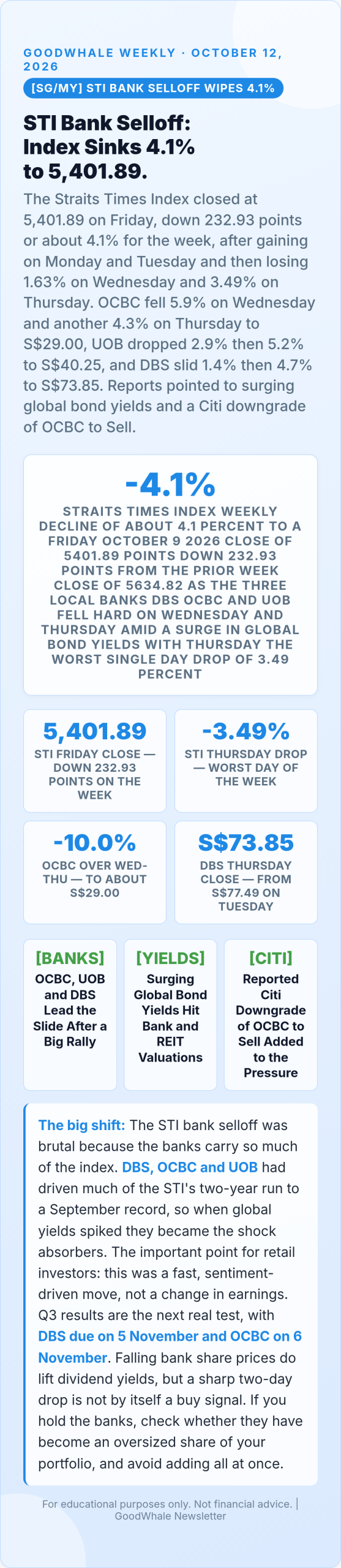
Meanwhile, singapore had a punishing week. After rising on Monday (+0.52% to 5,664.33) and Tuesday (+0.66% to 5,701.54), the Straits Times Index fell 1.63% on Wednesday and a steep 3.49% on Thursday, then eased another 0.20% on Friday to close at 5,401.89. That is a weekly loss of about 4.1%, or 232.93 points, from last week’s close of 5,634.82. The STI bank selloff did most of the damage: OCBC dropped 5.9% on Wednesday and 4.3% on Thursday to S$29.00, UOB fell 2.9% then 5.2% to S$40.25, and DBS slid 1.4% then 4.7% to S$73.85. Commentators pointed to a surge in global bond yields, a broader selloff in bank shares, and a reported Citi downgrade of OCBC to Sell. Only a month earlier, Singapore stocks had been at record highs.
For Singapore and Malaysia investors, the lesson is concentration risk. If your local portfolio is mostly DBS, OCBC and UOB plus a few S-REITs, this week showed how correlated those holdings can be when US yields jump. Malaysian investors holding Maybank, CIMB or Public Bank through Bursa are exposed to the same global bank sentiment even if local fundamentals differ. The next hard evidence will come with the third-quarter results: DBS reports on 5 November and OCBC on 6 November. Until then, price moves will mostly follow US Treasury yields. A staggered approach, adding in small tranches rather than all at once, is more sensible than trying to catch the exact bottom.
2. Treasury Yields Hit a 24-Year High as Fed Minutes Lean Hawkish

Notably, bond markets set the tone for the week. The 10-year Treasury yield closed Monday at 5.311%, its highest close since 2002, and reached 5.364% intraday on Wednesday before easing to 5.244% by Friday. The 30-year finished at 5.600% and the 2-year at 4.80%. Auctions were weak-ish: the 10-year cleared at 5.300% and the 30-year at 5.618%. The Fed minutes from the 15-16 September meeting, where the Fed raised rates 25 basis points to 3.75%-4.00%, showed 12 of 18 participants favouring one more hike by year-end, four favouring two, and two favouring none. Data since the meeting has been mixed: August inflation came in below expectations and September job growth was weaker than expected, but the ISM services prices-paid index was 74.0 and the Michigan survey showed one-year inflation expectations at 4.7%.
Stocks still held up. The S&P 500 set a record close of 7,818.93 on Tuesday and finished Friday at 7,811.54, up 1.15% for the week, helped by utilities, staples and energy. For Singapore and Malaysia investors, the practical point is that a risk-free yield above 5% raises the bar for everything else. S-REITs such as CICT, Mapletree Industrial Trust and Keppel DC REIT and Malaysian REITs are the most exposed, while short-dated Singapore T-bills and Savings Bonds look comparatively attractive for cash. September CPI on Wednesday, followed by PPI and retail sales on Thursday, will decide whether the yield spike extends or fades. The Fed’s next decision comes on 27-28 October.
3. OpenAI Revenue Scare Rattles the AI Chip Trade

However, the AI trade took a knock on Thursday after the Financial Times reported that OpenAI told investors its annualised revenue was approaching $50 billion at the end of September, about $20 billion below a figure near $70 billion that had circulated in the media. The higher number was reportedly based on a different counting method that included cloud-platform sales, so it was not a missed target, but investors reacted as if expectations had been reset. The PHLX semiconductor index fell 3.39% on Thursday and 4.30% for the week. Over the week, Arm lost 13.40%, Intel 12.26%, CoreWeave 8.41%, Lam Research 8.24% and Nvidia 2.00%. In Tokyo, SoftBank, which owns around 13% of OpenAI, fell as much as 7.3% on Friday before paring losses. Tech was one of only two S&P 500 sectors to decline for the week, down 0.52%.
For Singapore and Malaysia investors, this is a reminder that the AI supply chain is a leveraged bet on customers’ spending plans. Venture Corporation, AEM, UMS and Frencken in Singapore and Inari Amertron, ViTrox and MPI in Malaysia sell test, packaging and assembly services that depend on chipmakers and AI data-centre builders feeling confident about funding. With the 10-year Treasury yield above 5%, long-duration tech is already sensitive to any wobble. The sensible response is not to abandon the theme, but to size it carefully and watch real signals: TSMC reports on Thursday, and its capex commentary will say far more than any single revenue report.
4. Brent Climbs on Hormuz Attacks as Delta Cuts Its Profit Outlook

Additionally, oil ended the week higher despite a late pullback. Brent gained 2.42% to $104.72 and WTI rose 0.81% to $91.85. The big move came on Thursday, when Brent jumped 4.07% after tanker attacks in the Strait of Hormuz and a hurricane that shut in about 500,000 barrels a day of Gulf of Mexico output. On Friday, prices slipped roughly 0.4% after President Trump announced a deal for Russia to supply diesel to US and global markets. The knock-on showed up in airlines: Delta Air Lines reported third-quarter adjusted EPS of $1.72 on adjusted revenue of $17.6 billion, up 16%, but cut its full-year adjusted EPS guidance to $5.10-$5.60 from $6.50-$7.50. Adjusted fuel expense was $4.1 billion, up 62%, and Delta expects about $6 billion of additional fuel costs this year.
For Singapore and Malaysia investors, energy sits on both sides of the portfolio. Petronas Chemicals, Dialog Group and Yinson benefit from Brent above $100, and Petronas dividends help Malaysia’s budget. On the other side, Singapore Airlines and Capital A face the same fuel squeeze Delta described, and transport and logistics firms are exposed to diesel costs. Singapore, as a bunkering hub, also sits close to the refined-product story. Watch whether Friday’s Russia diesel announcement actually turns into barrels; until it does, treat any dip in oil as unconfirmed. If crude stays near $100 into year-end, expect sticky inflation and a higher-for-longer rate backdrop.
5. SpaceX Spooks Telecoms While Google Powers Up Constellation
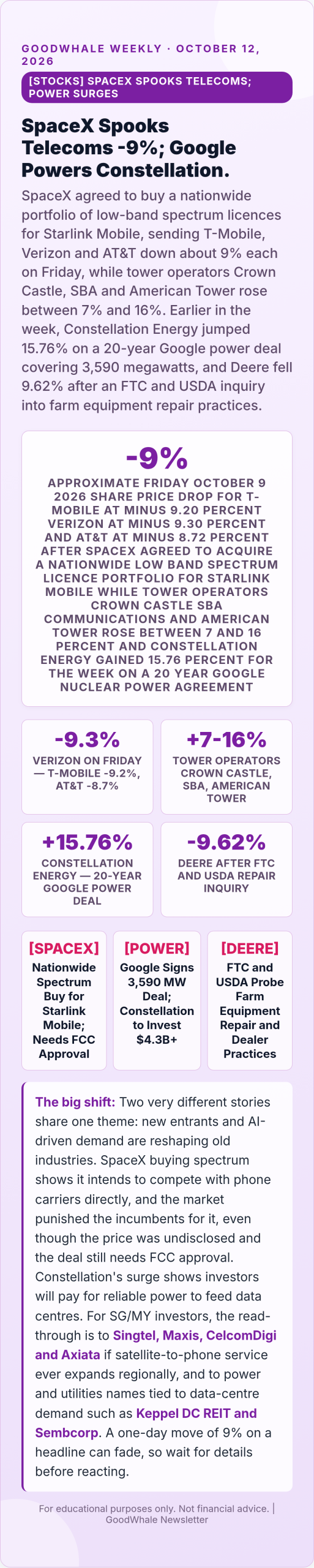
On the other hand, company news was dominated by two deals. On Friday, SpaceX agreed to acquire a nationwide low-band spectrum portfolio for Starlink Mobile, covering up to 14 MHz of paired 800 MHz spectrum and nearly the entire US population; the price was not disclosed and the deal needs final FCC approval. T-Mobile fell 9.20%, Verizon 9.30% and AT&T 8.72%, the three worst performers in the S&P 500, while tower owners Crown Castle, SBA Communications and American Tower rose between 7% and 16%. Earlier in the week, Constellation Energy signed a deal with Google for 3,590 megawatts of power, including a 20-year agreement for 890 MW from upgraded nuclear plants and a 15-year supply agreement for 2,700 MW, with Constellation committing more than $4.3 billion of new investment. Its shares gained 15.76% over the week, and Vistra added 15.33% after a US Department of Energy loan offer of up to $4.2 billion. On the downside, Deere fell 9.62% after the FTC and USDA opened an inquiry into farm equipment repair and dealer practices.
For Singapore and Malaysia investors, none of these are direct SGX or Bursa events, but the themes carry over. If satellite-to-phone service scales, regional telcos such as Singtel, Maxis, CelcomDigi and Axiata will eventually face the same question: who owns the customer? On the power side, data-centre demand is a tailwind for the energy and infrastructure names that supply it, including Keppel DC REIT and Sembcorp. Humana also jumped about 12% after better Medicare Advantage star ratings, a reminder that earnings season brings big single-stock swings. With US bank earnings starting Tuesday, expect more of them. Keep position sizes sensible, and remember that sharp one-day moves often partly reverse.
What I’m Watching Next Week
Key themes — October 12 to October 16
- September CPI (Wednesday) — The inflation print, plus PPI and retail sales on Thursday, will decide whether the 10-year Treasury yield stays above 5.2% or the spike fades. Bond markets are closed Monday for Columbus Day.
- US bank earnings — JPMorgan, Goldman Sachs, Citigroup and Wells Fargo report Tuesday, followed by Bank of America and Morgan Stanley on Wednesday. Their commentary on rates will colour sentiment toward DBS, OCBC and UOB.
- TSMC earnings (Thursday) — The best real-world test of whether AI demand is intact after this week’s OpenAI scare; watch capex guidance for Venture, AEM, UMS, Inari and ViTrox.
- Oil and Hormuz — Whether the Russia diesel announcement materialises and whether tanker attacks continue. Petronas Chemicals, Dialog and Yinson versus Singapore Airlines and Capital A.
- Local banks and REITs — Do DBS, OCBC and UOB stabilise after the selloff? Also CICT and Mapletree Industrial Trust as yield-sensitive names. The next Fed meeting is 27-28 October.
Bottom Line
This was a week where the bond market was the main character. The US 10-year Treasury yield closed Monday at 5.311%, its highest close since 2002, and touched 5.364% on Wednesday before easing to 5.244% by Friday, while Fed minutes showed 12 of 18 officials favouring one more rate hike this year. Wall Street shrugged it off: the S&P 500 set a record 7,818.93 on Tuesday and finished at 7,811.54, up 1.15%. Singapore did not shrug: the STI bank selloff took the index down about 4.1% to 5,401.89, with OCBC falling roughly 10% in two days, UOB about 8% and DBS about 6%. AI chips took a separate hit after the Financial Times reported OpenAI’s annualised revenue was approaching $50 billion rather than the roughly $70 billion some had assumed, and the semiconductor index fell 4.30% for the week. Oil rose, with Brent at $104.72 and WTI at $91.85 after Hormuz tanker attacks and a Gulf of Mexico hurricane, and Delta cut its full-year profit guidance on a $6 billion fuel surge. In company news, SpaceX’s spectrum purchase knocked about 9% off T-Mobile, Verizon and AT&T, while Constellation Energy surged 15.76% on a Google power deal. For Singapore and Malaysia investors, the playbook is selective: do not treat a two-day bank rout as either a crash or a bargain until the 5 and 6 November results; check concentration across banks and REITs; size AI-chain exposure (Venture, AEM, UMS, Frencken, Inari, ViTrox) carefully; and watch Wednesday’s CPI for the next move in yields. One bad week for the banks is a price event, not yet an earnings event.
For educational purposes only. Not financial advice. Always do your own research. Catch up on last week’s issue: GoodWhale Weekly: September Jobs Report Misses, Nvidia’s Record Buyback, STI Slips 1.3%.







Leave A Comment