
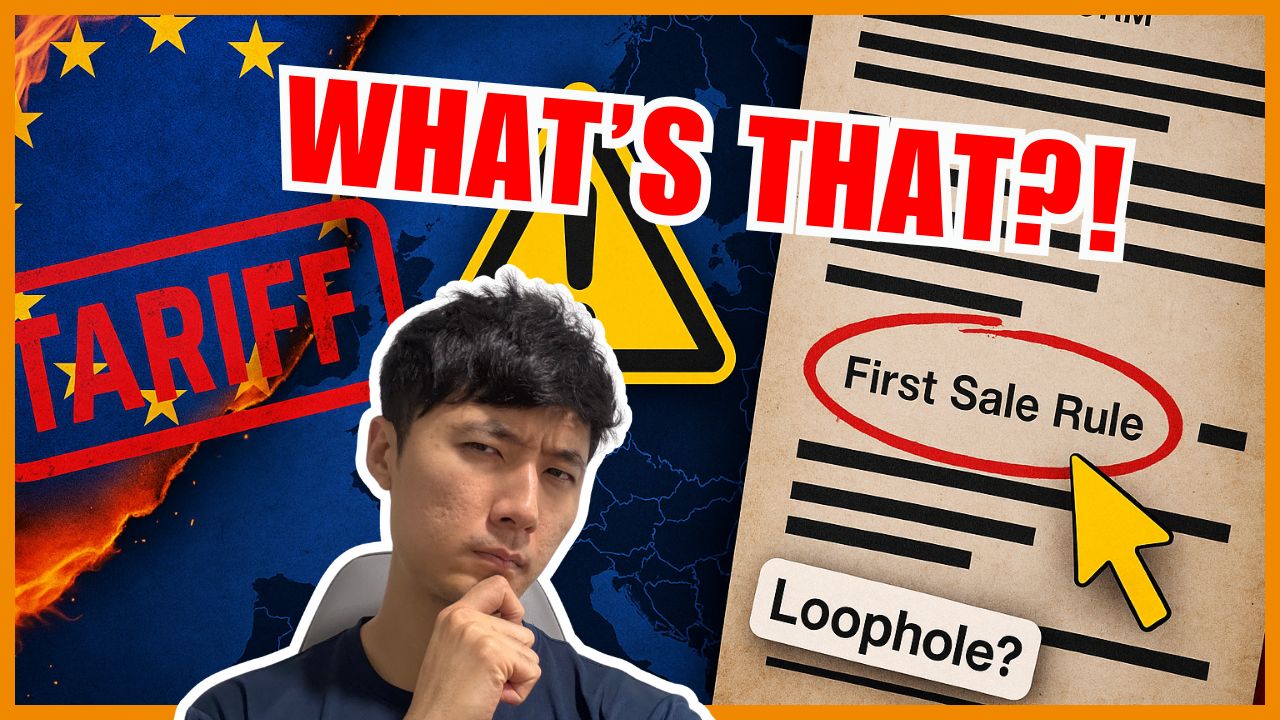
Tariffs are back in the headlines. With the U.S. and EU revisiting trade terms, and Trump’s camp signaling a tougher stance on imports, importers are bracing for impact. But here’s what most people don’t know: Not everyone pays the full price. Some U.S. companies are legally using a backdoor to reduce their tariff bill. A little-known strategy called the “first sale rule” as a tariff loophole!
And in today’s climate, it’s quietly gaining traction again.
Here’s what’s going on.
Why Tariffs Matter?
Tariffs are taxes on imported goods. When a U.S. company brings in products from overseas, say, from China or Europe, it usually pays a tariff based on the item’s declared value.
But tariffs don’t just affect businesses. They ripple across the whole economy.
Higher costs for importers often mean higher prices for consumers. They also impact investor confidence, raise inflation risk, and in some cases, shift production decisions entirely.
Recently, talks between the U.S. and EU hinted that a 10% minimum tariff rate could become the new baseline. That’s huge. Especially for businesses used to paying little or nothing under past trade agreements.
So what can companies do?
The “First Sale” Loophole. How It Works?
The First Sale Rule is a legal workaround in US customs law that allows importers to calculate tariff duties based on the price paid at the first point of sale (e.g., from a manufacturer to a middleman), rather than the final sale price to the US importer.
Here’s how it works:
- Normally, importers pay tariffs based on the transaction value when they buy goods from suppliers.
- But if a middleman (a third party) buys the goods first, then sells to the importer, the duty can be assessed on that first, lower transaction value.
For example:
- Factory in China sells to Hong Kong middleman: $5
- Middleman sells to US importer: $10
- Without First Sale: Tariff calculated on $10
- With First Sale: Tariff calculated on $5 (50% savings!)
Jia Xuan broke this down with examples and diagrams, making it crystal clear how businesses use this structure to legally reduce duty costs.
Who Benefits from This Loophole?
The First Sale Rule presents a substantial financial advantage for several key players in the global trade ecosystem. US importers are perhaps the biggest winners.
By paying tariffs on a lower, first-point-of-sale price, they drastically reduce their duty obligations. This directly improves their profit margins, giving them a pricing edge in competitive markets.
Intermediaries or middlemen, though often overlooked, gain newfound strategic importance in this equation. Even without providing operational value, their mere role in the transaction unlocks significant duty reductions for importers. This reinvigorates the traditional middle layer in supply chains, especially in cross-border trade.
Big retailers and e-commerce giants also stand to benefit immensely. These businesses typically deal in high volumes of imported goods, from apparel and electronics to general merchandise. By incorporating the First Sale Rule into their sourcing strategies, they can secure meaningful cost advantages across thousands of SKUs, amplifying profitability at scale.
Why This Matters Now
With Trump’s potential return and his renewed focus on tariffs, especially on Chinese goods, businesses are preparing for more pressure on import costs. The First Sale Rule could become even more widely used as trade friction intensifies.
Jia Xuan highlighted:
- This is not a gray area. The First Sale Rule is a legal, documented pathway, recognized by US Customs.
- However, strict documentation is required. The middleman must be genuinely independent (not just a shell company) and the transaction must be well-documented to prove the first sale’s legitimacy.
- Companies found abusing the structure (e.g., faking middlemen) have faced audits and fines.
Risks and Compliance Considerations
Not everyone can easily qualify for this duty-saving method.
Importers need:
- Clean and consistent paper trails.
- Proof that the middleman transaction was legitimate.
- Confidence that the product’s true value isn’t being misrepresented to dodge tax.
Bigger Picture: What Investors Should Note
The First Sale Rule exemplifies how agile businesses find ways to adapt in policy-heavy environments. It also reflects a recurring GoodWhale theme: Power to Control
“We can’t control the policy, but we can control how prepared we are.”
Whether you’re an investor in retail, logistics, or e-commerce, understanding how these cost optimizations affect margins is a strategic edge. The companies that adapt, legally and quickly, will protect profits while others bleed.
That’s why as investors, we need to learn of good practices and use it.
Check out 6 Timeless Lessons From Warren Buffett on Life and Money
GoodWhale’s Take
This article highlights one of the most surprising segments from this week’s Wealth Pulse: the First Sale Rule tariff loophole.
But it’s just one piece of the broader market discussion.
Watch the part 1 of 0ur Wealth Pulse session here:
In the second half of our session, Jia Xuan dives deep into clean energy stock turmoil, upcoming policy shifts, and how political decisions may impact your portfolio. We even touched on practical tools like GoodWhale Buddy to help investors upgrade their financial habits in real time.
Want to see how we unpack these complex topics in an investor-first, no-jargon format?
Watch the full replay now to catch everything we covered, including what’s ahead for the market.
To watch it for FREE, Claim Your 1-Month Wealth Pulse Access Now →













Leave a Reply