

GoodWhale and the United Nations Sustainable Development Goals
Growing up in Taiwan, I experienced firsthand the harsh realities of financial instability. My family was burdened with debt, and as a child, I watched my mother struggle to make ends meet, working tirelessly to support us while debt collectors knocked on our door. The lessons I learned during that time shaped me into the person I am today and fueled my passion for financial literacy. I believe, deeply and unequivocally, that financial literacy is a human right—one that should be accessible to all, no matter where they come from or their financial background.
As the Co-founder and CEO of GoodWhale, I have had the privilege of aligning our company’s mission with global efforts to create a more equitable world. At the heart of this is our commitment to the United Nations Sustainable Development Goals (SDGs), particularly SDG 1: No Poverty and SDG 4: Quality Education.

United Nations Sustainable Development Goals
The United Nations’ 2030 Agenda for Sustainable Development set out 17 ambitious goals that all UN members adopted in 2015. The SDGs are a universal call to action to end poverty, protect the planet, and ensure that all people enjoy peace and prosperity by 2030. The agenda is vast and bold, tackling everything from climate change to inequality. However, for me, as an individual and as the CEO of GoodWhale, these goals resonate deeply with the values that have guided me throughout my life.
When I was in my third year of college, I had a decision to make—pursue a career as a civil servant or take the risk of studying abroad, all while knowing that my family was still struggling financially. With my father losing his vision and unable to work, the easy route would have been to secure a stable job in Taiwan and provide for my family. But something inside me pushed me toward the more uncertain path. I knew that education—the same education my mother had fought for me to have—was the key to unlocking not just my future but the future of many others.
This belief led to the founding of GoodWhale. At GoodWhale, we harness the power of education and technology to create content and tools that empower individuals worldwide. Our mission is not just to teach financial literacy but to ensure that people have the knowledge and resources to make sustainable decisions about their wealth and their future.
In collaboration with the United Nations, institutions like United Nations Institute for Training and Research (UNITAR), and other global organizations, we’ve been fortunate to contribute toward initiatives like the SDG Open Hack, which promotes innovation, leadership, and entrepreneurship. Through hackathons, training, and community-building events, we help to cultivate the skills that individuals need to succeed, especially in underprivileged communities.
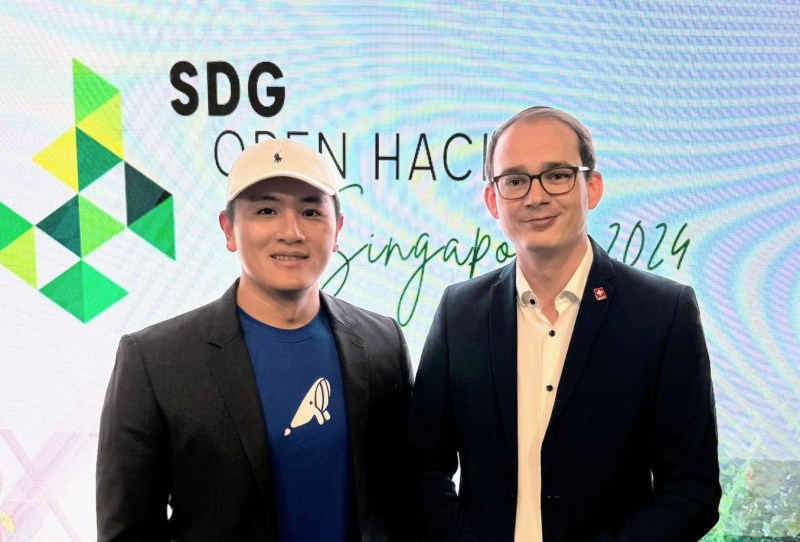
Will Huang, Co-founder & CEO , GoodWhale; Joël Henri Brunner, Representative, Embassy of Switzerland
Financial Literacy: A Human Right
Why do I believe that financial literacy is a human right? Because without the knowledge to manage finances, individuals and families remain trapped in cycles of poverty. In Taiwan, I saw this play out within my own family and community. My parents, like so many others, were not equipped with the tools to escape financial struggles. As I worked my way through college and eventually pursued my studies abroad, I realised that many of the financial systems in place are difficult to navigate without a basic understanding of economics and money management.
This is why we at GoodWhale are so passionate about SDG 1 and SDG 4. No poverty cannot be achieved without educating people about finances. Quality education is more than just reading, writing, and arithmetic. It’s about equipping individuals with the knowledge that will allow them to build sustainable, secure futures. Financial literacy, like literacy itself, should be a basic human right because it empowers individuals to make informed decisions that lead to stability, growth, and the ability to weather life’s challenges.
GoodWhale’s Commitment to the SDGs
GoodWhale’s commitment to the UN’s Sustainable Development Goals is not just a corporate responsibility. It is personal to me. I know what it’s like to be poor. I know what it’s like to not understand how the financial system works and to feel powerless because of it. But I also know that through education, through persistence, and with the right tools, individuals can change their futures.
That’s why GoodWhale has dedicated itself to SDG 1 and SDG 4. We believe that by equipping people with the knowledge and skills to manage their finances, we are actively contributing to the eradication of poverty. But it’s not just about knowledge; it’s about empowerment. Financial literacy gives people the power to take control of their own lives, to make informed decisions, and to break free from the cycles of debt and poverty.
GoodWhale supporting initiatives with UNITAR, universities like the University of Geneva, and organisations like Open Geneva have been instrumental in allowing us to take our mission to the next level. Through events like the SDG Open Hack, we are helping to foster an environment where individuals can innovate, collaborate, and create solutions to global challenges. We are proud to be part of these initiatives, and we are committed to continuing our work in support of the SDGs.

United Nations SDG Openhack 2024
Taiwan, though not officially recognised by the UN, has consistently contributed to global development in various fields, from technology to humanitarian aid. GoodWhale is proud to represent our Taiwanese community on the international stage, demonstrating that we are dedicated to global efforts even if my country is not officially a part of these organisations.
Our work with these global partners show that Taiwanese people are not just capable of contributing to the SDGs but are already doing so, and we at GoodWhale will continue to do our part to ensure that financial literacy is a right available to everyone, everywhere.




Leave a Reply