
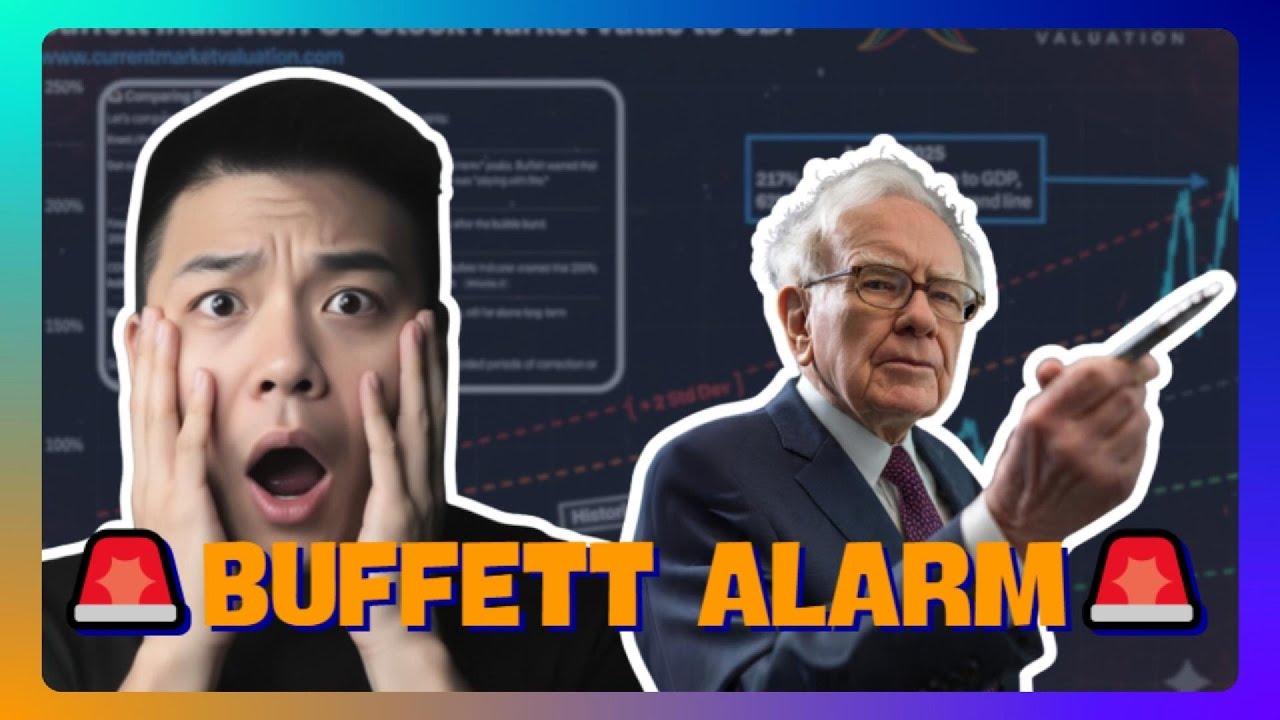
🔔 The Market’s Red Alarm Is Ringing
There’s a familiar alarm going off in the investing world — and it’s getting louder. According to several valuation models — price-to-sales, price-to-earnings, mean reversion, and interest rate models — the market is looking strongly overvalued.
But one particular signal stands out: the Buffett Indicator.
Right now, it’s showing over 200% — a level that even Warren Buffett himself would call “playing with fire.”
🎥 Watch the full video explanation here:
👉 https://www.youtube.com/watch?v=_Gu8BH471WI
💡 What Exactly Is the Buffett Indicator?
The Buffett Indicator compares the total market capitalisation of all publicly traded stocks to a country’s gross domestic product (GDP) — the total value of all goods and services produced by its economy.
In simple terms:
-
If the market cap = GDP, the market is fairly valued.
-
If the market cap is much higher than GDP, it means stock prices are rising faster than the real economy — a warning sign that valuations may be inflated.
For instance, if the total GDP is $100 trillion, but the total stock market value is $200 trillion, the Buffett Indicator would read 200%. That’s where we are today.
📈 A Quick History Lesson
When Buffett first introduced this measure in the early 2000s, the ratio hovered around 100%.
-
When it dropped to 70–80%, it often marked attractive buying opportunities.
-
When it rose beyond 120%, the market usually corrected.
Today, the indicator has shot up to 217%, about two standard deviations above its long-term average.
That’s the same “danger zone” seen before major market pullbacks in 2000 and 2022.
🧐 What the Indicator Gets Right (and Wrong)
The Buffett Indicator gives investors a big-picture sense of whether markets are running too hot. It’s simple, visual, and widely tracked on financial sites like GuruFocus and Capital Market Relations.
However, it’s not perfect. There are two key limitations:
-
It ignores interest rates.
When rates are low, investors shift money from bonds to equities, naturally pushing valuations higher. -
It only measures domestic GDP.
Many large US companies (think Apple, Microsoft, Coca-Cola) earn substantial profits overseas — revenue not captured in US GDP data.
So while the Buffett Indicator shows markets are overheated, it doesn’t mean a crash is guaranteed. It’s more of a caution sign than a countdown clock.
🧭 How Buffett Himself Uses It
Interestingly, Buffett never meant for the ratio to be a timing tool.
He used it to gauge whether the market environment looked attractive for long-term investing — not to decide when to sell.
If the ratio is high, it doesn’t mean “sell everything.”
It means be cautious, size your positions carefully, and keep cash ready for better opportunities ahead.
💬 Final Thoughts
At over 200%, the Buffett Indicator is flashing bright red.
Does that mean panic? Not necessarily. But it’s a reminder that valuations are stretched — and discipline matters now more than ever.
Remember: great investors don’t just chase hot markets. They prepare for the moment when value returns.
🎥 Watch the full breakdown on YouTube:
Stay updated with like-minded investors!
This is a segment of our wealth pulse session. Every Tuesday, SGT 8 pm, 2 parts. One part is for the public and you can find it in our YouTube Live. The second part is a closed-door session for our community members where we share more in-depth and personal portfolio.
Interested to find out more?
Here’s a 1-month free pass for you to experience or watch all our recordings!
Investing is a part of our money journey, so if you have no idea where to start, why not join to listen about what’s happening in the world!












Leave a Reply