
The Analyst’s New Sidekick: Leveraging AI for Deeper Company Analysis and Long-term Wealth
The Digital Shift: A Value Investor’s Perspective on AI in Finance
In today’s rapidly evolving digital landscape, it’s impossible to ignore the powerful tide of Artificial Intelligence. For those of us dedicated to the timeless craft of Value Investing, the emergence of tools like ChatGPT and specialized platforms such as Manus.ai presents both a fascinating opportunity and a moment for thoughtful reflection.
The question isn’t if we should use AI, but how we should use it. Does this technology threaten to make the diligent stock analyst obsolete, or does it offer a super-charger to our existing research engine, allowing us to build Long-term Wealth with greater clarity and efficiency?
For me, the answer is clear: AI is the ultimate sidekick, not the replacement. It accelerates the legwork, but the wisdom, the judgment, and the deep understanding of human psychology—that remains uniquely ours. As investors, our Investing Principles must remain firmly rooted, even as our tools become futuristic.
“AI cannot replace human fully because like uh human haven’t trusted all this AI to fully yet.”
This is the bedrock of my approach. Trust is earned, and in investing, trust comes from verification, deep analysis, and a commitment to understanding the story behind the numbers—a story that only a human mind, guided by experience, can truly appreciate.
The Foundation of Good Analysis
In our pursuit of successful investing, we can take a page from the timeless wisdom of Confucian thought. The core tenets of perseverance, self-reflection, and sticking to principle are as relevant in the boardroom as they were in ancient China.
Just as a scholar dedicates years to mastering the classics, a value investor must dedicate time to mastering company analysis. AI can provide the raw facts in seconds, but only discipline can turn those facts into conviction. We must exercise the Confucian virtue of 智Zhì (Wisdom) to discern the signal from the noise that AI sometimes generates.
My research routine, honed over years, still involves consuming a wealth of original sources: YouTube videos, articles, and going straight to the company’s website. These habits are crucial for building an intuitive feel for the business.
The Power of the Prompt: Treating AI as Your Research Apprentice
The secret to leveraging AI effectively lies in treating it not as an oracle, but as a brilliant, incredibly fast research apprentice. It needs structure, context, and clear instructions.
When engaging with tools like ChatGPT or Manus.ai, I follow a disciplined, five-step approach to ensure I get relevant, structured, and verifiable insights:
- Assign a Role: Define the AI’s identity (e.g., “Senior Value Investor,” “Marketing Analyst”). This immediately biases the output toward a useful perspective.
- Provide Context: Set the stage (e.g., “Analyze this company for its competitive moat and Long-term Wealth potential”).
- Define the Task: Be specific about the desired output (e.g., “Generate a summary of the founder’s vision and major milestones”).
- Specify the Format: Demand structure (e.g., “Use bullet points and strong headings”).
- Set the Style: Dictate the tone (e.g., “Analyze like Warren Buffett”).
Crucially, every single request must conclude with an instruction to provide source or citation. This step is non-negotiable for a value investor.
“Always ask him to give you source or citation where do they get this source annual report or quarterly report you can just put in there…”
We are not looking for magic; we are looking for verifiable facts sourced from official documents like the quarterly earning update and annual reports.
Case Study: The Trade Desk and the Agentic AI Advantage
While a simple AI like ChatGPT can provide basic facts—founder names, listing dates—a new generation of tools, often called “Agentic AI” like Manus.ai, is demonstrating an even greater potential.
These agentic tools don’t just generate text; they formulate a multi-step research plan. They tell you their thinking process: “I will use a browser to search Yahoo Finance, then I will scroll down to read the latest quarterly earning update, and finally, I will synthesize a report.” This transparency mirrors the disciplined steps a human analyst follows.
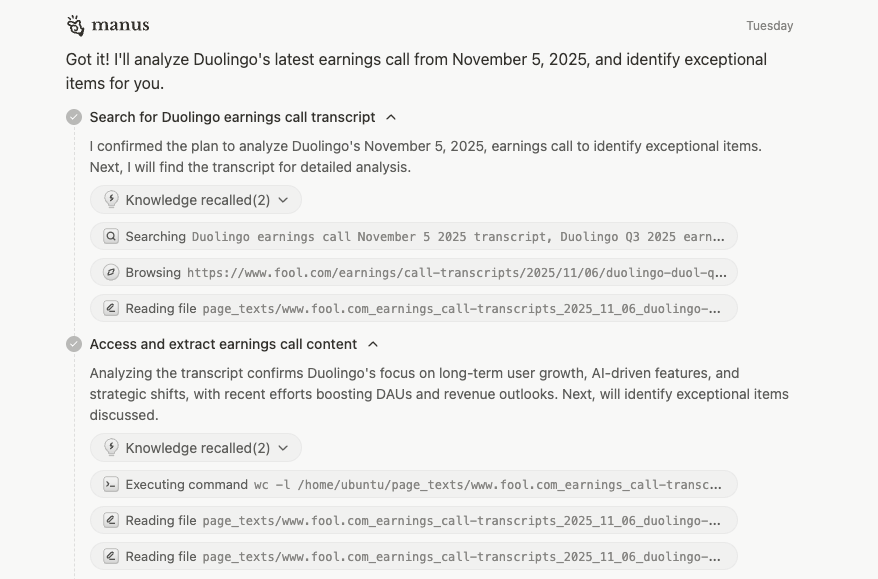
For instance, when looking at a complex programmatic advertising company like The Trade Desk, the AI can deliver a report detailing the “genesis of the Trade Desk,” the “founder vision,” and their “milestone journey.” It goes beyond surface-level facts to provide a structured narrative, which is the perfect starting point for deeper company analysis.
Why Human Appreciation Still Matters
This brings us to a crucial philosophical point. AI provides the ingredients and the recipe, but it cannot appreciate the final dish.
Think of it this way: In Southeast Asia, the food prepared by a humble hawker can be a masterpiece—a lifetime of experience distilled into a plate of Char Kway Teow or Nasi Lemak.
A machine can perfectly replicate the ingredients, measure the oil, and time the cooking process. But if you have never cooked before, if you don’t know the difference between fresh prawns and frozen ones, or the delicate balance of wok hei (the breath of the wok), how can you truly appreciate the master hawker’s skill?
“If you don’t know how to cook, it’s hard to appreciate how good the food is. … If you know how to cook, you’ll know, ‘Hey, ingredient if it’s fresh, you already win half the battle.'”
The same principle applies to Value Investing:

- The Industry ‘Wok Hei’: If you are not in or close to the industry, if you don’t understand the competitive intensity or the regulatory hurdles (the ‘fresh ingredients’), it is difficult to appreciate a company’s superior performance. AI might show a great margin, but you won’t know how tough it was to achieve that margin.
- The B2B Complexity: Consider B2B Business Models. These are often far more nuanced than B2C. A successful B2B company might have a revenue stream that seems stable at $3 billion for years, and then suddenly jumps to $6.5 billion (like the example of a successful company’s growth trend shown in the session). AI can plot the jump, but only a human analyst who understands the long sales cycles, the deep client integration, and the high switching costs can truly grasp the significance of that inflection point for Long-term Wealth creation. It’s the difference between seeing a line go up and understanding the 10 years of perseverance that led to the vertical leap.
Moats, Mentality, and The Long Game
Let’s look at the classic example of Ferrari, a company whose brand value is its ultimate moat. AI can quickly tell you about its product line and revenue streams. However, the qualitative insights are what truly matter to the Value Investing approach.
As shared in the session, highlighted an astonishing truth: buying a Ferrari requires an interview process.
“In other word, the buyer that so-called the Ferrari customer right need to go through interview one. It’s not everyone can buy Ferrari one. You need to go through this series of interview…”
This isn’t about sales; it’s about brand protection and cultural curation. The company is actively managing its scarcity and prestige. AI can report this fact, but the human investor must ask: What is the long-term monetary value of a brand that interviews its own customers?
This is a qualitative insight that goes straight to the heart of the company’s moat, its pricing power, and its ability to generate sustainable returns for Long-term Wealth. This judgment call cannot be automated.
Invest Better, Grow Better, The Human Way
The landscape of company analysis has changed forever. AI in Finance tools are here to stay, and they are immensely helpful for processing the flood of information that comes with every quarterly earning update and news cycle.
They are fantastic for:
- Quickly summarizing a founder’s vision.
- Tracing funding milestones.
- Checking basic valuation metrics (like those provided by Fiscal AI).
But the core of Value Investing—understanding the human story, assessing the depth of the moat, appreciating the management’s discipline (the Confucian spirit), and making a long-term judgment call on growth potential—is still a thoroughly human endeavor.
We must leverage the machine’s speed to free up our time to focus on what matters most: wisdom, judgment, and patience.
Let’s invest better, grow better, and in that day, let’s enjoy our fruit of labor and enjoy life.











Leave a Reply